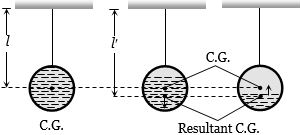
A hollow sphere is filled with water through a small hole in it. It is then hung by a long thread and made to oscillate. As the water slowly flows out of the hole at the bottom, the period of oscillation will
AIEEE 2005,AIIMS 2013,KVPY 2010, Medium


Download our appand get started for free
Experience the future of education. Simply download our apps or reach out to us for more information. Let's shape the future of learning together!No signup needed.*
Similar Questions
- 1Four harmonic waves of equal frequencies and equal intensities $I_0$ have phase angles $0, \pi / 3,2 \pi / 3$ and $\pi$. When they are superposed, the intensity of the resulting wave is $nI _0$. The value of $n$ isView Solution
- 2The total mechanical energy of a particle in $SHM$ isView Solution
- 3The equation of motion of a particle is $x = a\,cos (\alpha\, t)$ . The motion isView Solution
- 4View SolutionIdentify the function which represents a nonperiodic motion.
- 5View SolutionTime period of pendulum, on a satellite orbiting the earth, is
- 6Let $T_1$ and $T_2$ be the time periods of two springs $A$ and $B$ when a mass $m$ is suspended from them separately. Now both the springs are connected in parallel and same mass $m$ is suspended with them. Now let $T$ be the time period in this position. ThenView Solution
- 7A person of mass $M$ is, sitting on a swing of length $L$ and swinging with an angular amplitude $\theta_0$. If the person stands up when the swing passes through its lowest point, the work done by him, assuming that his centre of mass moves by a distance $l\, ( l < < L)$, is close toView Solution
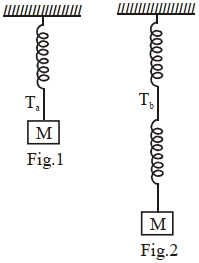
- 8Consider two identical springs each of spring constant $k$ and negligible mass compared to the mass $M$ as shown. Fig. $1$ shows one of them and Fig. $2$ shows their series combination. The ratios of time period of oscillation of the two $SHM$ is $\frac{ T _{ b }}{ T _{ a }}=\sqrt{ x },$ where value of $x$ isView Solution
(Round off to the Nearest Integer)
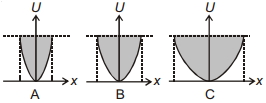
- 9The variations of potential energy $(U)$ with position $x$ for three simple harmonic oscillators $A, B$ and $C$ are shown in figure. The oscillators have same mass. The time period of oscillation is greatest forView Solution
- 10View SolutionWhich of the following statements is not true ? In the case of a simple pendulum for small amplitudes the period of oscillation is