A hollow sphere of inner radius $R$ and outer radius $2R$ is made of a material of thermal conductivity $K$. It is surrounded by another hollow sphere of inner radius $2R$ and outer radius $3R$ made of same material of thermal conductivity $K$. The inside of smaller sphere is maintained at $0^o C$ and the outside of bigger sphere at $100^o C$. The system is in steady state. The temperature of the interface will be ........ $^oC$
Advanced
Download our app for free and get started

Download our appand get started for free
Experience the future of education. Simply download our apps or reach out to us for more information. Let's shape the future of learning together!No signup needed.*
Similar Questions
- 1The temperature gradient in a rod of $0.5 m$ long is ${80^o}C/m$. If the temperature of hotter end of the rod is ${30^o}C$, then the temperature of the cooler end is ...... $^oC$View Solution
- 2View SolutionWoollen clothes are used in winter season because woolen clothes
- 3View SolutionThere is a black spot on a body. If the body is heated and carried in dark room then it glows more. This can be explained on the basis of
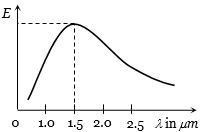
- 4In the figure, the distribution of energy density of the radiation emitted by a black body at a given temperature is shown. The possible temperature of the black body is ....... $K$View Solution
- 5A black body radiates heat energy at the rate of $2\times10^5\, J/sm^2$ at temp. of $127\,^oC$. The temp of black body at which rate becomes $32\times10^5\, J/s-m^2%$ is ....... $^oC$View Solution
- 6Column $I$ gives some devices and Column $II$ gives some process on which the functioning of these devices depend. Match the devices in Column $I$ with the processes in Column $II$ and indicate your answer by darkening appropriate bubbles in the $4 \times 4$ matrix given in the $ORS$.View Solution
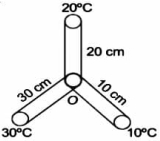
Column $I$ Column $II$ $(A)$ Bimetallic strip $(p)$ Radiation from a hot body $(B)$ Steam engine $(q)$ Energy conversion $(C)$ Incandescent lamp $(r)$ Melting $(D)$ Electric fuse $(s)$ Thermal expansion of solids - 7Three rods of same material, same area of crosssection but different lengths $10 \,cm , 20 \,cm$ and $30 \,cm$ are connected at a point as shown. What is temperature of junction $O$ is ......... $^{\circ} C$View Solution
- 8A black body at $1227^o C$ emits radiations with maximum intensity at a wavelength of $5000\;\mathring A$ . If the temperature of the body is increased by $1000^o C$, the maximum intensity will be observed at ...... $\mathring A$View Solution
- 9A body takes $T$ minutes to cool from ${62^o}C$ to ${61^o}C$ when the surrounding temperature is ${30^o}C$. The time taken by the body to cool from ${70^o}$ to $({A_1}\,{\rm{and }}{A_{\rm{2}}})$ isView Solution
- 10Two walls of thicknesses $d_1$ and $d_2$ and thermal conductivities $k_1$ and $k_2$ are in contact. In the steady state, if the temperatures at the outer surfaces are ${T_1}$ and ${T_2}$, the temperature at the common wall isView Solution