Question
A horizontal cesium plate ($\phi$ = l.9 eV) is moved vertically downward at a constant speed u in a room full of radiation of wavelength 250 run and above. What should be the minimum value of u so that the vertically upward component of velocity is nonpositive for each photoelectron?
Answer

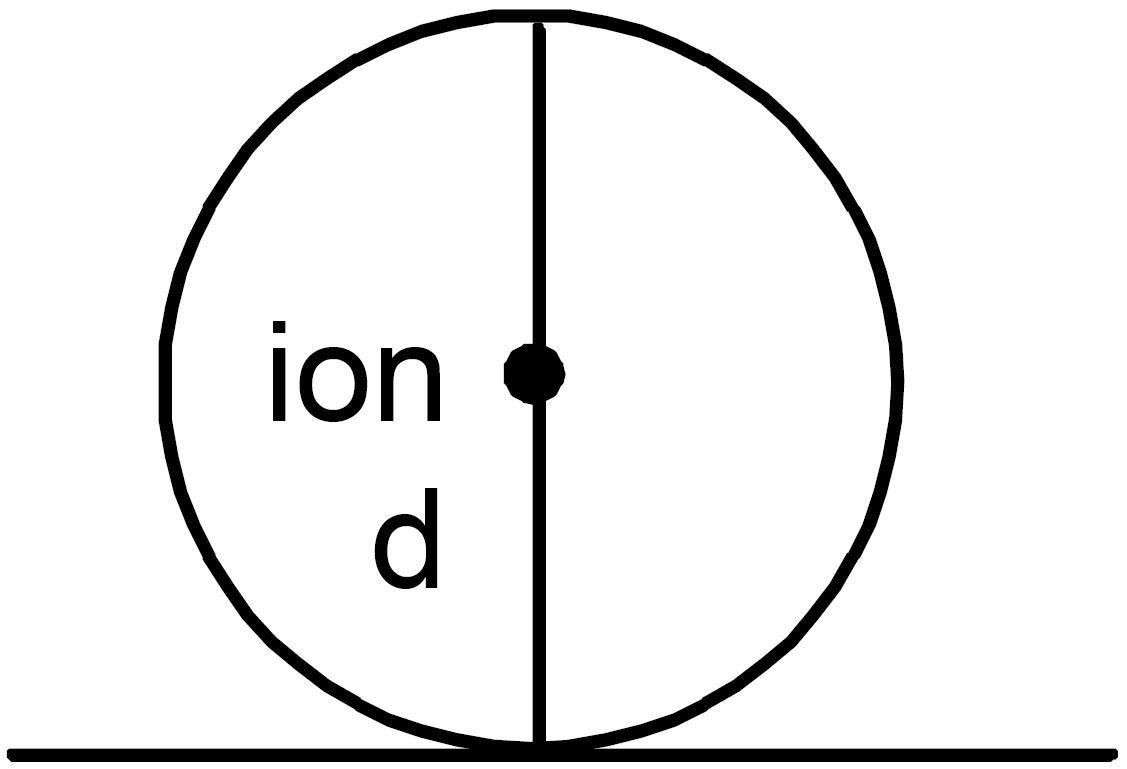
Work function $=\phi,$ distance = dThe particle will move in a circle
When the stopping potential is equal to the potential due to the singly charged ion at that point.
$\text{eV}_0=\frac{\text{hc}}{\lambda}-\phi$
$\Rightarrow\text{v}_0=\Big(\frac{\text{hv}}{\lambda}-\phi\Big)\frac{1}{\text{e}}$
$\Rightarrow\frac{\text{ke}}{2\text{d}}=\Big(\frac{\text{hc}}{\lambda}-\phi\Big)\frac{1}{\text{e}}$
$\Rightarrow\frac{\text{ke}}{\text{2d}}=\frac{\text{hc}}{\lambda}-\phi$
$\Rightarrow\frac{\text{hc}}{\lambda}=\frac{\text{ke}^2}{2\text{d}}+\phi=\frac{\text{ke}^2+2\text{d}\phi}{2\text{d}}$
$\Rightarrow\lambda=\frac{\text{hc 2d}}{\text{ke}^2+2\text{d}\phi}=\frac{2\text{hcd}}{\frac{1}{4\pi\omega_0\text{e}^2}2\text{d}\phi}=\frac{8\pi\omega_0\text{hcd}}{\text{e}^2+8\pi\omega_0\text{d}\phi}$

Need a full question paper?

Generate a complete, print-ready paper with questions like this in minutes — across 16+ boards, with answer keys.

Start Generating Free

Similar questions

A uniform disc of radius R is put over another uniform disc of radius 2R of the same thickness and density. The peripheries of the two discs touch each other. Locate the centre of mass of the system.
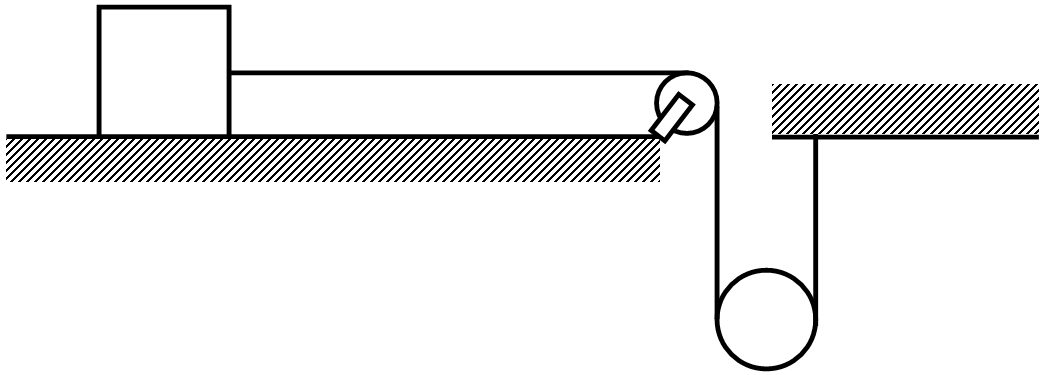
The descending pulley shown in figure has a radius 20cm and moment of inertia $0.20kg-m^2.$ The fixed pulley is light and the horizontal plane frictionless. Find the acceleration of the block if its mass is 1.0kg.
$i.$ Draw a ray diagram showing the image formation by a compound microscope. Hence obtain the expression for total magnification when the image is formed at least distance of distinct vision.
$iii.$ A compound microscope consists of an objective lens of focal length $2.0 \ cm$ and an eyepiece of focal length $6.0 \ cm$. If they are separated by a distance of $24 \ cm$, find the total magnification when the image is formed at infinity.
A heavy particle is suspended by a 1.5m long string. It is given a horizontal velocity of $\sqrt{57}\text{m/s}.$
  1. Find the angle made by the string with the upward vertical, when it becomes slack.
  2. Find the speed of the particle at this instant.
  3. Find the maximum height reached by the particle over the point of suspension. Take $g = 10m/s^2.$
Two point charges of magnitude +q and -q are placed at $\Big(-\frac{\text{d}}{2},0,0\Big)$ and $\Big(\frac{\text{d}}{2},0,0\Big)$, respectively. Find the equation of the equipoential surface where the potential is zero.
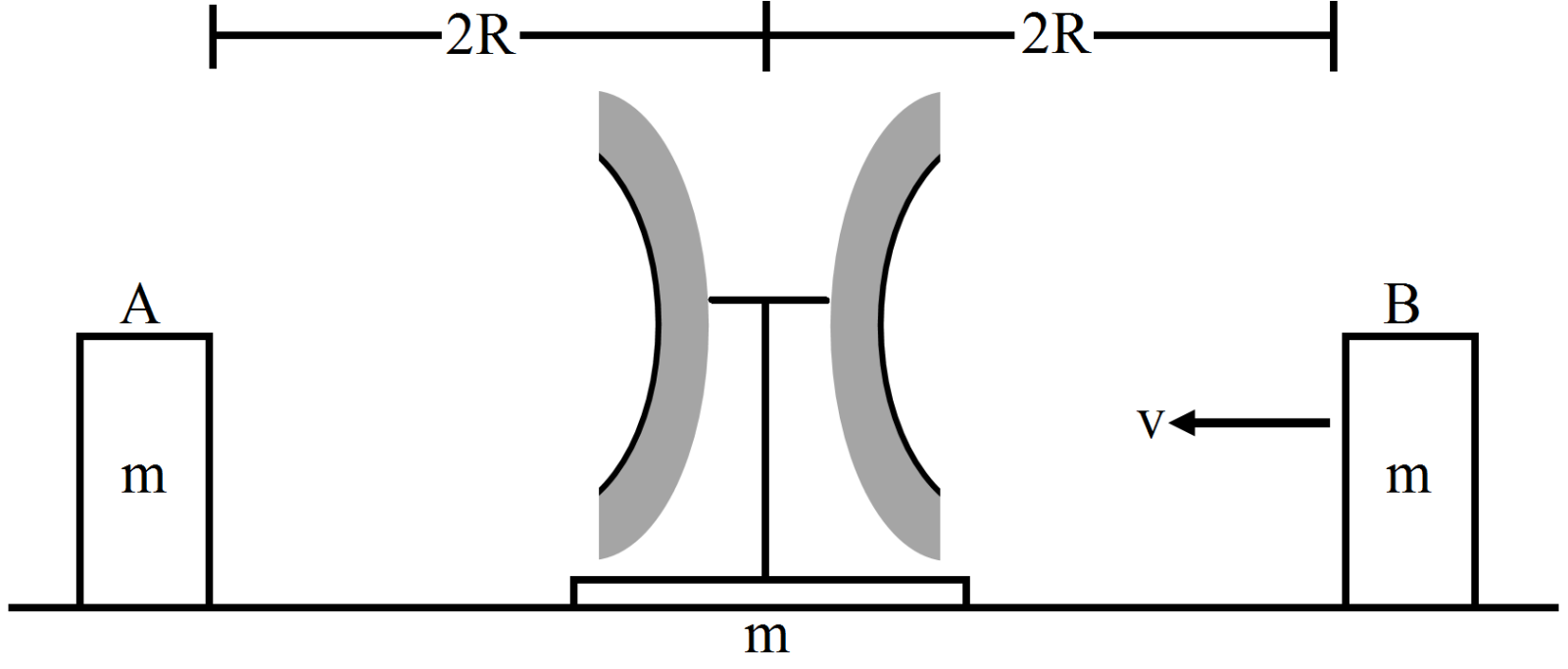
Two concave mirrors of equal radii of curvature R are fixed on a stand facing opposite directions. The whole system has a mass m and is kept on a frictionless horizontal table.

Two blocks A and B, each of mass m, are placed on the two sides of the stand. At t = 0, the separation between A and the mirrors is 2 R and also the separation between B and the mirrors is 2 R. The block B moves towards the mirror at a speed v. All collisions which take place are elastic. Taking the original position of the mirrors-stand system to be x = 0 and X-axis along AB, find the position of the images of A and B at t =
  1. $\frac{\text{R}}{\text{v}}$
  2. $\frac{3\text{R}}{\text{v}}$
  3. $\frac{5\text{R}}{\text{v}}$
A block of mass m slips on a rough horizontal table under the action of a horizontal force applied to it. The coefficient of friction between the block and the table is $\mu.$ The table does not move on the floor. Find the total frictional force applied by the floor on the legs of the table. Do you need the friction coefficient between the table and the floor or the mass of the table?
A 2kg block is placed over a 4kg block and both are placed on a smooth horizontal surface. The coefficient of friction between the blocks is 0.20. Find the acceleration of the two blocks if a horizontal force of 12N is applied to:
  1. The upper block.
  2. The lower block. Take $g = 10m/s^2.$
A motorcycle has to move with a constant speed on an overbridge which is in the form of a circular arc of radius R and has a total length L. Suppose the motorcycle starts from the highest point.
  1. What can its maximum velocity be for which the contact with the road is not broken at the highest point?
  2. If the motorcycle goes at speed $\frac{1}{\sqrt2}$ times the maximum found in part (a), where will it lose the contact with the road?
  3. What maximum uniform speed can it maintain on the bridge if it does not lose contact anywhere on the bridge?
A box weighing 2000N is to be slowly slid through 20m on a straight track having friction coefficient 0.2 with the box.
  1. Find the work done by the person pulling the box with a chain at an angle $\theta $ with the horizontal.
  2. Find the work when the person has chosen a value of $\theta $ which ensures him the minimum magnitude of the force.