MCQ
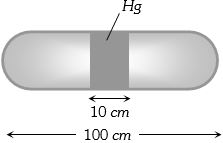
A horizontal uniform glass tube of $100 \,cm$, length sealed at both ends contain $10 \,cm$ mercury column in the middle. The temperature and pressure of air on either side of mercury column are respectively $81°C$ and $76\, cm$ of mercury. If the air column at one end is kept at $0°C$ and the other end at $273°C$, the pressure of air which is at $0°C$ is (in $cm$ of $Hg$)
  • A
    $76$
  • B
    $68.2$
  • $102.4$
  • D
    $122$

Answer

Correct option: C.
$102.4$
c
Let $x$ be the displacement of the mercury column on the side whose temperature is changed to $0^{\circ} C$. New pressure on both sides must be same so that the mercury column remains in equilibrium.

$\frac{ PV }{ T }$ is constant for air column.

$\Rightarrow \frac{P_{0}(45)}{273+31}=\frac{P_{1}(45-x)}{273+0}$

and $\frac{P_{0}(45)}{273+31}=\frac{P_{1}(45+x)}{273+273}$

Therefore, $x =15 \; cm$ and thus $P =102.4 \; cm$ of $Hg$

Need a full question paper?

Generate a complete, print-ready paper with questions like this in minutes — across 16+ boards, with answer keys.

Start Generating Free

Similar questions

A tunnel has been dug through the centre of the earth and a ball is released in it. It will reach the other end of the tunnel after
A liquid of mass $1$ $kg$ is filled in a flask as shown in figure. The force exerted by the flask on the liquid is $(g = 10\  m/s^2)$[Neglect atmospheric pressure]:
The time period of a particle executing $S.H.M.$ is $8 \,s$. At $t=0$ it is at the mean position. The ratio of distance covered by the particle in $1^{\text {st }}$ second to the $2^{\text {nd }}$ second is .............. $s$
In $S = a + bt + c{t^2}$. $S$ is measured in metres and $t$ in seconds. The unit of $c$ is
A force of $19.6\, N$ when applied parallel to the surface just moves a body of mass $10 \,kg$ kept on a horizontal surface. If a $5\, kg$ mass is kept on the first mass, the force applied parallel to the surface to just move the combined body is........ $N.$ 
Two wires are made of the same material and have the same volume. The first wire has cross-sectional area $A$ and the second wire has cross-sectional area $3A$. If the length of the first wire is increased by $\Delta l$ on applying a force $F$, how much force is needed to stretch the second wire by the same amount?
A $120\, m$ long train is moving in a direction with speed $20 \,m/s$. $A$ train $B$ moving with $30\, m/s$ in the opposite direction and $130\, m$ long crosses the first train in a time
Which of the following is an assumption of Kinetic theory of matter?
An ideal gas $(\gamma = 1.5)$ is expanded adiabatically. How many times has the gas to be expanded to reduce the root mean square velocity of molecules $2.0$ times
A thin rod of length $L$ is bent to form a semicircle. The mass of rod is $M$. What will be the gravitational potential at the centre of the circle?