A hot body, obeying Newton's law of cooling is cooling down from its peak value $80\,^oC$ to an ambient temperature of $30\,^oC$ . It takes $5\, minutes$ in cooling down from $80\,^oC$ to $40\,^oC$. ........ $\min.$ will it take to cool down from $62\,^oC$ to $32\,^oC$ ? (Given $ln\, 2\, = 0.693, ln\, 5\, = 1.609$)
JEE MAIN 2014, Diffcult
Download our app for free and get started
From $Newton's\,law$ of cooling,
$t = \frac{1}{k}{\log _e}\left( {\frac{{{\theta _2} - {\theta _0}}}{{{\theta _1} - {\theta _0}}}} \right)$
From question and above equation,
$5 = \frac{1}{k}{\log _e}\frac{{\left( {40 - 30} \right)}}{{\left( {80 - 130} \right)}}\,\,\,\,\,\,\,\,\,\,\,\,\,\,...\left( 1 \right)$
$And,t = \frac{1}{k}{\log _e}\frac{{\left( {32 - 30} \right)}}{{\left( {62 - 30} \right)}}\,\,\,\,\,\,\,\,\,\,\,\,\,\,\,\,...\left( 2 \right)$
Dividing equation $(2)$ by $(1)$,
$\frac{t}{5} = \frac{{\frac{1}{k}{{\log }_e}\frac{{\left( {32 - 30} \right)}}{{\left( {62 - 30} \right)}}}}{{\frac{1}{k}{{\log }_e}\frac{{\left( {40 - 30} \right)}}{{\left( {80 - 30} \right)}}}}$
On solving we get, time taken to cool down from ${62^ \circ }C\,to\,{32^ \circ }C,$
$t=8.6\,minutes.$

Download our appand get started for free
Experience the future of education. Simply download our apps or reach out to us for more information. Let's shape the future of learning together!No signup needed.*
Similar Questions
- 1The area of the hole of heat furnace is $10^{-4}\,m^2.$ It radiates $1.58\times 10^5\,cal$ of heat per hour. If the emissivity of the furnace is $0.80,$ then its temperature is .......... $K$View Solution
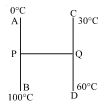
- 2Three identical rods $AB$, $CD$ and $PQ$ are joined as shown. $P$ and $Q$ are mid points of $AB$ and $CD$ respectively. Ends $A, B, C$ and $D$ are maintained at $0^o C, 100^o C, 30^o C$ and $60^o C$ respectively. The direction of heat flow in $PQ$ isView Solution
- 3Two vessels of different materials are similar in size in every respect. The same quantity of ice filled in them gets melted in $20$ minutes and $30$ minutes. The ratio of their thermal conductivities will beView Solution
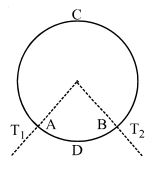
- 4Aring consisting of two parts $ADB$ and $ACB$ of same conductivity $k$ carries an amount of heat $H$. The $ADB$ part is now replaced with another metal keeping the temperatures $T_1$ and $T_2$ constant. The heat carried increases to $2H$. What $ACB$ should be the conductivity of the new$ADB$ part? Given $\frac{{ACB}}{{ADB}}= 3$View Solution
- 5View SolutionColour of shining bright star is an indication of its
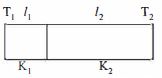
- 6One end of a thermally insulated rod is kept at a temperature $T_1$ and the other at $T_2$ . The rod is composed of two sections of length $l_1$ and $l_2$ and thermal conductivities $K_1$ and $K_2$ respectively. The temperature at the interface of the two section isView Solution
- 7Consider two hot bodies ${B_1}$ and ${B_2}$ which have temperatures ${100^o}C$ and ${80^o}C$ respectively at $t = 0$. The temperature of the surroundings is ${40^o}C$. The ratio of the respective rates of cooling ${R_1}$ and ${R_2}$ of these two bodies at $t = 0$ will beView Solution
- 8Two rods of same length and cross section are joined along the length. Thermal conductivities of first and second rod are ${K_1}\,\,{\rm{and}}\,\,{K_2}$. The temperature of the free ends of the first and second rods are maintained at ${\theta _1}\,\,{\rm{and }}{\theta _2}$ respectively. The temperature of the common junction isView Solution
- 9Certain substance emits only the wavelengths ${\lambda _1},\;{\lambda _2},\;{\lambda _3}$ and ${\lambda _4}$ when it is at a high temperature. When this substance is at a colder temperature, it will absorb only the following wavelengthsView Solution
- 10If a piece of metal is heated to temperature $\theta$ and then allowed to cool in a room which is at temperature $\theta_0$, the graph between the temperature $T$ of the metal and time t will be closest toView Solution