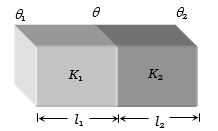
Two rods of same length and cross section are joined along the length. Thermal conductivities of first and second rod are ${K_1}\,\,{\rm{and}}\,\,{K_2}$. The temperature of the free ends of the first and second rods are maintained at ${\theta _1}\,\,{\rm{and }}{\theta _2}$ respectively. The temperature of the common junction is
Medium


Download our appand get started for free
Experience the future of education. Simply download our apps or reach out to us for more information. Let's shape the future of learning together!No signup needed.*
Similar Questions
- 1Two rods, one made of copper and the other steel of the same length and cross-sectional area are joined together. The thermal conductivity of copper is $385 \,Js ^{-1} m ^{-1} K ^{-1}$ and steel is $50 \,Js ^{-1} m ^{-1} K ^{-1}$. If the copper end is held at $100^{\circ} C$ and the steel end is held at $0^{\circ} C$, the junction temperature is ........... $C$ (Assuming no other heat losses)View Solution
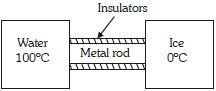
- 2An insulated container is filled with ice at $0\,^oC$ , and another container is filled with water that is continuously boiling at $100\,^oC$ . In series of experiments, the containers are connected by various thick metal rods that pass through the walls of container as shown in the figureView Solution
In the experiment $I$ : a copper rod is used and all ice melts in $20$ minutes.
In the experiment $II$ : a steel rod of identical dimensions is used and all ice melts in $80$ minutes.
In the experiment $III$ : both the rods are used in series and all ice melts in $t_{10}$ minutes.
In the experiment $IV$ : both rods are used in parallel and all ice melts in $t_{20}$ minutes.
- 3Three rods of identical area of cross-section and made from the same metal form the sides of an isosceles triangle $ABC$, right angled at $B$. The points $A$ and $B$ are maintained at temperatures $T$ and $\sqrt 2 T$ respectively. In the steady state the temperature of the point C is ${T_C}$. Assuming that only heat conduction takes place, $\frac{{{T_C}}}{T}$ is equal toView Solution
- 4Two identical beakers $A$ and $B$ contain equal volumes of two different liquids at $60\,^oC$ each and left to cool down. Liquid in $A$ has density of $8 \times10^2\, kg / m^3$ and specific heat of $2000\, Jkg^{-1}\,K^{-1}$ while liquid in $B$ has density of $10^3\,kgm^{-3}$ and specific heat of $4000\,JKg^{-1}\,K^{-1}$ . Which of the following best describes their temperature versus time graph schematically? (assume the emissivity of both the beakers to be the same)View Solution
- 5If two metallic plates of equal thicknesses and thermal conductivities ${K_1}$ and ${K_2}$ are put together face to face and a common plate is constructed, then the equivalent thermal conductivity of this plate will beView Solution

- 6A body cools in $7$ minutes from $60^{\circ}\,C$ to $40^{\circ}\,C$. The temperature of the surrounding is $10^{\circ}\,C$. The temperature of the body after the next $7$ minutes will beView Solution
- 7For a black body at temperature $727^{\circ} C$, its radiating power is $60\; watt$ and temperature of surrounding is $227^{\circ} C$. If temperature of black body is changed to $1227^{\circ} C$ then its radiating power will be ..... $watt$View Solution
- 8The maximum energy in the thermal radiation from a hot source occurs at a wavelength of $11 \times {10^{ - 5}}cm$. According to Wein's law, the temperature of the source (on Kelvin scale) will be $n$ times the temperature of another source (on Kelvin scale) for which the wavelength at maximum energy is $5.5 \times {10^{ - 5}}cm$. The value $n$ isView Solution
- 9When $p$ calories of heat is given to a body, it absorbs $q$ calories; then the absorbtion power of body will beView Solution
- 10A large cylindrical rod of length $L$ is made by joining two identical rods of copper and steel of length $(\frac {L}{2})$ each . The rods are completely insulated from the surroundings. If the free end of copper rod is maintained at $100\,^oC$ and that of steel at $0\,^oC$ then the temperature of junction is........$^oC$ (Thermal conductivity of copper is $9\,times$ that of steel)View Solution