Question
(a) How many subshells are associated with $n =4$ ? (b) How many electrons will be present in the subshells having $m_s$ value of $-\frac{1}{2}$ for $n=4$ ?

Answer

(a) For $n=4, l=0,1,2,3$
\begin{array}{rlc} 
& & \text { subshell } \\
l=0 & = & 4 s \\
1 & = & 4 p \\
2 & = & 4 d \\
3 & = & 4 f
\end{array}
Hence for $n=4$ there will be four subshells ( $4 s$, $4 p, 4 d$ and $4 f)$
(b) Number of orbitals for $n=4=4^2=16$ and for one electron present in each orbital $m _{ s }=-\frac{1}{2}$. Therefore the subshells with $n =4, m_{ s }=-\frac{1}{2}$ have 16 electrons.

Need a full question paper?

Generate a complete, print-ready paper with questions like this in minutes — across 16+ boards, with answer keys.

Start Generating Free

Similar questions

Write conjugate acid and conjugate base of H2O.
Identify the oxidising and reducing agent in following chemical reactions :
(i) $2 M g + S O _2 \longrightarrow 2 M g O + S$
(ii) $2 Cu ^{2+}+4 I ^{-} \longrightarrow 2 CuI + I _2$
(iii) $SO _2+2 H _2 S \longrightarrow 2 H _2 O +3 S$
(iv) $S n ^{2+}+ 2 H g ^{2+} \longrightarrow H g _2{ }^{2+}+ Sn ^{4+}$
  1. Which out of Cu, Fe, V, Ag is not in first transition series (3d series).
  2. Which element in Group 13 forms most acidic oxide? Give its formula.
Explain why the system are not aromatic.
Image
Arrange the following type of radiations in increasing order of frequency:
  1. Radiation from microwave oven.
  2. Amber light from traffic signal.
  3. Radiation from FM radio.
  4. Cosmic rays from outer space and (e) X-rays.
Give IUPAC name of the following:

  1.  

$\ \ \ \ \ \ \ \ \ \ \ \ \stackrel{8\ \ \ \ }{\text{CH}_2}-\stackrel{9\ \ \ \ }{\text{CH}_3}\ \ \ \ \ \ \ \ \ \ \ \ \ \text{CH}_3\ \ \ \text{CH}_2-\text{CH}_3\\\ \ \ \ \ \ \ \ \ \ \ \ \ \ |\ \ \ \ \ \ \ \ \ \ \ \ \ \ \ \ \ \ \ \ \ \ \ \ \ \ \ \ \ \ \ \ \ \ |\ \ \ \ \ \ \ \ \ | \\\text{CH}_3-\text{CH}-\text{CH}_2-\text{CH}_2-\text{CH}-\text{CH}-\text{CH}_2-\text{CH}_3\\\ \ \ \ \ \ \ \ \ \ \ \ \ \ ^{7\ \ \ \ \ \ \ \ \ \ \ \ \ 6\ \ \ \ \ \ \ \ \ \ \ \ \ \ \ 5\ \ \ \ \ \ \ \ \ \ \ \ \ \ \ 4\ \ \ \ \ \ \ \ \ \ \ \ \ \ \ 3\ \ \ \ \ \ \ \ \ \ \ \ \ \ \ 2\ \ \ \ \ \ \ \ \ \ \ \ \ \ 1}$
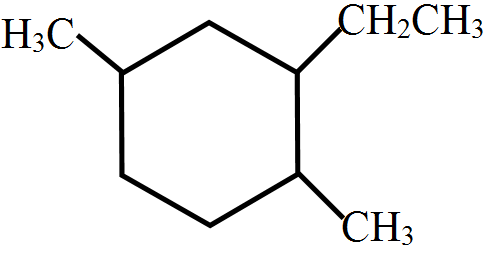
  1.  

A metal is higher than a particular metal in electrochemical series. Will the metal be stronger reducing agent or weaker reducing agent?
When fractional distillation method is used ? Explain the method.
Why are dipole moments of $\text{CO}_2,\text{BF}_3,\text{CCl}_4,\text{PF}_5,\text{SF}_6$ are zero?
Explain the formation of chemical bond.