Question
A human is moving on a plane surface with a box in his hand whose mass is 2 kg . If he walks with an acceleration of $0.5 m / s ^2$ to distance 40 m then what will be the work done by the man on the box during the motion?

Answer

 Given,
$\begin{aligned}
m & =2 kg \\
a & =0.5 m / s^2 \\
s & =40 m
\end{aligned}$
Here force and displacement are in same direction, then
$\therefore \quad \theta=0^{\circ}$
$\begin{aligned}work ( W ) & =\text { mas } \cos \theta \\ & =2 \times 0.5 \times 40 \cos 0^{\circ} \\ & =2 \times 0.5 \times 40 \quad \therefore \cos 0=1 \\ W & =40 J\end{aligned}$

Need a full question paper?

Generate a complete, print-ready paper with questions like this in minutes — across 16+ boards, with answer keys.
Start Generating Free

Similar questions

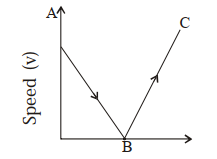
An object is thrown vertically upwards. After some time it returns to earth. Draw the speed time graph for the ball. (Note: Consider the air borne resistance as negligible here.)
Image
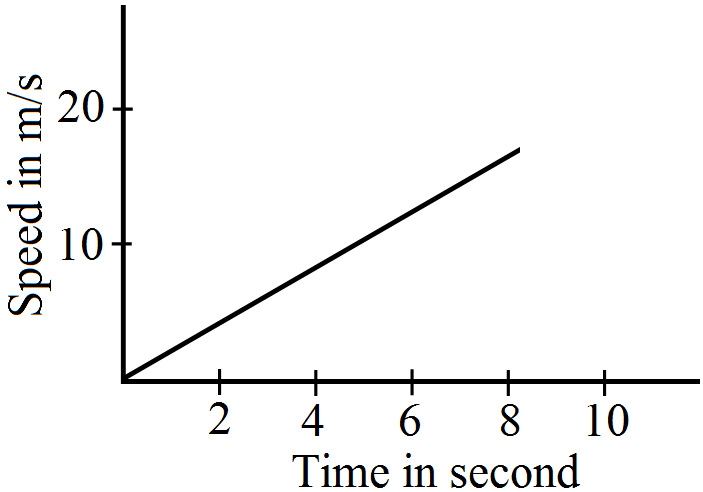
The speed of a car as a function of time is shown in figure. Find the distance travelled by the car in 8 seconds and its acceleration.
A steel wire fixed at both ends has a fundamental frequency of 200Hz. A person can hear sound of maximum frequency 14kHz. What is the highest harmonic that can be played on this string which is audible to the person?
What travels faster-a rifle bullet or the sound of a shot?
A compound microscope forms an inverted image of an object. In which of the following cases it is kely to create difficulties?
The bob of a vibrating simple pendulum is made of ice. How will the period of swing change when the ice starts melting?
Find the angle of projection for a projectile motion whose range R is n times the maximum height H.
The driver of a truck travelling with a velocity v suddenly notices a brick wall in front of him at a distance d. Is it better for him to apply brakes or to make a circular turn without applying brakes in order to just avoid crashing into the wall? Why?
Answer the following questions:Time period of a particle in SHM depends on the force constant k and mass m of the particle: $\text{T}=2\pi\sqrt{\frac{\text{m}}{\text{k}}}.$ A simple pendulum executes SHM approximately. Why then is the time period of a pendulum independent of the mass of the pendulum?
The gravitational field in a region is given by $\text{E}=(2\hat{\text{i}}+3\hat{\text{i}})\text{N/kg}.$ Show that no work is done by the gravitational field when a particle is moved on the line 3y + 2x = 5.
Hint: If a line y = mx + c makes angle $\theta$ with the X-axis, m $=\tan\theta$