Question
A hydrogen atom contains one proton and one electron. It may be assumed that the electron revolves in a circle of radius 0.53 angstrom (1 angstrom $= 10^{-10}m$ and is abbreviated as A) with the proton at the centre. The hydrogen atom is said to be in the ground state in this case. Find the magnitude of the electric force between the proton and the electron of a hydrogen atom in its ground state.
Answer

$\text{R}=0.53\text{A}^\circ=0.53\times10^{-10}\text{m}$$\text{F}=\frac{\text{Kq}_1\text{q}_2}{\text{r}^2}$
$=\frac{9\times10^9\times1.6\times1.6\times10^{-38}}{0.53\times0.53\times10^{-10}\times10^{-10}}$
$=82.02\times10^{-9}\text{N}$

Need a full question paper?

Generate a complete, print-ready paper with questions like this in minutes — across 16+ boards, with answer keys.

Start Generating Free

Similar questions

From the formula of potential energy of a system of two charges, obtain the equation of $P.E$. of electric dipole in external electric field.
State the conclusion of experiments about Iriction charge.
The magnetic force on a charged particle is always perpendicular to its velocity. Can the magnetic force change the velocity of the particle? Speed of the particle?
The amount of electric charge passing through a cross-section of wire in time t is $\mathrm{Q}(\mathrm{t})=\mathrm{At}^2+\mathrm{Bt}+\mathrm{C}$
Where $\mathrm{A}, \mathrm{B}$ and C are constants having values 5,4 and 1 respectively.
Calculate the value of electric current at $t=4 \mathrm{~s}$.
An electron moves in a circular orbit $6^{15} \times 10^{15}$ times per second. Find the magnitude of current in the loop.
A particle executes simple harmonic motion with an amplitude of 10cm. At what distance from the mean position are the kinetic and potential energies equal?
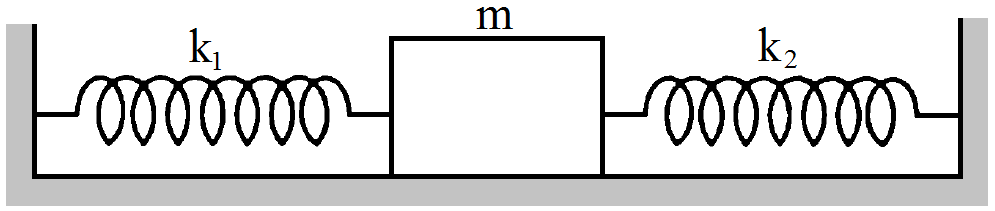
A block of mass $m$ is attached to two unstretched springs of spring constants $k_1$ and $k_2$ as shown in figure. The block is displaced towards right through a distance $x$ and is released. Find the speed of the block as it passes through the mean position shown.
Using the formula $\overrightarrow{\text{F}}=\text{q}\overrightarrow{\text{v}}\times\overrightarrow{\text{B}}$ and $\text{B}=\frac{\mu_0\text{i}}{2\pi\text{r}},$ show that the SI units of the magnetic field B and the permeability constant $\mu_0$ may be written as N/A-m and $NA^2$ respectively.
N small conducting liquid droplets, each of radius r, are charged to a potential V each. These droplets coalesce to form a single large drop without any charge leakage. Find the potential of the large drop.
Explain ground state and ionisation energy of hydrogen atom.