Question
A hydrogen atom initially in the ground level absorbs a photon, which excites it to the n = 4 level. Determine the wavelength and frequency of photon.

Answer

For ground level, n1 = 1
Let E1 be the energy of this level. It ls known that E1 Is related with n1 as:
$\text{E}_1=\frac{-13.6}{\text{n}^2_1}\text{ eV}$
$=\frac{-13.6}{1^2}=-13.6\text{ eV}$
The atom is excited to a higher level, n2 = 4.
Let E2 be the energy of this level.
$\therefore\ \text{E}_2=\frac{-13.6}{\text{n}^2_2}\text{ eV}$
$=\frac{-13.6}{4^2}=-\frac{13.6}{16}\text{ eV}$
The amount of energy absorbed by the photon is given as:
E = E2 - E1
$=\frac{-13.6}{16}-\Big(-\frac{13.6}{1}\Big)$
$=\frac{13.6\times15}{16}\text{ eV}$
$=\frac{13.6\times15}{16}\times1.6\times10^{-19}=2.04\times10^{-18}\text{ J}$
For a photon of wavelenqtha. the expression of energy Is written as:
$\text{E}=\frac{\text{hc}}{\lambda}$
Where,
h = Planck's constant = 6.6 x 10⁻³⁴ Js
c = Speed of light = 3 x 10⁸ m/s
$\therefore\ \lambda=\frac{\text{hc}}{\text{E}}$
$=\frac{6.6\times10^{-34}\times3\times10^8}{2.04\times10^{-18}}$
$=9.7\times10^{-8}\text{ m}=97\text{ nm}$
And, frequency of a photon is given by the relation,
$\text{v}=\frac{\text{c}}{\lambda}$
$=\frac{3\times10^8}{9.710^{-8}}\approx3.1\times10^{15}\text{ Hz}$
Hence, the wavelength of the photon is 97 nm while the frequency is 3.1 x 10¹⁵ Hz.

Need a full question paper?

Generate a complete, print-ready paper with questions like this in minutes — across 16+ boards, with answer keys.
Start Generating Free

Similar questions

A metal rod of cross sectional area 1.0cm2 is being heated at one end. At one time, the temperature gradient is 5.0°C/cm-1 at cross section A and is 2.5°C/cm-1 at cross section B. Calculate the rate at which the temperature is increasing in the part AB of the rod. The heat capacity of the part AB = 0.40J°C-1, thermal conductivity of the material of the rod = 200Wm-1°C-1. Neglect any loss of heat to the atmosphere.
The resistance of an iron wire and a copper wire at 20°C are $3.9\Omega$ and $4.1\Omega,$ respectively. At what temperature will the resistance be equal? Temperature coefficient of resistivity for iron is $5.0\times10^{-3}\text{K}^{-1}$ and for copper, it is $4.0\times10^{-3}\text{K}^{-1}.$ Neglect any thermal expansion.
Define resolving power of a compound microscope. How does the resolving power of a compound microscope change when:
  1. Refractive index of medium between the object and objective lens increases.
  2. Wavelength of radiation used is increased?
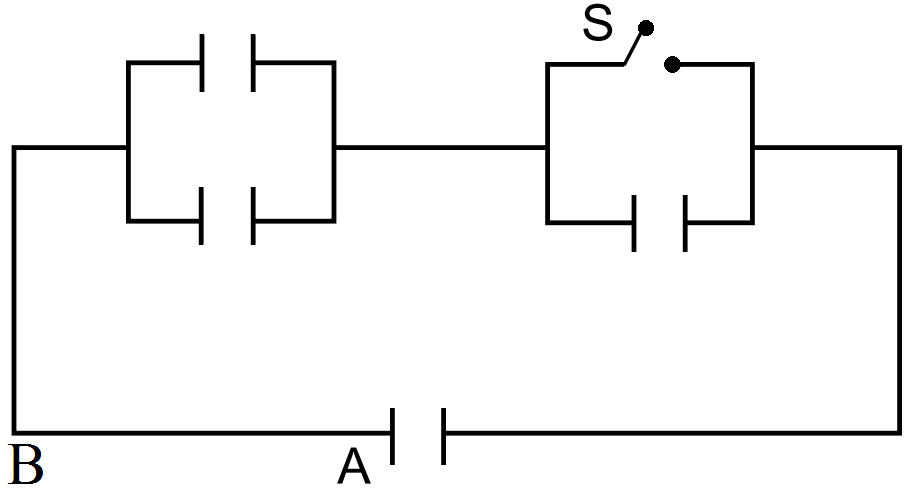
Each capacitor shown in figure has a capacitance of $5.0\mu\text{F}.$ The emf of the battery is 50V. How much charge will flow through AB if the switch S is closed?

A stone is thrown vertically upward with a speed of 28m/s.
  1. Find the maximum height reached by the stone.
  2. Find its velocity one second before it reaches the maximum height.
  3. Does the answer of part.
  4. Change if the initial speed is more than 28m/s suchas 40m/s or 80m/s?
What is the difference between cathode rays and beta rays? When the two are travelling in space, can you make out which is the cathode ray and which is the beta ray?
A compound microscope consists of an objective of focal length 1cm and an eyepiece of focal length 5cm. An object is placed at a distance of 0.5cm from the objective. What should be the separation between the lenses so that the microscope projects an inverted real image of the object on a screen 30cm behind the eyepiece?
A point charge causes an electric flux of –1.0 × 10³ Nm2 /C to pass through a spherical Gaussian surface of 10.0 cm radius centred on the charge.
  1. If the radius of the Gaussian surface were doubled, how much flux would pass through the surface?
  2. What is the value of the point charge?
State the principle of working of p-n diode as a rectifier. Explain, with the help of a circuit diagram, the use of p-n diode as a full wave rectifier. Draw a sketch of the input and output waveforms.
A hydrogen atom moving at speed υ collides with another hydrogen atom kept at rest. Find the minimum value of υ for which one of the atoms may get ionized. The mass of a hydrogen atom = 1.67 × 10⁻²⁷kg.