- Draw a ray diagram to show refraction of a ray of monochromatic light passing through a glass prism.
- Explain briefly how the phenomenon of total internal reflection is used in fibre optics.
CBSE DELHI - SET 1 2011
Download our app for free and get started
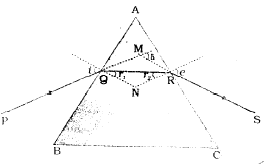
From $\Delta$ MQR, $(i - r_1) + (e - r_2)= \delta$
So$ (i + e)-(r_1 + r_2)= \delta$
From $\Delta PQN r_1+ r_2+ \angle QNR =180^\circ$
Also $A + \angle QNR =180^\circ$
Thus $A= r_1+ r_2$
So $ i + e - A= \delta$
At minimum deviation, $i = e, r_1= r_2 = r$ and $\delta = \delta_{m}$
$\Rightarrow \text{i} = \frac{\text{A} + \delta_{m}}{2}$
and $\text{r} = \frac{\text{A}}{2}$
Also $\mu = \frac{\sin\text{i}}{\sin\text{r}}$
Hence $\mu = \frac{\sin\bigg(\frac{\text{A} + \delta_{m}}{2}\bigg)}{\sin\bigg(\frac{\text{A}}{2}\bigg)}$
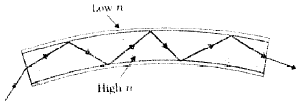
Each optical fibre consists of a core and cladding. Refractive index of the material of the core is higher than that of cladding. When a signal, in the form of light, is directed into the optical fibre, at an angle greater than the (relevant) critical angle, it undergoes repeated total internal reflections along the length of the fibre and comes out of it at the other end with almost negligible lossof intensity.

Download our appand get started for free
Experience the future of education. Simply download our apps or reach out to us for more information. Let's shape the future of learning together!No signup needed.*
Similar Questions
- 1View Solution
- Draw a labelled ray diagram to show the formation of image in an astronomical telescope for a distant object.
- Write three distinct advantages of a reflecting type telescope over a refracting type telescope.
- A convex lens of focal length 10 cm is placed coaxially 5 cm away from a concave lens of focal length 10 cm. If an object is placed 30 cm in front of the convex lens, find the position of the final image formed by the combined system.
- 2View Solution
- With the help of a suitable ray diagram, derive the mirror formula for a concave mirror.
- The near point of a hypermetropic person is 50 cm from the eye. What is the power of the lens required to enable the person to read clearly a book held at 25 cm from the eye?
- 3Derive the lens formula, $\frac{1}{\text{f}} = \frac{1}{\text{v}} - \frac{1}{\text{u}}$ for a concave lens, using the necessary ray diagram.View Solution
Two lenses of powers 10 D and – 5 D are placed in contact.- Calculate the power of the new lens.
- Where should an object be held from the lens, so as to obtain a virtual image of magnification 2?
- 4View SolutionWill the focal length of a lens for red light be more, same or less than that for blue light?
- 5View SolutionA 4.5 cm needle is placed 12 cm away from a convex mirror of focal length 15 cm. Give the location of the image and the magnification. Describe what happens as the needle is moved farther from the mirror.
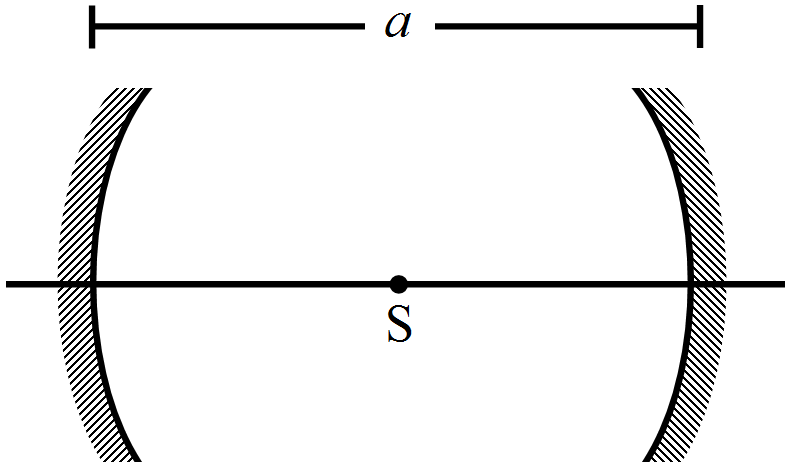
- 6View SolutionA point source S is placed midway between two converging mirrors having equal focal length f. Find the values of d for which only one image is formed.
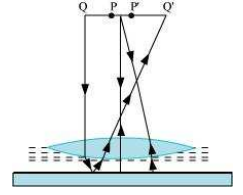
- 7View Solutionequiconvex lens (of refractive index 1.50) in contact with a liquid layer on top of a plane mirror. A small needle with its tip on the principal axis is moved along the axis until its inverted image is found at the position of the needle. The distance of the needle from the lens is measured to be 45.0 cm. The liquid is removed and the experiment is repeated. The new distance is measured to be 30.0 cm. What is the refractive index of the liquid?
- 8With the help of a ray diagram, show the formation of image of a point object due to refraction of light at a spherical surface separating two media of refractive indices $n_1$ and $n_2 (n_2 > n_1)$ respectively. Using this diagram, derive the relation.View Solution
$\frac{\text{n}_2}{\text{v}}-\frac{\text{n}_1}{\text{u}}=\frac{\text{n}_1-\text{n}_2}{\text{R}}$
Write the sign conventions used. What happens to the focal length of convex lens when it is immersed in water? - 9A small block of mass m and a concave mirror of radius R fitted with a stand lie on a smooth horizontal table with a separation d between them. The mirror together with its stand has a mass m. The block is pushed at t = 0 towards the mirror so that it starts moving towards the mirror at a constant speed V and collides with it. The collision is perfectly elastic. Find the velocity of the image:View Solution
- At a time $\text{t}<\frac{\text{d}}{\text{V}}$
- At a time $\text{t}>\frac{\text{d}}{\text{V}}.$
- 10View SolutionA Cassegrain telescope uses two mirrors. Such a telescope is built with the mirrors 20 mm apart. If the radius of curvature of the large mirror is 220 mm and the small mirror is 140 mm, where will the final image of an object at infinity be?