Question
A hydrogen atom moving at speed υ collides with another hydrogen atom kept at rest. Find the minimum value of υ for which one of the atoms may get ionized. The mass of a hydrogen atom $= 1.67 \times 10^{-27}kg.$

Answer

The hydrogen atoms after collision move with speeds $v_1$ and $v_2$​​​​​​​
$\text{mv}=\text{mv}_1+\text{mv}_2\ ....(\text{i})$
$\frac{1}{2}\text{mv}^2=\frac{1}{2}\text{mv}^2_1+\frac{1}{2}\text{mv}^2_2+\Delta\text{E}\ ....(\text{ii})$
From (i), $\text{v}^2=(\text{v}_1+\text{v}_2)^2=\text{v}^2_1+\text{v}^2_2+2\text{v}_1\text{v}_2$
From (ii), $\text{v}^2=\text{v}^2_1+\text{v}^2_2+\frac{2\Delta\text{E}}{\text{m}}$
$=2\text{v}_1\text{v}_2=\frac{2\Delta\text{E}}{\text{m}}\ ...(\text{iii})$
$(\text{v}_1-\text{v}_2)^2=\big(\text{v}_1+\text{v}_2\big)^2-4\text{v}_1\text{v}_2$
$(\text{v}_1-\text{v}_2)=\text{v}^2-\frac{4\Delta\text{E}}{\text{m}}$
For minimum value of ‘v’
$\text{v}_1=\text{v}_2$
$\text{v}^2-\Big(\frac{4\Delta\text{E}}{\text{m}}\Big)=0$
$\text{v}^2=\frac{4\Delta\text{E}}{\text{m}}=\frac{4\times13.6\times1.6\times10^{-19}}{1.67\times10^{-27}}$
$\text{v}=\sqrt{\frac{4\times13.6\times1.6\times10^{-19}}{1.67\times10^{-27}}}=7.2\times10^4\text{m/s}$

Need a full question paper?

Generate a complete, print-ready paper with questions like this in minutes — across 16+ boards, with answer keys.
Start Generating Free

Similar questions

Consider a metal ring kept on top of a fixed solenoid (say on a carboard) (Fig). The centre of the ring coincides with the axis of the solenoid. If the current is suddenly switched on, the metal ring jumps up. Explain.
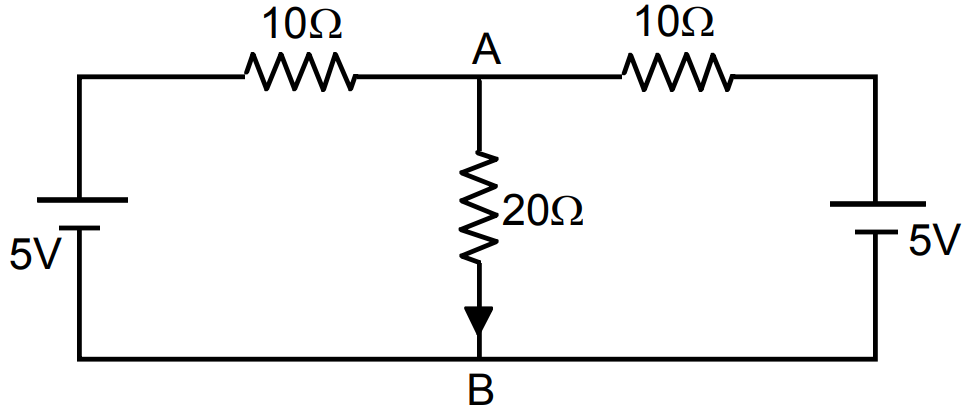
(a) Find the current in the $20\Omega$ resistor shown in the figure. (b) If a capacitor of capacitance $4\mu\text{F}$ is joined between the points A and B, what would be the electrostatic energy stored in it in steady state?
Write the mathematical relation for the resistivity of a material in terms of relaxation time, number density, mass and charge of charge carriers in it. Explain using this relation, why the resistivity of a metal increases and that of a semiconductor decreases with rise in temperature.
Find the magnetic field B at the centre of a rectangular loop of length l and width b, carrying a current i.
In a CE transistor amplifier there is a current and voltage gain associated with the circuit. In other words there is a power gain. Considering power a measure of energy, does the circuit voilate conservation of energy?
A pendulum bob of mass 50g is suspended from the ceiling of an elevator. Find the tension in the string if the elevator:
  1. Goes up with acceleration $1.2m/s^2.$
  2. Goes up with deceleration $1.2m/s^2.$
  3. Goes up with uniform velocity.
  4. Goes down with acceleration $1.2m/s^2.$
  5. Goes down with deceleration $1.2m/s^2.$
  6. Goes down with uniform velocity.
  1. Derive the expression for the torque on a rectangular current carrying loop suspended in a uniform magnetic field.
  2. A proton and a deuteron having equal momenta enter in a region of uniform magnetic field at right angle to the direction of the field. Depict their trajectories in the field.
Two persons each of mass m are standing at the two extremes of a railroad car of mass M resting on a smooth track. The person on left jumps to the left with a horizontal speed u with respect to the state of the car before the jump. Thereafter, the other person jumps to the right, again with the same horizontal speed u with respect to the state of the car before his jump. Find the velocity of the car after both the persons have jumped off.
In a Young's double slit experiment, the separation between the slits = 2.0mm, the wavelength of the light = 600nm and the distance of the screen from the slits = 2.0m. If the intensity at the centre of the central maximum is $0.20W/ m^2,$ what will be the intensity at a point 0.5cm away from this centre along the width of the fringes?
What are the values of the self-induced emf in the circuit of the previous problem at the times indicated therein?