Question
  1. Derive the expression for the torque on a rectangular current carrying loop suspended in a uniform magnetic field.
  2. A proton and a deuteron having equal momenta enter in a region of uniform magnetic field at right angle to the direction of the field. Depict their trajectories in the field.
Answer

  1.  

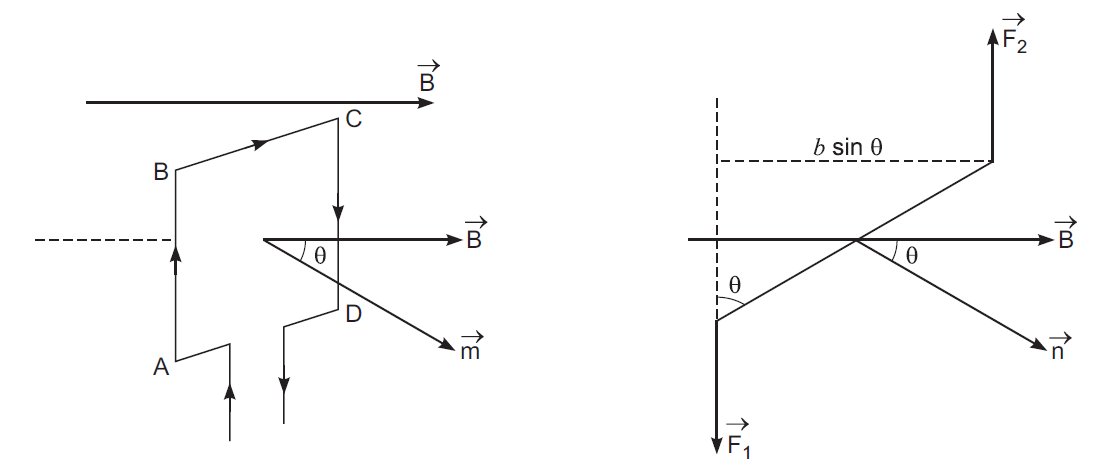
A rectangular loop ABCD of dimensions l and b, carrying a steady current is placed in uniform magnetic field as shown in fig; such that normal of the plane is at angle q with the magnetic field lines.
The force $F_{BC}$ and $F_{AD} $ on arms BC and AD are equal, opposite and along the axis of the coil, so they cancel each other.
The forces $F_{AB}$ and $F_{CD}$ are also equal and opposite, but are not collinear, so they constitute a couple, and the magnitude of the torque can be given as
$\tau = \text{F}_{AB}.\frac{\text{b}}{2}\sin\theta + \text{F}_{CD}.\frac{\text{b}}{2}\sin\theta$
Since
$|\text{F}_{AB}| = |\text{F}_{CD}| =\text{BI}\ell$
$\tau = \text{BI}\ell\times\text{b}\times\sin\theta$
$ = \text{BI}(\ell\text{b})\sin\theta$
= BI A sin $\theta$
$[\text{A} = \ell \text{b} = \text{ area of the rectangle}]$
Since magnetic moment m = I |A|
$\tau = \text{mB} \sin \theta$
In vector from $\overrightarrow{\tau} = \overrightarrow{\text{m}}\times\overrightarrow{\text{B}}$
  1. If a charge particle enters right angle to the direction of magnetic field, it follows a circular trajectory, and radius can be given as
$\text{q}v\text{B} = \frac{\text{m}v^{2}}{\text{r}}$
$\Rightarrow\text{r} = \frac{\text{m}v}{\text{qB}} = \frac{\text{p}}{\text{qB}}$
Since momentum are equal, and they have equal charges.
So, $r_p : r_d = 1:1.$

Need a full question paper?

Generate a complete, print-ready paper with questions like this in minutes — across 16+ boards, with answer keys.

Start Generating Free

Similar questions

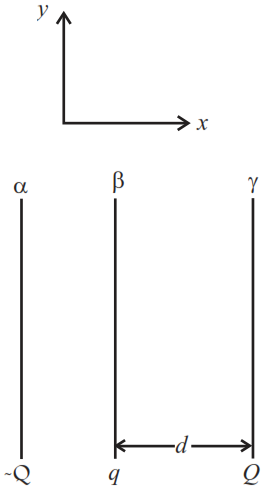
Two fixed, identical conducting plates $(\alpha\ \&\ \beta)$, each of surface area S are charged to -Q and q, respectively, where Q > q > 0. A third identical plate $(\gamma)$, free to move is located on the other side of the plate with charge q at a distance d (Fig.). The third plate is released and collides with the plate $\beta$. Assume the collision is elastic and the time of collision is sufficient to redistribute charge amongst $\beta\ \&\ \gamma$.

Find the charges on $\beta$ and $\gamma$ after the collision.
Find the maximum magnifying power of a compound Microscope having a 25 diopter lens as the objective, a 5 diopter lens as the eyepiece and the separation 30cm between the two lenses. The least distance for clear vision is 25cm.
A small town with a demand of 800kW of electric power at 220V is situated 15km away from an electric plant generating power at 440V. The resistance of the two wire line carrying power is 0.5Ω per km. The town gets power from the line through a 4000-220V step-down transformer at a sub-station in the town.
  1. Estimate the line power loss in the form of heat.
  2. How much power must the plant supply, assuming there is negligible power loss due to leakage?
  3. Characterise the step up transformer at the plant.
A horizontal cesium plate ($\phi$ = l.9 eV) is moved vertically downward at a constant speed u in a room full of radiation of wavelength 250 run and above. What should be the minimum value of u so that the vertically upward component of velocity is nonpositive for each photoelectron?
Critically analyse bar magnet and solenoid and calculate the value of magnetic field generated on the axial point of the solenoid.
The half-life of $^{40}K$ is $1.30 \times 10^9y.$ A sample of 1.00g of pure KCI gives 160 counts/ s. Calculate the relative abundance of $^{40}K$ (fraction of ^{40}K present) in natural potassium.
(a) For circuits used for transporting electric power, a low power factor implies large power loss in transmission. Explain.
(b) Power factor can often be improved by the use of a capacitor of appropriate capacitance in the circuit. Explain.
Answer the following questions:
(a) Are the equations of nuclear reactions (such as those given in Section 13.7) 'balanced' in the sense a chemical equation (e.g., $2 H _2+ O _2 \rightarrow 2 H _2 O$ ) is? If not, in what sense are they balanced on both sides?
(b) If both the number of protons and the number of neutrons are conserved in each nuclear reaction, in what way is mass converted into energy (or vice-versa) in a nuclear reaction?
(c) A general impression exists that mass-energy interconversion takes place only in nuclear reaction and never in chemical reaction. This is strictly speaking, incorrect. Explain.
A U-tube having unequal arm-lengths has water in it. A tuning fork of frequency 440Hz can set up the air in the shorter arm in its fundamental mode of vibration and the same tuning fork can set up the air in the longer arm in its first overtone vibration. Find the length of the air columns. Neglect any end effect and assume that the speed of sound in air = 330m/s.
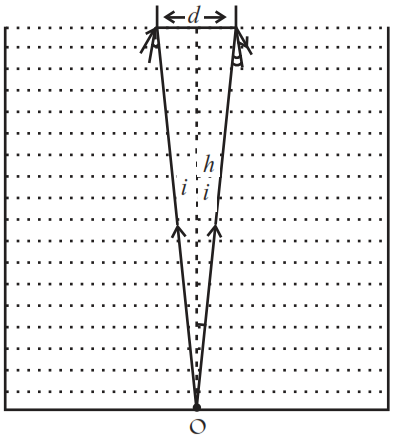
A jar of height h is filled with a transparent liquid of refractive index μ (Fig). At the centre of the jar on the bottom surface is a dot. Find the minimum diameter of a disc, such that when placed on the top surface symmetrically about the centre, the dot is invisible.