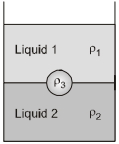
A jar is filled with two non-mixing liquids $1$ and $2$ having densities $\rho_1$ and, $\rho_2$ respectively. A solid ball, made of a material of density $\rho_3$ , is dropped in the jar. It comes to equilibrium in the position shown in the figure.Which of the following is true for $\rho_1 , \rho_2$ and $\rho_3$?
AIEEE 2008, Medium
Download our app for free and get started
From the figure it is clear that liquid $1$ floats on liquid $2$.
The lighter liquid floats over heavier liquid. Therefore
we can conclude that ${\rho _1} < {\rho _2}$
Also ${\rho _3} < {\rho _2}$ otherwise the ball would have sink to the bottom of the jar.
Also ${\rho _3} < {\rho _1}$ otherwise the ball would have floated in liquid $1$. From the above discussion we conclude that
${\rho _1} < {\rho _3} < {\rho _2}.$

Download our appand get started for free
Experience the future of education. Simply download our apps or reach out to us for more information. Let's shape the future of learning together!No signup needed.*
Similar Questions
- 1Which of the following option correctly describes the variation of the speed $v$ and acceleration $'a'$ of a point mass falling vertically in a viscous medium that applies a force $F = -kv,$ where $'k'$ is a constant, on the body? (Graphs are schematic and not drawn to scale)View Solution
- 2A cylindrical vessel of cross-section $A$ contains water to a height $h$ . There is a hole in the bottom of radius $'a'$ . The time in which it will be emptied isView Solution
- 3A cylindrical vessel of height $500 \mathrm{~mm}$ has an orifice (small hole) at its bottom. The orifice is initially closed and water is filled in it up to height $\mathrm{H}$. Now the top is completely sealed with a cap and the orifice at the bottom is opened. Some water comes out from the orifice and the water level in the vessel becomes steady with height of water column being $200 \mathrm{~mm}$. Find the fall in height (in ${m m}$ ) of water level due to opening of the orifice.View Solution
|Take atmospheric pressure $=1.0 \times 10^5 \mathrm{~N} / \mathrm{m}^2$, density of water $=1000 \mathrm{~kg} / \mathrm{m}^3$ and $g=10 \mathrm{~m} / \mathrm{s}^2$. Neglect any effect of surface tension.]
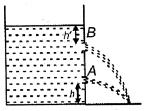
- 4A tank is filled with water and two holes $A$ and $B$ are made in it. For getting same range, ratio of $h^{\prime} T h$ is ..........View Solution
- 5The total area of cross-section is $0.25\,m^2$. If the blood is flowing at the rate of $100\, cm^3/sec$, then the average velocity of flow of blood through the capillaries is ........ $mm/sec$View Solution
- 6A water drop of radius $1\,\mu m$ falls in a situation where the effect of buoyant force is negligible. Coefficient of viscosity of air is $1.8 \times 10^{-5}\,Nsm ^{-2}$ and its density is negligible as compared to that of water $10^{6}\,gm ^{-3}$. Terminal velocity of the water drop is________ $\times 10^{-6}\,ms ^{-1}$View Solution
(Take acceleration due to gravity $=10\,ms ^{-2}$ )
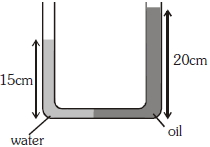
- 7In a $U-$tube as shown in figure, water and oil are in the left side and right side of the tube respectively. The helghts from the bottom for water and oil columns are $15\; \mathrm{cm}$ and $20\; \mathrm{cm}$ respectively. The density of the oil is......$kg/{m}^{3}$View Solution
[take $\rho_{water} \left.=1000 \;\mathrm{kg} / \mathrm{m}^{3}\right]$
- 8A spherical ball of density $\rho$ and radius $0.003$ $m$ is dropped into a tube containing a viscous fluid filled up to the $0$ $ cm$ mark as shown in the figure. Viscosity of the fluid $=$ $1.260$ $N.m^{-2}$ and its density $\rho_L=\rho/2$ $=$ $1260$ $kg.m^{-3}$. Assume the ball reaches a terminal speed by the $10$ $cm$ mark. The time taken by the ball to traverse the distance between the $10$ $cm$ and $20$ $cm$ mark isView Solution
( $g$ $ =$ acceleration due to gravity $= 10$ $ ms^{^{-2}} )$

- 9Karman line is a theoretical construct that separates the earth's atmosphere from outer space. It is defined to be the height at which the lift on an aircraft flying at the speed of a polar satellite $(8 \,km / s )$ is equal to its weight. Taking a fighter aircraft of wing area $30 \,m ^2$, and mass $7500 \,kg$, the height of the Karman line above the ground will be in the range .............. $km$ (assume the density of air at height $h$ above ground to be $\rho( h )=1.2 e ^{\frac{ h }{10}} \,kg / m ^3$ where $h$ is in $km$ and the lift force to be $\frac{1}{2} \rho v^2 A$, where $v$ is the speed of the aircraft and $A$ its wing area).View Solution
- 10In Millikan's oil drop experiment, what is viscous force acting on an uncharged drop of radius $2.0 \times 10^{-5}\, {m}$ and density $1.2 \times 10^{3} \,{kgm}^{-3}$ ? Take viscosity of liquid $=1.8 \times 10^{-5}\, {Nsm}^{-2} .$ (Neglect buoyancy due to air).View Solution