In a $U-$tube as shown in figure, water and oil are in the left side and right side of the tube respectively. The helghts from the bottom for water and oil columns are $15\; \mathrm{cm}$ and $20\; \mathrm{cm}$ respectively. The density of the oil is......$kg/{m}^{3}$
[take $\rho_{water} \left.=1000 \;\mathrm{kg} / \mathrm{m}^{3}\right]$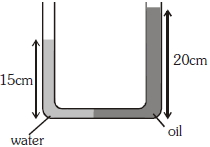
NEET 2019, Medium
Download our app for free and get started
$\rho_{oil} \mathrm{h}_{\text {oil }}={ \rho_{water} } \mathrm{h}_{\text {water }} $
$\Rightarrow \rho_{oil} =\frac{1000(15)}{20}=750 \mathrm{kg} \mathrm{m}^{-3}$

Download our appand get started for free
Experience the future of education. Simply download our apps or reach out to us for more information. Let's shape the future of learning together!No signup needed.*
Similar Questions
- 1Sixty four spherical rain drops of equal size are falling vertically through air with terminal velocity $1.5\, m/s$. All of the drops coalesce to form a big spherical drop, then terminal velocity of big drop is ........... $m/s$View Solution
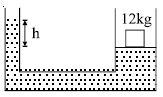
- 2The area of cross-section of the wider tube shown in figure is $800$ $cm^2$. If a mass of $12$ $ kg $ is placed on the massless piston, the difference in heights $h$ in the level of water in the two tubes is ........ $cm$View Solution
- 3View SolutionSelect wrong statement about pressure ..........
- 4A nurse measures the blood pressure of a seated patient to be $190 \,mm$ of $Hg$.View Solution
- 5View SolutionAn ice cube contains a large air bubble. The cube is floating on the horizontal surface of water contained in a trough. What will happen to the water level, when the cube melts?
- 6A cylindrical vessel open at the top is $20$ $cm $ high and $10$ $cm$ in diameter. A circular hole whose cross-sectional area $1$ $cm^2$ is cut at the centre of the bottom of the vessel. Water flows from a tube above it into the vessel at the rate $100$ $cm^3$ $s^{^{-1}}$. The height of water in the vessel under steady state is ....... $cm$ (Take $g$ $=$ $1000 $ $cm s^{^{-2}})$View Solution
- 7$Assertion :$ For Reynold’s number $Re > 2000$, the flow of fluid is turbulent.View Solution
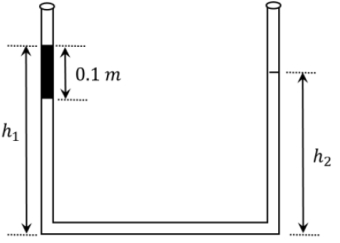
$Reason :$ Inertial forces are dominant compared to the viscous forces at such high Reynold’s numbers. - 8An open-ended U-tube of uniform cross-sectional area contains water (density $10^3 kg m ^{-3}$ ). Initially the water level stands at $0.29 m$ from the bottom in each arm. Kerosene oil (a water-immiscible liquid) of density $800 kg m ^{-3}$ is added to the left arm until its length is $0.1 m$, as shown in the schematic figure below. The ratio $\left(\frac{h_1}{h_2}\right)$ of the heights of the liquid in the two arms is-View Solution
- 9A copper ball of radius $'r'$ travels with a uniform speed $'v'$ in a viscous fluid. If the ball is changed with another ball of radius $'2r'$ , then new uniform speed will beView Solution
- 10A small drop of water falls from rest through a large height $h$ in air; the final velocity isView Solution