Question
A jet engine works on the principle of

Answer

(c)

Equilibrium of Forces
 

Need a full question paper?

Generate a complete, print-ready paper with questions like this in minutes — across 16+ boards, with answer keys.
Start Generating Free

Similar questions

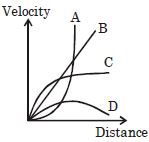
A small spherical solid ball is dropped in a viscous liquid. Its journey in the liquid is best  described in the figure drawn by:-
A stone of mass $0.3\,kg$ attached to a $1.5\,m$ long string is whirled around in a horizontal circle at a speed of $6\,m s ^{-1}$. The tension in the string is $............\,N$
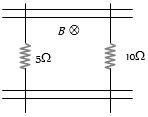
A pair of parallel conducting rails lie at right angle to a uniform magnetic field of $2.0\, T$ as shown in the fig. Two resistors $10 \Omega$ and $5 \Omega$ are to slide without friction along the rail. The distance between the conducting rails is $0.1\, m$. Then
A wire of length $L$ and $3$ identical cells of negligible internal resistances are connected in series. Due to current, the temperature of the wire is raised by $\Delta T$ in a time $t$. A number $N$ of similar cells is now connected in series with a wire of the same material and cross-section but of length $2\, L$. The temperature of the wire is raised by the same amount $\Delta T$ in the same time $t$. the value of $N$ is
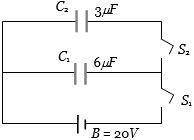
In the circuit shown here ${C_1} = 6\,\mu F,\;{C_2} = 3\,\mu F$ and battery $B = 20\,V$. The switch ${S_1}$ is first closed. It is then opened and afterwards ${S_2}$ is closed. What is the charge finally on ${C_2}$.......$\mu C$
Identify the pair which has different dimensions
The specific resistance of a wire is $\rho $, its volume is $3\,{m^3}$ and its resistance is $3\, ohms$, then its length will be
Two vectors $\dot{A}$ and $\dot{B}$ are defined as $\dot{A}=a \hat{i}$ and $\overrightarrow{\mathrm{B}}=\mathrm{a}(\cos \omega t \hat{\mathrm{i}}+\sin \omega t \hat{j}$ ), where a is a constant and $\omega=\pi / 6 \mathrm{rad} \mathrm{s}^{-1}$. If $|\overrightarrow{\mathrm{A}}+\overrightarrow{\mathrm{B}}|=\sqrt{3}|\overrightarrow{\mathrm{A}}-\overrightarrow{\mathrm{B}}|$ at time $t=\tau$ for the first time, the value of $\tau$, in, seconds, is. . . . . .
The displacement of a body executing $SHM$ is given by $x = A \sin (2\pi t + \pi /3).$ The first time from $t = 0$ when the velocity is maximum is .... $\sec$
If the temperature of the atmosphere is increased the following character of the sound wave is effected