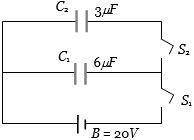
In the circuit shown here ${C_1} = 6\,\mu F,\;{C_2} = 3\,\mu F$ and battery $B = 20\,V$. The switch ${S_1}$ is first closed. It is then opened and afterwards ${S_2}$ is closed. What is the charge finally on ${C_2}$.......$\mu C$
Diffcult
Download our app for free and get started
(c) Common potential $V = \frac{{6 \times 20 + 3 \times 0}}{{(6 + 3)}} = \frac{{120}}{9}\,Volt$
So, charge on $3\,\mu F$ capacitor
${Q_2} = 3 \times {10^{ - 6}} \times \frac{{120}}{9} = 40\,\mu C$
So, charge on $3\,\mu F$ capacitor
${Q_2} = 3 \times {10^{ - 6}} \times \frac{{120}}{9} = 40\,\mu C$

Download our appand get started for free
Experience the future of education. Simply download our apps or reach out to us for more information. Let's shape the future of learning together!No signup needed.*
Similar Questions
- 1A molecule with a dipole moment $p$ is placed in an electric field of strength $E$. Initially the dipole is aligned parallel to the field. If the dipole is to be rotated to be anti-parallel to the field, the work required to be done by an external agent isView Solution
- 2Two plates are $2\,cm$ apart, a potential difference of $10\;volt$ is applied between them, the electric field between the plates is.........$N/C$View Solution
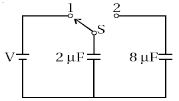
- 3A capacitor of $2\,\, \mu F$ is charged as shown in the diagram. When the switch $S$ is turned to position $2,$ the percentage of its stored energy dissipated is ......$\%$View Solution
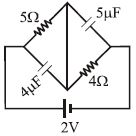
- 4Find the ratio of energy stored in $5\,\mu F$ and $4\,\mu F$ capacitor in the given circuit in steady stateView Solution
- 5Two capacitors of capacitances $1\ \mu F$ and $3\ \mu F$ are charged to the same voltages $5\,V$. They are connected in parallel with oppositely charged plates connected together. Then:View Solution
- 6If $3$ charges are placed at the vertices of equilateral triangle of charge ‘$q$’ each. What is the net potential energy, if the side of equilateral triangle is $l\, cm$View Solution
- 7Two identical positive charges are placed on the $y$-axis at $y=-a$ and $y=+a$. The variation of $V$ (electric potential) along $x$-axis is shown by graphView Solution
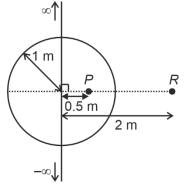
- 8An infinitely long thin wire, having a uniform charge density per unit length of $5 nC / m$, is passing through a spherical shell of radius $1 m$, as shown in the figure. A $10 nC$ charge is distributed uniformly over the spherical shell. If the configuration of the charges remains static, the magnitude of the potential difference between points $P$ and $R$, in Volt, is. . . .View Solution
[Given: In SI units $\frac{1}{4 \pi \in_0}=9 \times 10^9, \ln 2=0.7$. Ignore the area pierced by the wire.]
- 9An electric dipole of moment $p$ is placed in an electric field of intensity $E.$ The dipole acquires a position such that the axis of the dipole makes an angle $\theta$ with the direction of the field. Assuming that the potential energy of the dipole to be zero when $\theta = 90^o$ , the torque and the potential energy of the dipole will respectively beView Solution
- 10A capacitor is charged to $200\, volt$ it has $0.1$ coulomb charge. When it is discharged, energy will be.....$J$View Solution