MCQ
A juggler throws balls vertically upwards with same initial velocity in air. When the first ball reaches its highest position, he throws the next ball. Assuming the juggler throws $n$ balls per second, the maximum height the balls can reach is
  • A
    $g / 2 n$
  • B
    $g / n$
  • C
    $2 g n$
  • $g / 2 n^{2}$

Answer

Correct option: D.
$g / 2 n^{2}$
d
Time taken by ball to reach highest point $=\frac{ u }{ g }$

Frequency of throw $=\frac{ g }{ u }= n$

$u =\frac{ g }{ n }$

$H _{\max }=\frac{ u ^{2}}{2 g }=\frac{\left(\frac{ g }{ n }\right)^{2}}{2 g }$

$\frac{g}{2 n^{2}}$

Need a full question paper?

Generate a complete, print-ready paper with questions like this in minutes — across 16+ boards, with answer keys.

Start Generating Free

Similar questions

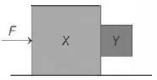
Consider the system shown below. A horizontal force $F$ is applied to a block $X$ of mass $8 \,kg$, such that the block $Y$ of mass $2 \,kg$ adjacent to it does not slip downwards under gravity. There is no friction between the horizontal plane and the base of the block $X$. The coefficient of friction between the surfaces of blocks $X$ and $Y$ is $0.5$. The minimum value of $F$ is ............ $N$ (take, acceleration due to gravity to be $10 \,ms ^{-2}$ )
In a surface tension experiment with a capillary tube water rises upto $0.1\, m$. If the same experiment is repeated on an artificial satellite, which is revolving around the earth, water will rise in the capillary tube upto a height of
Shown here are the velocities and acceleration vectors for a man in several different types of motion. In which case is the man slowing down and turning to the right
A string breaks if its tension exceeds $10$ newtons. A stone of mass $250\, gm$ tied to this string of length $10 \,cm$ is rotated in a horizontal circle. The maximum angular velocity of rotation can be ..........  $rad/s$
A block of mass $m$ is placed on a surface with a vertical cross section given by $y = \frac{{{x^3}}}{6}$ If the coefficient of friction is $0.5$,the maximum height above the ground at which the block can be placed without slipping is:
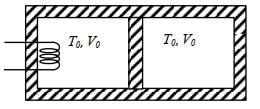
A thermally insulating cylinder has a thermally insulating and frictionless movable partition in the middle, as shown in the figure below. On each side of the partition, there is one mole of an ideal gas, with specific heat at constant volume, $C_v=2 R$. Here, $R$ is the gas constant. Initially, each side has a volume $V_0$ and temperature $T_0$. The left side has an electric heater, which is turned on at very low power to transfer heat $Q$ to the gas on the left side. As a result the partition moves slowly towards the right reducing the right side volume to $V_0 / 2$. Consequently, the gas temperatures on the left and the right sides become $T_L$ and $T_R$, respectively. Ignore the changes in the temperatures of the cylinder, heater and the partition.

($1$) The value of $\frac{T_R}{T_0}$ is

$(A)$ $\sqrt{2}$ $(B)$ $\sqrt{3}$ $(C)$ $2$ $(D)$ $3$

($2$) The value of $\frac{Q}{R T_0}$ is

$(A)$ $4(2 \sqrt{2}+1)$ $(B)$ $4(2 \sqrt{2}-1)$ $(C)$ $(5 \sqrt{2}+1)$ $(D)$ $(5 \sqrt{2}-1)$

Give the answer or qution ($1$) and ($2$)

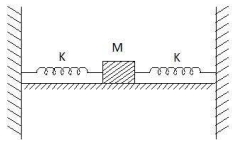
In the figure given below. a block of mass $M =490\,g$ placed on a frictionless table is connected with two springs having same spring constant $\left( K =2 N m ^{-1}\right)$. If the block is horizontally displaced through ' $X$ 'm then the number of complete oscillations it will make in $14 \pi$ seconds will be $.........$
A guitar string of length $90\,cm$ vibrates with a fundamental frequency of $120\,Hz.$ The length of the string producing a fundamental frequency of $180\,Hz$ will be $...........cm$.
Two identical satellites are at $R$ and $7R$ away from earth surface, the wrong statement is ($R $ = Radius of earth)
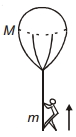
A man of mass $m$ is suspended in air by holding the rope of a balloon of mass $M$. As the man climbs up the rope, the balloon