MCQ
A juggler throws balls vertically upwards with same initial velocity in air. When the first ball reaches its highest position, he throws the next ball. Assuming the juggler throws $n$ balls per second, the maximum height the balls can reach is
  • A
    $g / 2 n$
  • B
    $g / n$
  • C
    $2 g n$
  • $g / 2 n^{2}$

Answer

Correct option: D.
$g / 2 n^{2}$
d
Time taken by ball to reach highest point $=\frac{ u }{ g }$

Frequency of throw $=\frac{ g }{ u }= n$

$u =\frac{ g }{ n }$

$H _{\max }=\frac{ u ^{2}}{2 g }=\frac{\left(\frac{ g }{ n }\right)^{2}}{2 g }$

$\frac{g}{2 n^{2}}$

Need a full question paper?

Generate a complete, print-ready paper with questions like this in minutes — across 16+ boards, with answer keys.

Start Generating Free

Similar questions

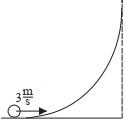
A hollow spherical ball of uniform density rolls up a curved surface with an initial velocity $3\, m / s$ (as shown in figure). Maximum height with respect to the initial position covered by it will be $...........cm$.
For a particular resonance tube, following are four of the six harmonics below $1000 Hz$; $300,600,750$ and $900 \,Hz$. The two missing harmonics are
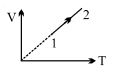
An ideal gas undergoes the process $1 \rightarrow 2$ as shown in the figure, the heat supplied and work done in the process is $\Delta \,\,Q$ and $\Delta \,\,W$ respectively. The ratio $\Delta \,\,Q :$ $\Delta \,\,W$ is
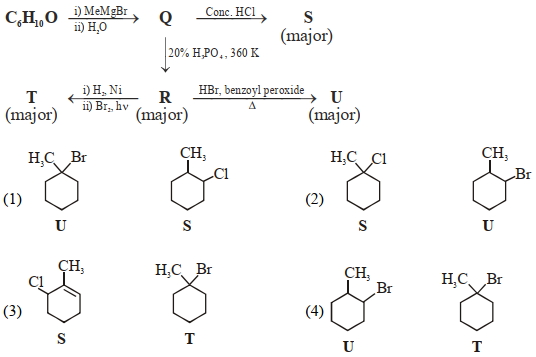
Choose the correct option($s$) for the following set of reactions
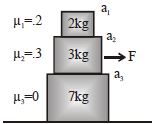
Find the acceleration of $a_1, a_2$ and $a_3$. If $10\,N$ force $F$ is applied on $3\,kg$ block :-
The ratio of the kinetic energy to the total energy of an electron in a Bohr orbit is
The equation of a simple harmonic motion is $X = 0.34\cos (3000t + 0.74)$ where $X$ and $t$ are in $mm$ and $sec$. The frequency of motion is
$A$ cone of radius $r$ and height $h$ rests on a rough horizontal surface, the coefficient of friction between the cone and the surface being $\mu$ . $A$ gradually increasing horizontal force $F$ is applied to the vertex of the cone. The largest value of $\mu$ for which the cone will slide before it topples is
A black body at $200 K$ is found to exit maximum energy at a wavelength of $14\mu m$. When its temperature is raised to $1000K$ , the wavelength at which maximum energy is emitted is
The angle of prism is $30^o$. The rays incident at an angle of $60^o$ at one refracting face suffer a deviation of $30^o$. Then the angle of emergence is......$^o$