The equation of a simple harmonic motion is $X = 0.34\cos (3000t + 0.74)$ where $X$ and $t$ are in $mm$ and $sec$. The frequency of motion is
Easy
Download our app for free and get started
From given equation $\omega = 3000,$
==> $n = \frac{\omega }{{2\pi }} = \frac{{3000}}{{2\pi }}$

Download our appand get started for free
Experience the future of education. Simply download our apps or reach out to us for more information. Let's shape the future of learning together!No signup needed.*
Similar Questions
- 1The potential energy of a particle of mass $1\, kg$ in motion along the $x-$ axis is given by $U = 4\,(1 -cos\,2x)$, where $x$ is in $metres$ . The period of small oscillation (in $second$ ) isView Solution
- 2Two simple harmonic motions are represented by the equations ${y_1} = 0.1\sin \left( {100\pi t + \frac{\pi }{3}} \right)$ and ${y_2} = 0.1\cos \pi t.$ The phase difference of the velocity of particle $1$ with respect to the velocity of particle $2$ isView Solution
- 3Force constant of a spring is $K$ . If half part is detached then force constant of the remaining spring will beView Solution
- 4Two pendulums have time periods $T$ and $\frac{{5T}}{4}.$They start $S.H.M.$ at the same time from the mean position. What will be the phase difference between them after the bigger pendulum has complete one oscillation ..... $^o$View Solution
- 5The period of oscillation of a simple pendulum of length $L$ suspended from the roof of a vehicle which moves without friction down an inclined plane of inclination $\alpha$, is given byView Solution
- 6If the displacement of a particle executing $SHM $ is given by $y = 0.30\sin (220t + 0.64)$ in metre, then the frequency and maximum velocity of the particle isView Solution
- 7A pendulum clock that keeps correct time on the earth is taken to the moon it will run (it is given that $g_{Moon} = g_{Earth}/6$ )View Solution
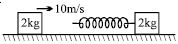
- 8A $2\, Kg$ block moving with $10\, m/s$ strikes a spring of constant $\pi ^2 N/m$ attached to $2\, Kg$ block at rest kept on a smooth floor. The time for which rear moving block remain in contact with spring will be ... $\sec$View Solution
- 9Time period of a particle executing $SHM$ is $8\, sec.$ At $t = 0$ it is at the mean position. The ratio of the distance covered by the particle in the $1^{st}$ second to the $2^{nd}$ second is :View Solution
- 10The ratio of frequencies of two pendulums are $2 : 3$, then their length are in ratioView Solution