Question
A lady cannot see objects closer than 40cm from the left eye and closer than 100cm from the right eye. While on a mountaineering trip, she is lost from her team. She tries to make an astronomical telscope from her reading glasses to look for her teammates.
  1. Which glass should she use as the eyepiece?
  2. What magnification can she get with relaxed eye?
Answer

The lady can not see objects closer than 40cm from the left eye and 100cm from the right eye.For the left glass lens,
v = -40cm,
u = -25cm 
$\therefore \frac{1}{\text{f}}=\frac{1}{\text{v}}-\frac{1}{\text{u}}=\frac{1}{-40}-\frac{1}{-25}=\frac{1}{25}-\frac{1}{40}=\frac{3}{200}$
$\Rightarrow \text{f}=\frac{200}{3}\text{cm}$
For the right glass lens,
v = -100cm,
u = -25cm
$\frac{1}{\text{f}}=\frac{1}{\text{v}}-\frac{1}{\text{u}}=\frac{1}{-100}-\frac{1}{-25}=\frac{1}{100}=\frac{3}{100}$
$\Rightarrow\text{f}=\frac{100}{3}\text{cm}$
  1. For an astronomical telescope, the eye piece lens should have smaller focal length. So, she should
use the right lens $\big(\text{f}=\frac{100}{3}\text{cm}\big)$ as the eye piece lens.
  1. With relaxed eye, (normal adjustment)
$\text{f}_0=\frac{200}{3}\text{cm}$
$\text{f}_\text{e}=\frac{100}{3}\text{cm}$
magnification $=\text{m}=\frac{\text{f}_0}{\text{f}_\text{e}}=\frac{\big(\frac{200}{3}\big)}{\big( \frac{100}{3}\big)}=2$

Need a full question paper?

Generate a complete, print-ready paper with questions like this in minutes — across 16+ boards, with answer keys.

Start Generating Free

Similar questions

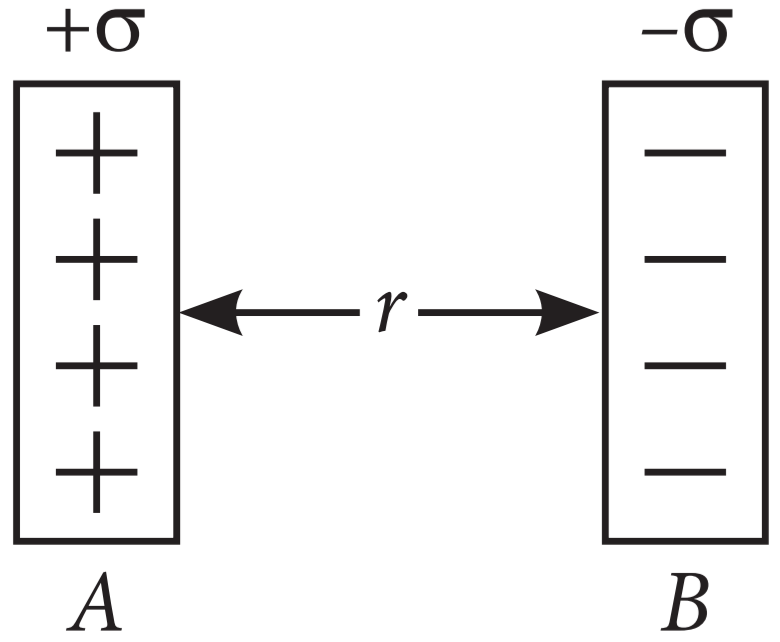
Surface charge density is defined as charge per unit surface area of surface charge distribution. i.e., $\sigma=\frac{\text{dq}}{\text{dS}}.$ Two large, thin metal plates are parallel and close to each other. On their inner faces, the plates have surface charge densities of opposite signs having magnitude of $17.0 \times 10^{-22}Cm^{-2 }$ as shown. The intensity of electric field at a point is $\text{E}=\frac{\sigma}{\epsilon_0},$ where $\epsilon_0=$ permittivity of free space.
  1. $E$ in the outer region of the first plate is:
  1. $17 \times 10^{-22} N/C$
  2. $1.5 \times 10^{-25} N/C$
  3. $1.9 \times 10^{-10} N/C$
  4. Zero.
  1. $E$ in the outer region of the second plate is:
  1. $17 \times 10^{-22} N/C$
  2. $1.5 \times 10^{-15} N/C$
  3. $1.9 \times 10^{-10} N/C$
  4. Zero.
  1. $E$ between the plates is:
  1. $17 \times 10^{-22} N/C$
  2. $1.5 \times 10^{-15} N/C$
  3. $1.9 \times 10^{-10} N/C$
  4. Zero.
  1. The ratio of $E$ from right side of $B$ at distances $2\ cm$ and $4\ cm,$ respectively is:
  1. $1 : 2$
  2. $2 : 1$
  3. $1 : 1$
  4. $1:\sqrt{2}$
  1. ln order to estimate the electric field due to a thin finite plane metal plate, the Gaussian surface considered is:
  1. Spherical.
  2. Spherical.
  3. Straight line.
  4. None of these.
Find the change in the volume of $1.0$ litre kerosene when it is subjected to an extra pressure of $2.0 \times 10^5N/m^2$ from the following data. Density of kerosene $= 800\ kg/m^3$ and speed of sound in kerosene $= 1330m/s.$
(a) Define mutual inductance and write its S.I. unit.
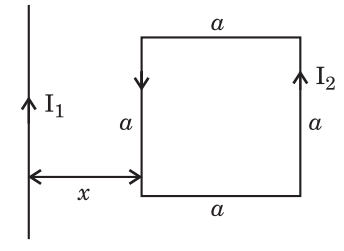
(b) A square loop of side 'a' carrying a current $I_{2}$ is kept at distance x from an infinitely long straight wire carrying a current $I_{1}$ as shown in the figure. Obtain the expression for the resultant force acting on the loop.
Image
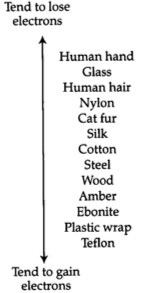
The triboelectric series is a list that ranks materials according to their tendency to gain or lose electrons. The process of electron transfer as a result of two objects coming into contact with one another and then separating is called triboelectric charging. During such an interaction, one of the two objects will always gain electrons (becoming negatively charged) and the other object will lose electrons (becoming positively charged). The relative position of the two objects on the triboelectric series will define which object gains electrons and which object loses electrons.
In triboelectric series, materials are ranked from high to low in terms of the tendency for the material to lose electron. If an object high up on this list (Glass, for example) is rubbed with an object low down on the list (Teflon, for example), the glass will lose electrons to the teflon. The glass will, in this case, become positively charged and the teflon will become negatively charged. Materials in the middle of the list (steel and wood, for example) are items those do not have a strong tendency to give up or accept electrons.
Image
(i) Materials in the upper position have ________ tendency to become positively charged
(a) no (b) medium (c) high (d) low
(ii) Name two materials which do not have a strong tendency to give up or accept electrons.
(a) Steel, wood (b) Plastic wrap, Teflon (c) Ebonite, Nylon (d) Nylon, cat fur
(iii) if human hair is rubbed with amber, how those will be charged?
(a) Hair will be negatively charged, Amber will be positively charged.
(b) Both positive
(c) Hair will be positively charged, Amber will be negatively charged.
(d) Both negative
(iv) Triboelectric charging is the process of electron transfer between two objects
(a) By contact (b) Without contact (c) By anyone of these (d) By none of these

OR

The object which loses electron becomes ________ charged and the object gains electron becomes ________ charged.
(a) positively, positively
(b) negatively, positively
(c) negatively, negatively
(d) positively, negatively
In tug of war, the team that exerts a larger tangential force on the ground wins. Consider the period in which a team is dragging the opposite team by applying a larger tangential force on the ground. List which of the following works are positive, which are negative and which are zero?
  1. Work by the winning team on the losing team.
  2. Work by the losing team on the winning team.
  3. Work by the ground on the winning team.
  4. Work by the ground on the losing team.
  5. Total external work on the two teams.
Hydrogen is the simplest atom of nature.
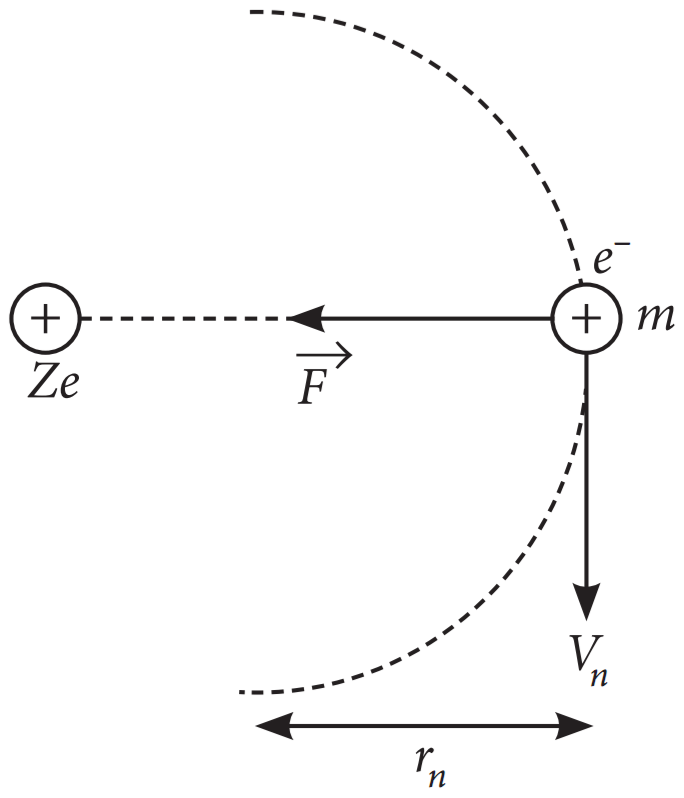
There is one proton in its nucleus and an electron moves around the nucleus in a circular orbit.
According to Niels Bohr, this electron moves in a stationary orbit. When this electron is in the stationary orbit, it emits no electromagnetic radiation.The angular momentum of the electron is quantized, i.e., ⁣$\text{mvr}=\big(\frac{\text{nh}}{2\pi}\big)$ where $m =$ mass of the electron $, v =$ velocity of the electron in the orbit $, r =$ radius of the orbit and $n = 1, 2, 3, ....$ When transition takes place from $K^{th}$ orbit to $J^{th}$ orbit, energy photon is emitted. If the wavelength of the emitted photon is $\lambda$ we find that $\frac{1}{\lambda}=\text{R}\bigg[\frac{1}{\text{J}^2}-\frac{1}{\text{K}^2}\bigg]$ where find that On a different planet, the hydrogen atom's structure was somewhat different from ours. The angular momentum of electron was $\text{P}=2\text{n}\Big(\frac{\text{h}}{2\pi}\Big)$ i.e., an even multiple of $\Big(\frac{\text{h}}{2\pi}\Big)$.
  1. The minimum permissible radius of the orbit will be.
  1. $\frac{2\epsilon_0\text{h}^2}{\text{m}\pi\text{e}^2}$
  2. $\frac{4\epsilon_0\text{h}^2}{\text{m}\pi\text{e}^2}$
  3. $\frac{\epsilon_0\text{h}^2}{\text{m}\pi\text{e}^2}$
  4. $\frac{\epsilon_0\text{h}^2}{\text{2m}\pi\text{e}^2}$
  1. In our world, the velocity of electron is $v_0$ when the hydrogen atom is in the ground state. The velocity of electron in this state on the other planet should be.
  1. $\text{v}_0$
  2. $\frac{\text{v}_0}{2}$
  3. $\frac{\text{v}_0}{4}$
  4. $\frac{\text{v}_0}{8}$
  1. In our world, the ionization potential energy of a hydrogen atom is $13.6eV.$ On the other planet, this ionization potential energy will be.
  1. $13.6eV$
  2. $3.4eV$
  3. $1.5eV$
  4. $0.85eV$
  1. Check the correctness of the following statements about the Bohr model of hydrogen atom.
  1. The acceleration of the electron in $n = 2$ orbit is more than that in $n = 1$ orbit.
  2. The angular momentum of the electron in $n = 2$ orbit is more than that in $n = 1$ orbit.
  3. The kinetic energy of the electron in $n = 2$ orbit is less than that in $n = 1$ orbit.
  1. Only $(III)$ and $(I)$ are correct
  2. Only $(III)$ and $(I)$ are correct
  3. Only $(II)$ and $(III)$ are correct.
  4. All the statements are correct.
  1. In Bohr's model of hydrogen atom, let $PE$ represent potential energy and $TE$ the total energy. In going to a higher orbit.
  1. $PE$ increases $,TE$ decreases
  2. $PE$ decreases $,TE$ increases
  3. $PE$ increases $,TE$ increases
  4. $PE$ decreases $,TE$ decreases
Light of wavelength 488 nm is produced by an argon laser which is used in the photoelectric effect. When light from this spectral line is incident on emitter, the stopping (cut-off) potential of photoelectrons is 0.38 V. Find the work function of the material from which material is made.
Two long bar magnets are placed with their axes coinciding in such a way that the north pole of the first magnet is 2·0cm from the south pole of the second. If both the magnets have a pole strength of 10A-m, find the force exerted by one magnet on the other.
An elevator is descending with uniform acceleration. To measure the acceleration, a person in the elevator drops a coin at the moment the elevator starts. The coin is 6ft above the floor of the elevator at the time it is dropped. The person observes that the coin strikes the floor in 1 second. Calculate from these data the acceleration of the elevator.
Drive the formula for the magnifying power of a compound microscope if the final images formed at Infinity. Draw the necessary diagram.