Question
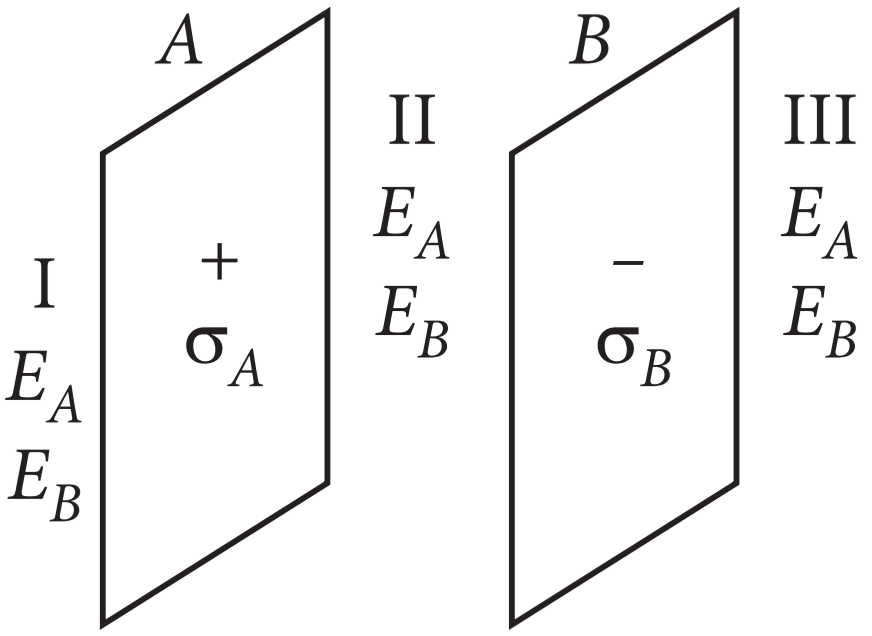
Surface charge density is defined as charge per unit surface area of surface charge distribution. i.e., $\sigma=\frac{\text{dq}}{\text{dS}}.$ Two large, thin metal plates are parallel and close to each other. On their inner faces, the plates have surface charge densities of opposite signs having magnitude of $17.0 \times 10^{-22}Cm^{-2 }$ as shown. The intensity of electric field at a point is $\text{E}=\frac{\sigma}{\epsilon_0},$ where $\epsilon_0=$ permittivity of free space.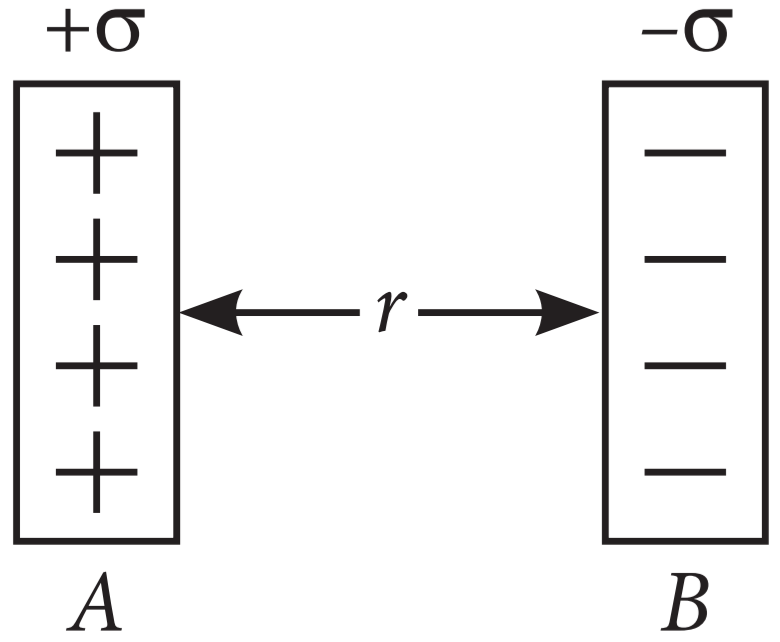
- $E$ in the outer region of the first plate is:
- $17 \times 10^{-22} N/C$
- $1.5 \times 10^{-25} N/C$
- $1.9 \times 10^{-10} N/C$
- Zero.
- $E$ in the outer region of the second plate is:
- $17 \times 10^{-22} N/C$
- $1.5 \times 10^{-15} N/C$
- $1.9 \times 10^{-10} N/C$
- Zero.
- $E$ between the plates is:
- $17 \times 10^{-22} N/C$
- $1.5 \times 10^{-15} N/C$
- $1.9 \times 10^{-10} N/C$
- Zero.
- The ratio of $E$ from right side of $B$ at distances $2\ cm$ and $4\ cm,$ respectively is:
- $1 : 2$
- $2 : 1$
- $1 : 1$
- $1:\sqrt{2}$
- ln order to estimate the electric field due to a thin finite plane metal plate, the Gaussian surface considered is:
- Spherical.
- Spherical.
- Straight line.
- None of these.