Question
A lady cannot see objects closer than 40cm from the left eye and closer than 100cm from the right eye. While on a mountaineering trip, she is lost from her team. She tries to make an astronomical telscope from her reading glasses to look for her teammates.
  1. Which glass should she use as the eyepiece?
  2. What magnification can she get with relaxed eye?

Answer

The lady can not see objects closer than 40cm from the left eye and 100cm from the right eye.

For the left glass lens,

v = -40cm,

u = -25cm 

$\therefore \frac{1}{\text{f}}=\frac{1}{\text{v}}-\frac{1}{\text{u}}=\frac{1}{-40}-\frac{1}{-25}=\frac{1}{25}-\frac{1}{40}=\frac{3}{200}$

$\Rightarrow \text{f}=\frac{200}{3}\text{cm}$

For the right glass lens,

v = -100cm,

u = -25cm

$\frac{1}{\text{f}}=\frac{1}{\text{v}}-\frac{1}{\text{u}}=\frac{1}{-100}-\frac{1}{-25}=\frac{1}{100}=\frac{3}{100}$

$\Rightarrow\text{f}=\frac{100}{3}\text{cm}$

  1. For an astronomical telescope, the eye piece lens should have smaller focal length. So, she should

use the right lens $\big(\text{f}=\frac{100}{3}\text{cm}\big)$ as the eye piece lens.

  1. With relaxed eye, (normal adjustment)

$\text{f}_0=\frac{200}{3}\text{cm}$

$\text{f}_\text{e}=\frac{100}{3}\text{cm}$

magnification $=\text{m}=\frac{\text{f}_0}{\text{f}_\text{e}}=\frac{\big(\frac{200}{3}\big)}{\big( \frac{100}{3}\big)}=2$
Need a full question paper?

Generate a complete, print-ready paper with questions like this in minutes — across 16+ boards, with answer keys.

Start Generating Free

Similar questions

The dimensions $\text{ML}^{-1}\text{T}^{-2}$ may correspond to:
  1. Work done by a force.
  2. Linear momentum.
  3. Pressure.
  4. Energy per unit volume.
A plumb bob is hung from the ceiling of a train compartment. If the train moves with an acceleration 'a' along a straight horizontal track, the string supporting the bob makes an angle $\tan^{-1}\Big(\frac{\text{a}}{\text{g}}\Big)$ with the normal to the ceiling. Suppose the train moves on an inclined straight track with uniform velocity. If the angle of incline is $\tan^{-1}\Big(\frac{\text{a}}{\text{g}}\Big),$ the string again makes the same angle with the normal to the ceiling. Can a person sitting inside the compartment tell by looking at the plumb line whether the train is accelerated on a horizontal straight track or it is going on an incline? If yes, how? If no, suggest a method to do so.
Read the passage given below and answer the following questions from 1 to 5.

PE of Spring

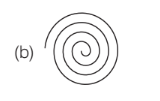
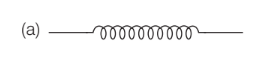
There are many types of spring. Important among these are helical and spiral springs as shown in figure.

Usually, we assume that the springs are massless. Therefore, work done is stored in the spring in the form of elastic potential energy of the spring. Thus, potential energy of a spring is the energy associated with the state of compression or expansion of an elastic spring.
 

  1. The potential energy of a body is increases in which of the following cases?
  1. If work is done by conservative force
  2. If work is done against conservative force
  3. If work is done by non-conservative force
  4. If work is done against non- conservative force
  1. The potential energy, i.e. U (x) can be assumed zero when:
  1. x = 0
  2. gravitational force is constant
  3. infinite distance from the gravitational source
  4. All of the above
  1. The ratio of spring constants of two springs is 2 : 3. What is the ratio of their potential energy, if they are stretched by the same force?
  1. 2 : 3
  2. 3 : 2
  3. 4 : 9
  4. 9 : 4
  1. The potential energy of a spring increases by 15 J when stretched by 3cm. If it is stretched by 4cm, the increase in potential energy is:
  1. 27 J
  2. 30 J
  3. 33 J
  4. 36 J
  1. The potential energy of a spring when stretched through a distance x is 10 J. What is the amount of work done on the same spring to stretch it through an additional distance x?
  1. 10 J
  2. 20 J
  3. 30 J
  4. 40 J
A batsman deflects a ball by an angle of 45º without chainging its initial speed which is equal to 54 km/h. What is the impulse imparted to the ball? (Mass of the ball is 0.15 kg.)
Certain collisions are referred to as elastic collisions. Elastic collisions are collisions in which both momentum and kinetic energy are conserved. The total system kinetic energy before the collision equals the total system kinetic energy after the collision. If total kinetic energy is not conserved, then the collision is referred to as an inelastic collision.
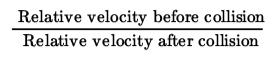
The coefficient of restitution, denoted by (e), is the measure of degree elasticity of collision. It is defined as the ratio of the final to inital relative speed between two objects after they collide. It normally ranges from 0 to 1 where 1 would be a perfectly elastic collision. A perfectly inelastic collision has a coefficient of 0 . In real life most of the collisions are neither perfectly elastic nor perfectly inealstic and $0< e <1$.

1. The following are the data of a collision between a truck and a car.
Mass of the car $=1000 kg$
Mass of the truck $=3000 kg$
Mass of the truck Before collision:
Speed of the car $=20 m / s$
Momentum of the car $=20000 kg m / s$
Speed of the truck $=20 m / s$
Momentum of the truck $=60000 kg m / s$
After collision:
Speed of the car $=40 m / s$ in the opposite direction
Momentum of the car $=40000 kg m / s$ in the opposite direction
Speed of the truck $=0$
Momentum of the truck $=0$
The collision is
(a) Both elastic since kinetic energy and momentum is conserved
(b) Elastic since momentum is conserved
(c) Inelastic since kinetic energy is conserved
(d) Elastic since kinetic energy is conserved
2. The coefficient of restitution is the measure of
(a) Malleability of a substance    (b) Conductivity of a substance
(c) degree of elasticity of collision    (d) Elasticity of a substance
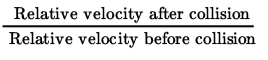
3. Coefficient of restitution is defined as
(a) 
Image
(b) Relative velocity after collision x relative velocity before collision
(c) Relative velocity after collision + relative velocity before collision
(d) 
Image
OR
In real life most of the collisions are
(a) Range of coefficient of restitution is 0 < e < 1
(b) both neither perfectly nor perfectly inelastic and range of coefficient of restitution is 0 < e < 1.
(c) neither perfectly elastic nor perfectly inelastic
(d) perfectly inelastic
4. For perfectly elastic and perfectly inelastic collision, the value of coefficient of restitution are respectively
(a) $+1,-1$    (b) 0,1    (c) $0,-1$    (d) 1,0
Explain why
(a) a horse cannot pull a cart and run in empty space.
(b) passengers are thrown forward from their seats when a speeding bus stops suddenly.
(c) it is easier to pull a lawn mower than to push it.
(d) a cricketer moves his hands backward while holding a catch.
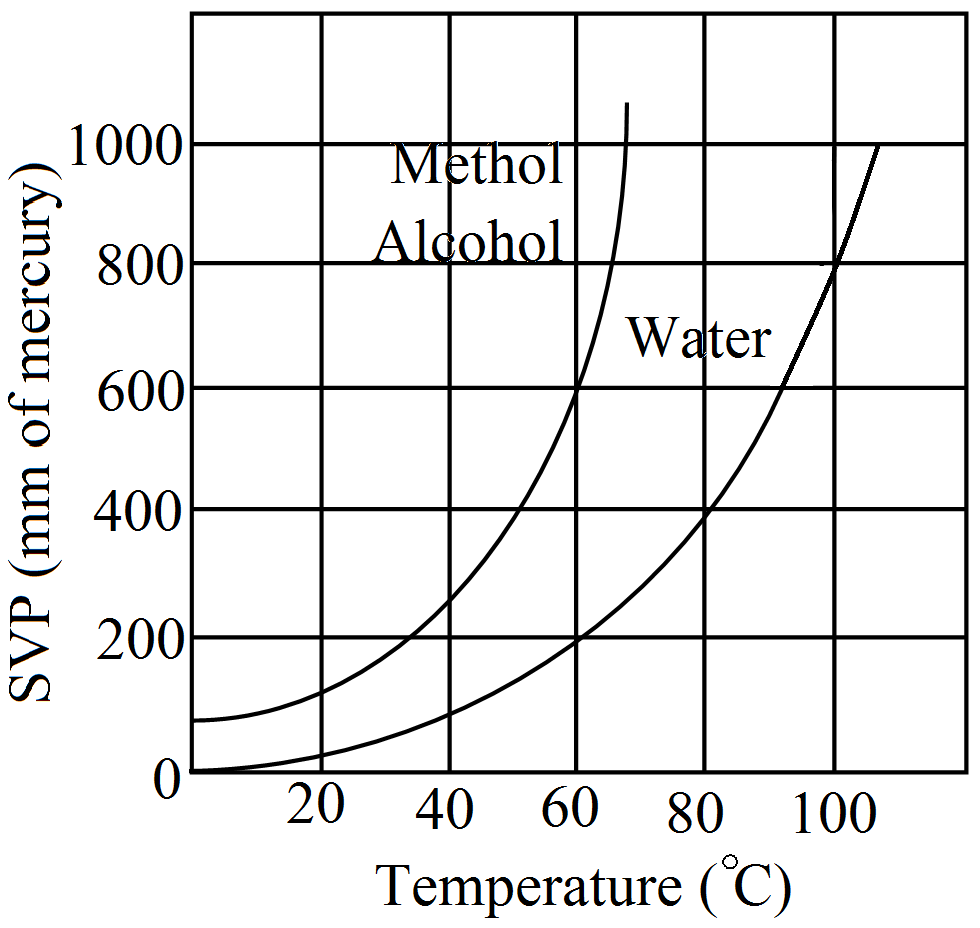
The human body has an average temperature of 98°F. Assume that the vapour pressure of the blood in the veins behaves like that of pure water. Find the minimum atmospheric pressure which is necessary to prevent the blood from boiling. Use figure. of the text for the vapour pressures.


Read the passage given below and answer the following questions from 1 to 5.

Rolling Motion
The rolling motion can be regarded as the combination of pure rotation and pure translation. It is also one of the most common motions observed in daily life.

Suppose the rolling motion (without slipping) of a circular disc on a level surface. At any instant, the point of contact P0 of the disc with the surface is at rest (as there is no slipping). If v CM is the velocity of centre of mass which is the geometric centre C of the disc, then the translational velocity of disc is v CM , which is parallel to the level surface. Velocity of centre of mass, $\text{V}_\text{cm}=\text{R}\omega$

  1. A solid cylinder is sliding on a smooth horizontal surface with velocity v0 without rotation. It enters on the rough surface. After that it has travelled some distance, the friction force increases its:
  1. translational kinetic energy
  2. rotational kinetic energy
  3. total mechanical energy
  4. angular momentum about an axis passing through point of contact of the cylinder and the surface
  1. A cylinder rolls down an inclined plane of inclination 30°, the acceleration of cylinder is:
  1. $\frac{\text{g}}{3}$
  2. g
  3. $\frac{\text{g}}{2}$
  4. $\frac{2g}{3}$
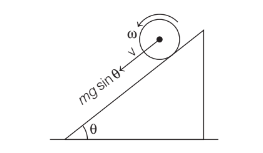
  1. Sphere is in pure accelerated rolling motion in the figure shown:

Choose the correct option.

  1. The direction of fs is upwards
  2. The direction of fs is downwards
  3. The direction of gravitational force is upwards
  4. The direction of normal reaction is downwards
  1. Kinetic energy of a rolling body will be:
  1. $\frac{1}{2}\text{mv}^2_\text{ cm}(\text{l}+\frac{\text{k}^2}{\text{R}^2}\big)$
  2. $\frac{1}{2}\text{I}\infty^2$
  3. $\frac{1}{2}\text{mv}^2\text{cm}$
  4. (d) None of the above
  1. A body is rolling down an inclined plane. Its translational and rotational kinetic energies are equal. The body is a:
  1. solid sphere
  2. hollow sphere
  3. solid cylinder
  4. hollow cylinder
The electron beam in a colour TV is accelerated through 32kV and then strikes the screen. What is the wavelength of the most energetic X-ray photon?
In the HCl molecule, the separation between the nuclei of the two atoms is about 1.27 Å $\left(1 Å=10^{-10} m\right)$. Find the approximate location of the CM of the molecule, given that a chlorine atom is about 35.5 times as massive as a hydrogen atom and nearly all the mass of an atom is concentrated in its nucleus.