Question
Explain why
(a) a horse cannot pull a cart and run in empty space.
(b) passengers are thrown forward from their seats when a speeding bus stops suddenly.
(c) it is easier to pull a lawn mower than to push it.
(d) a cricketer moves his hands backward while holding a catch.

Answer

(a) While pulling a cart, the horse pushes the earth with a force at similar but opposite reaction on the horse’s
hoof. The leading component of this reaction is responsible for the movement of the cart. Since there is no reaction in empty space, the horse isunable to pull the cart.
(b) Due to inertial motion, when a fast moving bus stops suddenly the lower part of the passenger sitting in the bus stops suddenly and the upper part of passenger wants to maintain the uniform speed. For this reason, when a fast moving bus stops. Suddenly the passenger falls forward.
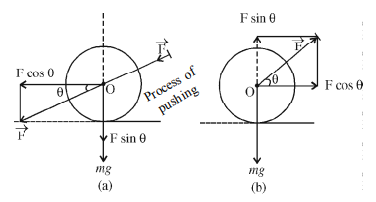
(c) The lawn mover as shown in figure, as point O. It has two stages as shown in figure. Pushing a lawn mover increases the effective load of lawn mover because the vertical component of the force adds to the load as shown in figure (a). While pulling the lawn mover reduces the effective load because the vertical component of the force adds to the weight. The vertical component of force decreases with the load as shown in figure (b).
Image
(d) A cricket player, while catching the ball, pulls his hands backward along with the ball because it takes more time to change momentum and less force has to be felt due to which the ball causes less pain in the player’s hand.

Need a full question paper?

Generate a complete, print-ready paper with questions like this in minutes — across 16+ boards, with answer keys.

Start Generating Free

Similar questions

A pipe 20 cm long is closed at one end. Which harmonic mode of the pipe is resonantly excited by a 430 Hz source? Will the same source be in resonance with the pipe if both ends are open? (Speed of sound in air is $340 ms^{-1}$).
Read the passage given below and answer the following questions from 1 to 5.
Power is defined as the time rate at which work is done or energy is transferred. The average power of a force is defined as the ratio of the work, W, to the total time t taken
Pav = W/t
The instantaneous power is defined as the limiting value of the average power as time interval approaches zero.
P = dw/dt
The work dW done by a force F for a displacement dr is dW = F.dr. The instantaneous power can also be expressed as
P = F.dr/dt
P = F.v
Where v is the instantaneous velocity when the force is F. Power, like work and energy, is a scalar quantity. Its dimensions are [ML2 T-3]. In the SI, its unit is called a watt (W). The watt is 1 J s-1. The unit of power is named after James Watt, one of the innovators of the steam engine in the eighteenth century. There is another unit of power, namely the horse-power (hp)
1 hp = 746W
This unit is still used to describe the output of automobiles, motorbikes.
  1. The time rate at which work is done or energy is transferred is called as:
  1. Energy
  2. Force
  3. Power
  4. None of these
  1. Limiting value of power as time interval approaches zero is called as:
  1. Average power
  2. Instantaneous power
  3. Both a and b
  4. None of these
  1. Power is directly proportional to:
  1. Force
  2. Velocity
  3. Both
  4. None of these
  1. Define instantaneous power. Give its SI unit and dimensions.
  1. 1 horse power is equal to how many watt?
In tug of war, the team that exerts a larger tangential force on the ground wins. Consider the period in which a team is dragging the opposite team by applying a larger tangential force on the ground. List which of the following works are positive, which are negative and which are zero?
  1. Work by the winning team on the losing team.
  2. Work by the losing team on the winning team.
  3. Work by the ground on the winning team.
  4. Work by the ground on the losing team.
  5. Total external work on the two teams.
(a) A child stands at the centre of a turntable with his two arms outstretched. The turntable is set rotating with an angular speed of 40 rev/min. How much is the angular speed of the child if he folds his hands back and thereby reduces his moment of inertia to 2/5 times the initial value? Assume that the turntable rotates wihout
friction.
(b) Show that the child’s new kinetic energy of rotation is more than the initial kinetic energy of rotation. How do you account for this increase in kinetic energy?
You are holding a cage containing a bird. Do you have to make less effort if the bird flies from its position in the cage and manages to stay in the middle without touching the walls of the cage? Does it make a difference whether the cage is completely closed or it has rods to let air pass?
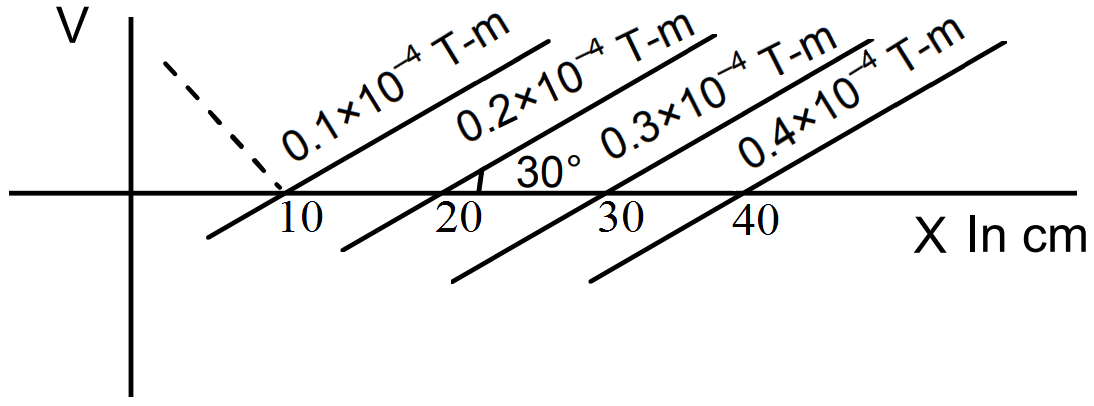
Figure shows some of the quipotential surfaces of the magnetic scalar potential. Fmd the magnetic field B at a point in the region.

The plate current, plate voltage and grid voltage of a 6F6 triode tube are related as $\text{i}_\text{p}=41(\text{V}_\text{p}+7\text{V}_\text{g})^{1.41}$ where Vp and Vg are in volts and ip in microamperes. The tube is operated at Vp = 250V, Vg = -20V. Calculate (a) the tube current, (b) the plate resistance, (c) the mutual conductance and (d) the amplification factor.
When the diode shows saturated current, dynamic place resistance is:
  1. Zero.
  2. Infinity.
  3. Indeterminate.
  4. Different for different diodes.
A triode has mutual conductance = 2.0milli mho and plate resistance $=20\text{k}\Omega$ It is desired to amplify a signal by a factor of 30. What load resistance should be added in the circuit?