Question
Read the passage given below and answer the following questions from 1 to 5.

Rolling Motion
The rolling motion can be regarded as the combination of pure rotation and pure translation. It is also one of the most common motions observed in daily life.

Suppose the rolling motion (without slipping) of a circular disc on a level surface. At any instant, the point of contact P0 of the disc with the surface is at rest (as there is no slipping). If v CM is the velocity of centre of mass which is the geometric centre C of the disc, then the translational velocity of disc is v CM , which is parallel to the level surface. Velocity of centre of mass, $\text{V}_\text{cm}=\text{R}\omega$

  1. A solid cylinder is sliding on a smooth horizontal surface with velocity v0 without rotation. It enters on the rough surface. After that it has travelled some distance, the friction force increases its:
  1. translational kinetic energy
  2. rotational kinetic energy
  3. total mechanical energy
  4. angular momentum about an axis passing through point of contact of the cylinder and the surface
  1. A cylinder rolls down an inclined plane of inclination 30°, the acceleration of cylinder is:
  1. $\frac{\text{g}}{3}$
  2. g
  3. $\frac{\text{g}}{2}$
  4. $\frac{2g}{3}$
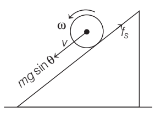
  1. Sphere is in pure accelerated rolling motion in the figure shown:
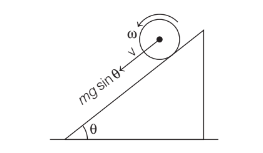
Choose the correct option.

  1. The direction of fs is upwards
  2. The direction of fs is downwards
  3. The direction of gravitational force is upwards
  4. The direction of normal reaction is downwards
  1. Kinetic energy of a rolling body will be:
  1. $\frac{1}{2}\text{mv}^2_\text{ cm}(\text{l}+\frac{\text{k}^2}{\text{R}^2}\big)$
  2. $\frac{1}{2}\text{I}\infty^2$
  3. $\frac{1}{2}\text{mv}^2\text{cm}$
  4. (d) None of the above
  1. A body is rolling down an inclined plane. Its translational and rotational kinetic energies are equal. The body is a:
  1. solid sphere
  2. hollow sphere
  3. solid cylinder
  4. hollow cylinder

Answer

  1. (b) rotational kinetic energy

Explanation:

The frictional force will reduce v 0, hence translational KE will also decrease. It will increases w, which increases its rotational kinetic energy. There is no torque about the line of contact, angular momentum will remain constant. The frictional force will decrease the mechanical energy.

  1. a$\frac{\text{g}}{3}$

Explanation:

$\text{a}=\frac{\text{g}\sin\theta}{1+\frac{\text{k}^2}{\text{R}^2}}=\frac{\text{g}\sin30^\circ}{1+\frac{1}{2}}\Rightarrow\text{a}\frac{\frac{\text{g}}{2}}{\frac{3}{2}}=\frac{\text{g}}{3}$

  1. (a) The direction of fs is upwards

Explanation:

As we know that,

The direction of fs will be upwards to provide torque for rolling of sphere.

  1. $\frac{1}{2}\text{mv}^2_\text{ cm}(\text{l}+\frac{\text{k}^2}{\text{R}^2}\big)$

Explanation:

KE of a rolling body = Rotational KE + Translational KE

$=\frac{1}{2}\text{l}\omega^2+\frac{1}{2}\text{mv}^2_\text{cm}(\because\text{I}=\text{mk}^2)$

and $\text{v}_\text{cm}=\text{R}\omega$

$=\frac{1}{2}\frac{\text{mk}^2\text{v}^2_\text{cm}}{\text{R}^2}+\frac{1}{2}\text{mv}^2_\text{cm}$

where, k is the corresponding radius of gyration of the body.

$\frac{1}{2}\text{mv}^2_\text{ cm}(\text{l}+\frac{\text{k}^2}{\text{R}^2}\big)$

  1. (d) hollow cylinder

Explanation:

When a body rolls down on inclined plane, it is accompanied by rotational and translational kinetic energies.

Rotational kinetic energy$=\frac{1}{2}\text{I}\omega^2=\text{K}_\text{R}$

where, I is the moment of inertia and w is the angular velocity. Translational kinetic energy for pure rolling,

$\text{v}_\text{cm}=\text{r}\omega$

$=\frac{1}{2}\text{mv}^2_\text{cm}=\text{K}_\text{r}=\frac{1}{2}\text{m}(r\omega)^2$

where, m is mass of the body, vCM is the velocity and $\omega$ is the angular velocity.
Given,
Translational KE = Rotational KE

$\therefore \frac{1}{2}\text{m}(\text{r}^2\omega^2)=\frac{1}{2}\text{I}\omega^2$

$\Rightarrow\text{I}=\text{mr}^2$

We know that, mr 2 is the moment of inertia of hollow cylinder about its axis, where m is the mass of hollow cylindrical body and r is the radius of the cylinder.

Need a full question paper?

Generate a complete, print-ready paper with questions like this in minutes — across 16+ boards, with answer keys.

Start Generating Free

Similar questions

No part of India is situated on the equator. Is it possible to have a geostationary satellite which always remains over New Delhi?
Consider a gravity-free hall in which an experimenter of mass 50kg is resting on a 5kg pillow, 8ft above the floor of the hall. He pushes the pillow down so that it starts falling at a speed of 8ft/s. The pillow makes a perfectly elastic collision with the floor, rebounds and reaches the experimenter's head. Find the time elapsed in the process.
The electron beam in a colour TV is accelerated through 32kV and then strikes the screen. What is the wavelength of the most energetic X-ray photon?
A dimensionless quantity:
  1. Never has a unit.
  2. Always has a unit
  3. May have a unit.
  4. Does not exist.
Read the passage given below and answer the following questions from 1 to 5.
If a stone is thrown by hand, we see it falls back to the earth. Of course using machines we can shoot an object with much greater speeds and with greater and greater initial speed, the object scales higher and higher heights. A natural query that arises in our mind is the following: can we throw an object with such high initial speeds that it does not fall back to the earth ?
Thus minimum speed required to throw object to infinity away from earth’s gravitational field is called escape velocity.
$\text{V}_{\text{e}}=\sqrt{(2\text{gr})}$
Where g is acceleration due to gravity and r is radius of earth and after solving ve 11.2 km/s. This is called the escape speed, sometimes loosely called the escape velocity. This applies equally well to an object thrown from the surface of the moon with g replaced by the acceleration due to Moon’s gravity on its surface and r replaced by the radius of the moon. Both are smaller than their values on earth and the escape speed for the moon turns out to be 2.3 km/s, about five times smaller. This is the reason that moon has no atmosphere. Gas molecules if formed on the surface of the moon having velocities larger than this will escape the gravitational pull of the moon.
Earth satellites are objects which revolve around the earth. Their motion is very similar to the motion of planets around the Sun and hence Kepler’s laws of planetary motion are equally applicable to them. In particular, their orbits around the earth are circular or elliptic. Moon is the only natural satellite of the earth with a near circular orbit with a time period of approximately 27.3 days which is also roughly equal to the rotational period of the moon about its own axis.
  1. Time period of moon is:
  1. 27.3 days
  2. 20 days
  3. 85 days
  4. None of these
  1. Escape velocity from earth is given by:
  1. 20 km/s
  2. 11.2 km/s
  3. 2 km/s
  4. None of these
  1. Define escape velocity. Give its formula.
  1. Why moon don’t Have any atmosphere?
  1. What is satellite? Which law governs them?
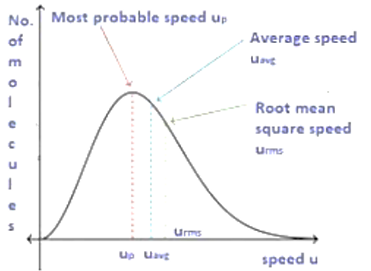
Root mean square velocity (RMS value)is the square root of the mean of squares of the velocity of individual gas molecules and the Average velocity is the arithmetic mean of the velocities of different molecules of a gas at a given temperature.
Image
1. Moon has no atmosphere because:
(a) the escape velocity of the moon’s surface is more than the r.m.s velocity of all molecules
(b) it is far away from the surface of the earth
(c) the r.m.s. velocity of all the gas molecules is more than the escape velocity of the moon’s surface
(d) its surface temperature is $10^{\circ} C$
2. For an ideal gas, $\frac{C_P}{C_V}$ is
(a) $\leq 1$    (b) none of these    (c) $>1$    (d) $<1$
3. The root means square velocity of hydrogen is $\sqrt{5}$ times that of nitrogen. If $T$ is the temperature of the gas then:
(a) $T\left(H_2\right)=T\left(N_2\right)$    (b) $T \left( H _2\right)< T \left( N _2\right)$
(c) $T \left( H _2\right) \neq T \left( N _2\right)$    (d) $T \left( H _2\right)> T \left( N _2\right)$
4. Suppose the temperature of the gas is tripled and $N _2$ molecules dissociate into an atom. Then what will be the rms speed of atom:
(a) $v_0 \sqrt{2}$    (b) $v_0 \sqrt{6}$    (c) $v_0 \sqrt{3}$    (d) $v_0$
OR
The velocities of the molecules are $v , 2 v , 3 v , 4 v \& 5 v$. The RMS speed will be:
(a) 11 v    (b) $v (12)^{11}$   (c) v    (d) $v (11)^{12}$
Read the passage given below and answer the following questions from (i) to (v).

Pressure of an Ideal Gas: according to kinetic theory of gases pressure is given by

$\text{P}=\frac{1}{3}\text{ nmv}^2$

Where, n is number of molecules per unit volume, m is mass and v2 is mean squared speed. Though we choose the container to be a cube, the shape of the vessel really is immaterial.

The average kinetic energy of a molecule is proportional to the absolute temperature of the gas; it is independent of pressure, volume or the nature of the ideal gas. This is a fundamental result relating temperature, a macroscopic measurable parameter of a gas (a thermodynamic variable as it is called) to a molecular quantity, namely the average kinetic energy of a molecule. The two domains are connected by the Boltzmann constant and given by E =  kbT.

Where kb is Boltzmann constant having value of 1.38 × 10-23 joule per Kelvin.

We have seen that in thermal equilibrium at absolute temperature T, for each translational mode of motion, the average energy is $\frac{1}{2}\text{K}_\text{b}\text{t}$. The most elegant principle of classical statistical mechanics (first proved by Maxwell) states that this is so for each mode of energy: translational, rotational and vibrational. That is, in equilibrium, the total energy is equally distributed in all possible energy modes, with each mode having an average energy equal to $\frac{1}{2}\text{K}_\text{b}\text{t}$. This is known as the law of equipartition of energy. Accordingly, each translational and rotational degree of freedom of a molecule contributes $\frac{1}{2}\text{K}_\text{b}\text{t}$ to the energy, while each vibrational frequency contributes $2\times\frac{1}{2}\text{Kb T}=\text{K}_\text{b}\text{T}$ since a vibrational mode has both kinetic and potential energy modes.

  1. Boltzmann constant has value of:
  1. 1.38 × 10 - 23 joule per Kelvin.
  2. 1.38 × 10 - 28 joule per Kelvin.
  3. 1.38 × 10 - 30 joule per Kelvin.
  4. None of these.
  1. SI unit of Boltzmann constant is given by:
  1. Joules per meter
  2. Joules per Kelvin
  3. Joules per Newton
  4. None of these
  1. According to kinetic theory give formula for pressure of idea gas.
  2. According to kinetic theory what is average kinetic energy of molecules of ideal gas?
  3. What is law of equipartition of energy?
Read the passage given below and answer the following questions from 1 to 5.
When a body is subjected to a deforming force, a restoring force is developed in the body. This restoring force is equal in magnitude but opposite in direction to the applied force. The restoring force per unit area is known as stress. If F is the force applied normal to the cross–section and A is the area of cross section of the body.
Magnitude of the stress $=\frac{\text{F}}{\text{A}}$
The SI unit of stress is N-m-2 or Pascal (Pa) and its dimensional formula is [ML-1 T-2]. The restoring force per unit area in this case is called tensile stress. If the cylinder is compressed under the action of applied forces, the restoring force per unit area is known as compressive stress. Tensile or compressive stress can also be termed as longitudinal stress. In both the cases, there is a change in the length of the cylinder. The change in the length ΔL to the original length L of the body is known as longitudinal strain.
The restoring force per unit area developed due to the applied tangential force is known as tangential or shearing stress.
  1. Restoring force per unit area is called as:
  1. Stress
  2. Strain
  3. Modulus of elasticity
  4. None of these
  1. Ratio of change in dimension to original dimension is called:
  1. Stress
  2. Strain
  3. Modulus of elasticity
  4. None of these
  1. Define shear stress.
  1. Define stress. Give its SI unit and dimension.
  1. Define strain. Give its SI unit and dimension
A spring balance has a scale that reads from 0 to 50 kg . The length of the scale is 20 cm . A body suspended from this balance, when displaced and released, oscillates with a period of 0.6 s . What is the weight of the body ?
Read the passage given below and answer the following questions from (i) to (v).
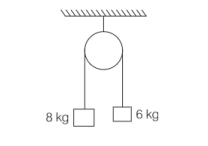
Force of Friction on Connected Bodies When bodies are in contact, there are mutual contact forces satisfying the third law of motion. The component of contact force normal to the surfaces in contact is called normal reaction. The component parallel to the surfaces in contact is called friction

In the above figure, 8 kg and 6 kg are hanging stationary from a rough pulley and are about to move. They are stationary due to roughness of the pulley.
  1. Which force is acting between pulley and rope?
  1. Gravitational force
  2. Tension force
  3. Frictional force
  4. Buoyant force
  1. The normal reaction acting on the system is
  1. 8g
  2. 6g
  3. 2g
  4. 4g
  1. The tension is more on side having mass of:
  1. 8kg
  2. 6kg
  3. Same on both
  4. Nothing can be said
  1. The force of friction acting on the rope is:
  1. 20N
  2. 30N
  3. 40N
  4. 50N
  1. Coefficient of friction of the pulley is
  1. $\frac{1}{6}$
  2. $\frac{1}{7}$
  3. $\frac{1}{5}$
  4. $\frac{1}{4}$