A large horizontal surface moves up and down in $SHM$ with an amplitude of $1 \,cm$. If a mass of $10\, kg$ (which is placed on the surface) is to remain continually in contact with it, the maximum frequency of $S.H.M.$ will be ... $Hz$
AIIMS 1995, Medium


Download our appand get started for free
Experience the future of education. Simply download our apps or reach out to us for more information. Let's shape the future of learning together!No signup needed.*
Similar Questions
- 1Two springs of force constants $300\, N/m$ (Spring $A$) and $400\, N/m$ (Spring $B$) are joined together in series . The combination is compressed by $8.75\, cm$. The ratio of energy stored in $A$ and $B$ is $\frac{{{E_A}}}{{{E_B}}}$. Then $\frac{{{E_A}}}{{{E_B}}}$ is equal toView Solution
- 2If a particle under S.H.M. has time period 0.1 sec and amplitude $2 \times 10^{-3}$. It has maximum velocityView Solution
- 3View SolutionIdentify the correct statement
- 4The displacement of a particle varies with time as $x = 12\sin \omega t - 16{\sin ^3}\omega t$ (in $cm$). If its motion is $S.H.M.$, then its maximum acceleration isView Solution
- 5If the length of simple pendulum is increased by $300\%$, then the time period will be increased by ..... $\%$View Solution
- 6The mass of a particle is $1\,\,kg$ and it is moving along $x-$ axis. The period of its small oscillation is $\frac {\pi }{2}$ . Its potential energy may beView Solution
- 7A point object is kept in front of a plane mirror. The plane mirror is doing $SHM$ of amplitude $2\,cm$. The plane mirror moves along the $x-$ axis and $x-$ axis is normal to the mirror. The amplitude of the mirror is such that the object is always infront of the mirror. The amplitude of $SHM$ of the image is .... $cm$View Solution
- 8$x$ and $y$ displacements of a particle are given as $x(t) = a\,sin\,\omega t$ and $y(t) = a\,sin\,2\omega t.$ Its trajectory will look likeView Solution
- 9View SolutionThe phase difference between the instantaneous velocity and acceleration of a particle executing simple harmonic motion is
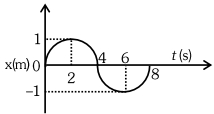
- 10The $x-t$ graph of a particle performing simple harmonic motion is shown in the figure. The acceleration of the particle at $t=2 s$ is :View Solution