The displacement of a particle varies with time as $x = 12\sin \omega t - 16{\sin ^3}\omega t$ (in $cm$). If its motion is $S.H.M.$, then its maximum acceleration is
Medium


Download our appand get started for free
Experience the future of education. Simply download our apps or reach out to us for more information. Let's shape the future of learning together!No signup needed.*
Similar Questions
- 1The amplitude of a particle executing $S.H.M.$ with frequency of $60 \,Hz$ is $0.01 \,m$. The maximum value of the acceleration of the particle isView Solution
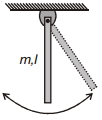
- 2A uniform rod of mass $m$ and length $I$ is suspended about its end, Time period of small angular oscillations is ..........View Solution
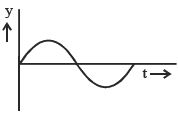
- 3The displacement versus time graph of $SHM$ is Which of the following is its acceleration versus time graph ?View Solution
- 4When two displacements represented by $y_1 = asin\left( \omega t \right)$ and $y_2 = bcos\left(\omega t \right)$ are superimposed the motion isView Solution
- 5A rod of mass $‘M’$ and length $‘2L’$ is suspended at its middle by a wire. It exhibits torsional oscillations; If two masses each of $‘m’$ are attached at distance $‘L/2’$ from its centre on both sides, it reduces the oscillation frequency by $20\%$. The value of ratio $m/M$ is close toView Solution
- 6When the potential energy of a particle executing simple harmonic motion is one-fourth of its maximum value during the oscillation, the displacement of the particle from the equilibrium position in terms of its amplitude $a$ isView Solution
- 7A mass $m =100\, gms$ is attached at the end of a light spring which oscillates on a frictionless horizontal table with an amplitude equal to $0.16$ metre and time period equal to $2 \,sec$. Initially the mass is released from rest at $t = 0$ and displacement $x = - 0.16$ metre. The expression for the displacement of the mass at any time $t$ isView Solution
- 8Two masses $m_1=1 \,kg$ and $m_2=0.5 \,kg$ are suspended together by a massless spring of spring constant $12.5 \,Nm ^{-1}$. When masses are in equilibrium $m_1$ is removed without disturbing the system. New amplitude of oscillation will be .......... $cm$View Solution
- 9Two waves executing simple harmonic motion travelling in the same direction with same amplitude and frequency are superimposed. The resultant amplitude is equal to the $\sqrt{3}$ times of amplitude of individual motions. The phase difference between the two motions is $.....(degree)$View Solution
- 10Starting from the origin a body oscillates simple harmonically with a period of $2\ s$. After what time will its kinetic energy be $75\%$ of the total energy?View Solution