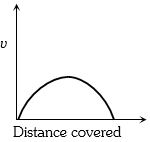
A lead shot of $1mm$ diameter falls through a long column of glycerine. The variation of its velocity $v$. with distance covered is represented by
- A
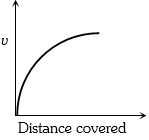
- B
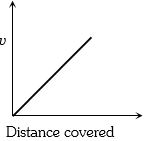
- C
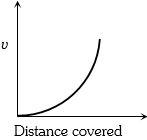
- D
AIIMS 2003, Medium


Download our appand get started for free
Experience the future of education. Simply download our apps or reach out to us for more information. Let's shape the future of learning together!No signup needed.*
Similar Questions
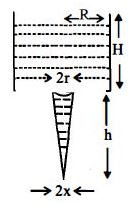
- 1Consider a water jar of radius $R$ that has water filled up to height $H$ and is kept on a stand of height $h$ (see figure) . Through a hole of radius $r$ $(r << R)$ at its bottom, the water leaks out and the stream of water coming down towards the ground has a shape like a funnel as shown in the figure. If the radius of the cross-section of water stream when it hits the ground is $x.$ ThenView Solution
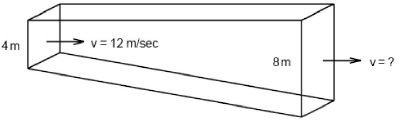
- 2A river gradually deepens, from a depth of $4 \ m$ to a depth of $8\ m$ as shown. The width, $W$, of the river does not change. At the depth of $4 \ m$, the river's speed is $12\ m/sec.$ Its elocity at the $8\ m$ depth is ......... $m/sec$View Solution
- 3Water is filled in a container upto height of $3\,m$. A small hole of area $‘A_0’$ is punched in the wall of the container at a height $52.5\, cm$ from the bottom. The cross sectional area of the container is $A$. If $A_0/A = 0.1$ then $v^2$ is......... $m^2/s^2$ (where $v$ is the velocity of water coming out of the hole)View Solution
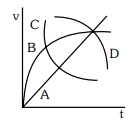
- 4A spherical ball is dropped in a long column of a highly viscous liquid. The curve in the graph shown, which represents the speed of the ball $(v)$ as a function of time $(t)$ isView Solution
- 5A liquid is flowing in a horizontal uniform capillary tube under a constant pressure difference $P$. The value of pressure for which the rate of flow of the liquid is doubled when the radius and length both are doubled isView Solution
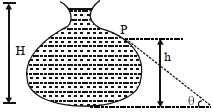
- 6Figure here shows the vertical cross section of a vessel filled with a liquid of density $\rho$. The normal thrust per unit area on the walls of the vessel at the point $P$, as shown, will beView Solution
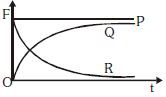
- 7A heavy spherical ball is dropped near surface in a long column of viscous liquid. Which of the following graphs represent the variation ofView Solution
$(i)$ Gravitational force with time
$(ii)$ Viscous force with time
$(iii)$ Net force acting on the ball with time
- 8Water is flowing steadily through a horizontal tube of non uniform cross-section. If the pressure of water is $4$ $\times $ $10^4$ $N/m^2$ at a point where cross-section is $0.02$ $m^2$ and velocity of flow is $2$ $m/s$, what is pressure at a point where cross-section reduces to $0.01$ $m^2$.View Solution
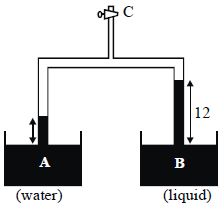
- 9The limbs of a $U$ -tube glass are lowered into vessels $A$ and $B, A$ containing water. Some air is pumped out through the top of the tube $C$. The liquids in the left hand limb $A$ and the right hand limb $B$ rise to heights of $10\, cm$ and $12\, cm$ respectively. The density of liquid $B$ is ........ $g/cm^3$View Solution
- 10The pressure of confined air is $p$. If the atmospheric pressure is $P$, thenView Solution