MCQ
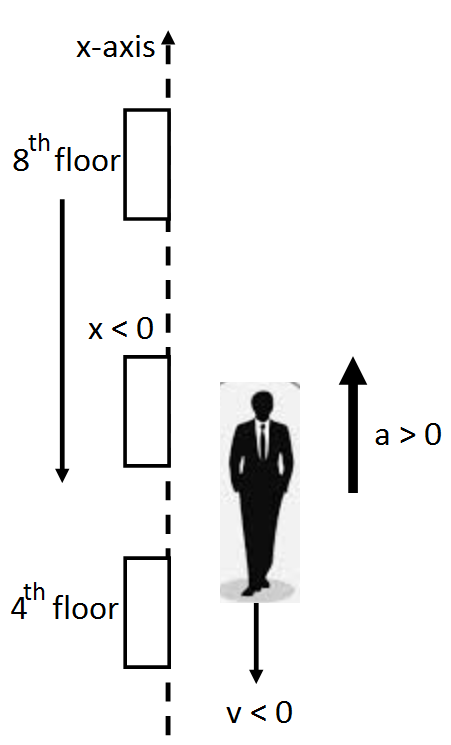
A lift is coming from $8^{th}$ floor and is just about to reach $4^{th}$ floor. Taking ground floor as origin and positive direction upwards for all quantities, which one of the following is correct?
  • $x < 0, v < 0, a > 0.$
  • B
    $x > 0, v < 0, a < 0.$
  • C
    $x > 0, v < 0, a > 0.$
  • D
    $x > 0, v > 0, a < 0.$

Answer

Correct option: A.
$x < 0, v < 0, a > 0.$
Key concept: The time rate of change of velocity of an object is called acceleration of the object.
It is a vector quantity. Its direction is same as that of change in velocity $($Not of the velocity$).$
In the table: Possible ways of velocity change.
When only direction of velocity changes.
When only magnitude of velocity changes.
When both magnitude and direction of velocity change.
Acceleration perpendicular to velocity.
Acceleration parallel or anti­parallel to velocity.
Acceleration has two components-one is perpendicular to velocity and another parallel or anti­parallel to velocity.
E.g.: Uniform circular motion
E.g.: Motion under gravity.
E.g.: Projectile motion.
Here we will take upward direction positive. As. the lift is coming in downward direction, the displacement will be negative. We have to see whether the motion is accelerating or retarding.
We know that due to downward motion displacement will be negative. When the lift reaches $4^{th}$ floor and is about to stop velocity is decreasing with time, hence motion is retarding in nature.
Thus, $x < 0; a > 0.$
As displacementisinnegativedirection, velocity will also be negative, i.e. $v < 0.$
The motion of lift will be shown like this.

Need a full question paper?

Generate a complete, print-ready paper with questions like this in minutes — across 16+ boards, with answer keys.

Start Generating Free

Similar questions

If mass of $He$ atom is $4$ times that of hydrogen atom then mean velocity of $He$ is
A particle at a distance of $1 m$ from the origin starts moving, such that $d r / d \theta=r$, where $r$ and $\theta$ are polar co-ordinates. Then, the angle between resultant velocity and tangential velocity is
Orbital velocity of earth's satellite near the surface is $7 \,km/s$. When the radius of the orbit is $4$ times than that of earth's radius, then orbital velocity in that orbit is ......... $km/sec$
A sonometer wire of length $114\, cm$ is fixed at both the ends. Where should the two bridges be placed so as to divide the wire into three segments whose fundamental frequencies are in the ratio $1 : 3 : 4$ ?
Under a constant pressure head, the rate of flow of liquid through a capillary tube is $V$. If the length of the capillary is doubled and the diameter of the bore is halved, the rate of flow would become
A body thrown vertically upwards with an initial velocity $u$ reaches maximum height in $6$ seconds. The ratio of the distances travelled by the body in the first second and the seventh second is
The force $F$ on a sphere of radius $'a'$ moving in a medium with velocity $'v'$ is given by $F = 6\pi \eta av$. The dimensions of $\eta $ are
A body of mass $8\,kg$ is moved by a force $F = 3x\,N,$ where $x$ is the distance covered. Initial position is $x = 2\,m$ and the final position is $x = 10\,m$. The initial speed is $0.0\,m/s.$ The final speed is  ........... $m/s$
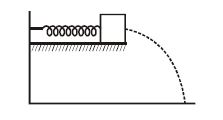
As shown in figure there is a spring block system. Block of mass $500\,g$ is pressed against a horizontal spring fixed at one end to compress the spring through $5.0\,cm$ . The spring constant is $500\,N/m$ . When released, calculate the distance where it will hit the ground $4\,m$ below the spring ? $(g = 10\,m/s^2)$
A cricketer hits a ball with a velocity $25\,\,m/s$ at ${60^o}$ above the horizontal. How far above the ground it passes over a fielder $50 m$ from the bat  ........ $m$ (assume the ball is struck very close to the ground)