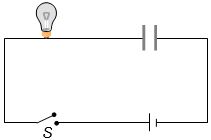
A light bulb, a capacitor and a battery are connected together as shown here, with switch $S$ initially open. When the switch $S$ is closed, which one of the following is true
Medium
Download our app for free and get started
(a) Initially when key is closed, the capacitor acts as short-circuit, so bulb will light up. But finally the capacitor becomes fully charged, so it will act as open circuit, so bulb will not glow.
Download our app
and get started for free
Experience the future of education. Simply download our apps or reach out to us for more information. Let's shape the future of learning together!No signup needed.*
Two identical thin rings, each of radius $R $ meter are coaxially placed at distance $R$ meter apart. If $Q_1$ and $Q_2$ coulomb are respectively the charges uniformly spread on the two rings, the work done in moving a charge $q$ from the centre of one ring to that of the other is
In the following diagram the work done in moving a point charge from point $P$ to point $A, B$ and $C$ is respectively as $W_A,\, W_B$ and $W_C$, then (there is no charge nearby)
A parallel plate capacitor with area $200\,cm^2$ and separation between the plates $1.5\,cm$, is connected across a battery of $emf$ $V$. If the force of attraction between the plates is $25\times10^{-6}\,N$, the value of $V$ is approximately........$V$ $\left( {{\varepsilon _0} = 8.85 \times {{10}^{ - 12}}\,\frac{{{C^2}}}{{N{m^2}}}} \right)$
Two capacitors $C_1$ and $C_2 = 2C_1$ are connected in a circuit with a switch between them as shown in the figure. Initially the switch is open and $C_1$ holds charge $Q$. The switch is closed. At steady state, the charge on each capacitor will be
There is a uniform spherically symmetric surface charge density at a distance $R_0$ from the origin. The charge distribution is initially at rest and starts expanding because of mutual repulsion. The figure that represents best the speed $V(R(t))$ of the distribution as a function of its instantaneous radius $R(t)$ is
A capacitor stores $60\ \mu C$ charge when connected across a battery. When the gap between the plates is filled with a dielectric , a charge of $120\ \mu C$ flows through the battery , if the initial capacitance of the capacitor was $2\ \mu F$, the amount of heat produced when the dielectric is inserted.......$\mu J$