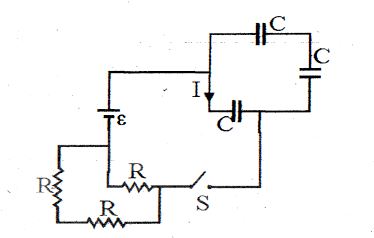
In the given circuit switch $S$ is closed at $t = 0$ . The current $I$ in the figure at time $t$ is
Advanced


Download our appand get started for free
Experience the future of education. Simply download our apps or reach out to us for more information. Let's shape the future of learning together!No signup needed.*
Similar Questions
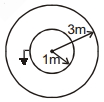
- 1Figure shows a solid conducting sphere of radius $1 m$, enclosed by a metallic shell of radius $3 \,m$ such that their centres coincide. If outer shell is given a charge of $6 \,\mu C$ and inner sphere is earthed, find magnitude charge on the surface of inner shell is ............. $\mu C$View Solution
- 2Two parallel plate capacitors of capacity $C$ and $3\,C$ are connected in parallel combination and charged to a potential difference $18\,V$. The battery is then disconnected and the space between the plates of the capacitor of capacity $C$ is completely filled with a material of dielectric constant $9$. The final potential difference across the combination of capacitors will be $V$View Solution
- 3The force between the plates of a parallel plate capacitor of capacitance $C$ and distance of separation of the plates $d$ with a potential difference $V$ between the plates, isView Solution
- 4Three capacitors each of $6\,\mu F$ are available. The minimum and maximum capacitances which may be obtained areView Solution
- 5Two equal charges $q$ of opposite sign separated by a distance $2a$ constitute an electric dipole of dipole moment $p$. If $P$ is a point at a distance $r$ from the centre of the dipole and the line joining the centre of the dipole to this point makes an angle $\theta $ with the axis of the dipole, then the potential at $P$ is given by $(r > > 2a)$ (Where $p = 2qa$)View Solution
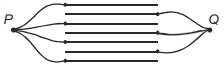
- 6Seven identical plates each of area $A$ and successive separation $d$ are arranged as shown in figures. The effective capacitance of the system between $P$ and $Q$ isView Solution
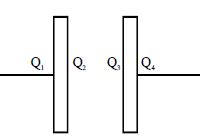
- 7In an insulated parallel-plate capacitor of capacitance $C$, the four surfaces have charges $Q_1, Q_2, Q_3$ and $Q_4$ as shown. The potential difference between the plate isView Solution
- 8Two charge $ + \,q$ and $ - \,q$ are situated at a certain distance. At the point exactly midway between themView Solution
- 9The capacity of a parallel plate condenser is $10\,\mu F$ without dielectric. Dielectric of constant $2$ is used to fill half the distance between the plates, the new capacitance in $\mu F$ isView Solution
- 10$A$ and $B$ are two identical spheres charge on them is $7\,\mu C$ and $1\,\mu C$ respectively. Now both are connected by a wire. Calculate flow of charge from $A$ to $B$......$\mu C$View Solution