MCQ
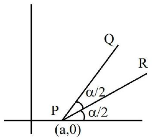
A line passing through the point $\mathrm{P}(\mathrm{a}, \theta)$ makes an acute angle $\alpha$ with the positive x -axis. Let this line be rotated about the point $P$ through an angle $\frac{\alpha}{2}$ in the clock-wise direction. If in the new position, the slope of the line is $2-\sqrt{3}$ and its distance from the origin is $\frac{1}{\sqrt{2}}$, then the value of $3 a^{2} \tan ^{2} \alpha-2 \sqrt{3}$ is
  • 4
  • B
    6
  • C
    5
  • D
    8

Answer

Correct option: A.
4
(A) 4
Image
$m_{P R}=2-\sqrt{3}=\tan 15^{\circ}$
$\therefore \frac{\alpha}{2}=15^{\circ} \quad \Rightarrow \alpha=30^{\circ}$
equation of $P R$ :
$y=\tan 15^{\circ}(x-a)$
$y=(2-\sqrt{3})(x-a)$
$\perp$ distance from origin $=\frac{1}{\sqrt{2}}$
$\left|\frac{\sqrt{3} a-2 a}{\sqrt{4+3-4 \sqrt{3}+1}}\right|=\frac{1}{\sqrt{2}}$
$\frac{|\mathrm{a}|(2-\sqrt{3})}{2 \sqrt{(2-\sqrt{3})}}=\frac{1}{\sqrt{2}}$
$|a|=\frac{\sqrt{2}}{\sqrt{2-\sqrt{3}}}=\sqrt{2}(\sqrt{2+\sqrt{3}})$
$a^{2}=2(2+\sqrt{3})$
$3 a^{2} \tan ^{2} \alpha-2 \sqrt{3}$
$3 \times(4+2 \sqrt{3}) \cdot \frac{1}{3}-2 \sqrt{3}=4$

Need a full question paper?

Generate a complete, print-ready paper with questions like this in minutes — across 16+ boards, with answer keys.

Start Generating Free

Similar questions

The number of solution $(s)$ of the equation $log_7(2^x -1) + log_7(2^x -7) = 1$, is -
The conjugate of a complex number is $\frac{1}{{i - 1}}$ then that complex number is
If projection of any line on co-ordinate axis $3, 4,$ and $5$, then its length is
Let $C$ be the circle with centre at $(1, 1)$ and radius $= 1$. If  $T$ is the circle centred at $(0, y),$ passing through origin and touching the circle $C$ externally, then the radius of $T$ is equal 
If $A$ and $B$ are two events such that $P(A \cap B)=0.1$, and $P(A \mid B)$ and $P(B \mid A)$ are the roots of the equation $12 x^2-7 x+1=0$, then the value of $\frac{ P (\overline{ A } \cup \overline{ B })}{ P (\overline{ A } \cap \overline{ B })}$ is:
Let $H : \frac{ x ^2}{ a ^2}-\frac{ y ^2}{ b ^2}=1$, where $a > b >0$, be $a$ hyperbola in the $xy$-plane whose conjugate axis $LM$ subtends an angle of $60^{\circ}$ at one of its vertices $N$. Let the area of the triangle $LMN$ be $4 \sqrt{3}$..

List $I$ List $II$
$P$ The length of the conjugate axis of $H$ is $1$ $8$
$Q$ The eccentricity of $H$ is $2$ ${\frac{4}{\sqrt{3}}}$
$R$ The distance between the foci of $H$ is $3$ ${\frac{2}{\sqrt{3}}}$
$S$ The length of the latus rectum of $H$ is $4$ $4$

The correct option is:

Let $a, b, c$  are three non-coplanar vectors such that ${r_1} = a - b + c,\,\,{r_2} = b + c - a,\,\,{r_3} = c + a + b,$ $r = 2a - 3b + 4c.$ If $r = {\lambda _1}{r_1} + {\lambda _2}{r_2} + {\lambda _3}{r_3},$ then
For $\alpha, \beta, \gamma \neq 0$. If $\sin ^{-1} \alpha+\sin ^{-1} \beta+\sin ^{-1} \gamma=\pi$ and $(\alpha+\beta+\gamma)(\alpha-\gamma+\beta)=3 \alpha \beta$, then $\gamma$ equal to
Let $x=(\sqrt{50}+7)^{1 / 3}-(\sqrt{50}-7)^{1 / 3}$. Then,
If $1 - i$ is a root of the equation ${x^2} - ax + b = 0$, then $b = $