MCQ 14 Marks
Given below are two statements :
Statement I : $\lim _{x \rightarrow 0}\left(\frac{\tan ^{-1} x+\log _e \sqrt{\frac{1+x}{1-x}}-2 x}{x^5}\right)=\frac{2}{5}$
Statement II : $\lim _{x \rightarrow 1}\left(x^{\frac{2}{1-x}}\right)=\frac{1}{\mathrm{e}^{2}}$
In the light of the above statements, choose the correct answer from the options given below :
- A
Statement I is false but Statement II is true
- B
Statement I is true but Statement II is false
- C
Both Statement I and Statement II are false
- ✓
Both Statement I and Statement II are true
AnswerCorrect option: D. Both Statement I and Statement II are true
(D) Both Statement I and Statement II are true
$\lim _{x \rightarrow 0} \frac{\tan ^{-1} x+\frac{1}{2}[ \ell n (1+x)-\ell n (1-x)]-2 x}{x^{5}}$
$=\lim _{x \rightarrow 0} \frac{\left(x-\frac{x^{3}}{3}+\frac{x^{5}}{5} \ldots \right)+\frac{1}{2}\left[x-\frac{x^{2}}{2}+\frac{x^{3}}{3} \ldots-\left(-x-\frac{x^{2}}{2}-\frac{x^{3}}{3} \ldots\right)\right]-2 x}{x^{5}}$
$=\lim _{x \rightarrow 0} \frac{2 x+\frac{2 x^{5}}{5} \ldots-2 x}{x^{5}}=\frac{2}{5}$
$\lim _{x \rightarrow 1} x^{\frac{2}{(1-x)}}=e^{\lim _{x \rightarrow 1}\left(\frac{2}{1-x}\right)(x-1)}=e^{-2}$
$\Rightarrow$ Both statements correct
View full question & answer→MCQ 24 Marks
Let $A=\left[\begin{array}{ccc}2 & 2+p & 2+p+q \\ 4 & 6+2 p & 8+3 p+2 q \\ 6 & 12+3 p & 20+6 p+3 q\end{array}\right]$.
If $\operatorname{det}(\operatorname{adj}(\operatorname{adj}(3 \mathrm{~A})))=2^{\mathrm{m}} \cdot 3^{\mathrm{n}}, \mathrm{m}, \mathrm{n} \in \mathbb{N}$, then $\mathrm{m}+\mathrm{n}$ is equal to
Answer(B) 24
$|A|=\left|\begin{array}{ccc}2 & 2+p & 2+p+q \\ 4 & 6+2 p & 8+3 p+2 q \\ 6 & 12+3 p & 20+6 p+3 q\end{array}\right|$
$\mathrm{C}_{3} \rightarrow \mathrm{C}_{3}-\mathrm{C}_{2}-\mathrm{C}_{1} \times \frac{\mathrm{q}}{2}$
Then $\mathrm{C}_{3} \rightarrow \mathrm{C}_{2}-\mathrm{C}_{1} \mathrm{X}\left(1+\frac{\mathrm{p}}{2}\right)$
$\Rightarrow|\mathrm{A}|=\left|\begin{array}{ccc}2 & 0 & 0 \\ 4 & 2 & 2+\mathrm{p} \\ 6 & 6 & 8+3 \mathrm{p}\end{array}\right|$
$\Rightarrow|A|=2(16+6 p-12-6 p)=8=2^{3}$
$|\operatorname{adj}(\operatorname{adj}(3 \mathrm{~A}))|=|3 \mathrm{~A}|^{(3-1)^{2}}=|3 \mathrm{~A}|^{4}$
$=\left(3^{3}|\mathrm{~A}|\right)^{4}=\left(3^{3} \times 2^{3}\right)^{4}=2^{12} \times 3^{12}$
$\Rightarrow \mathrm{m}+\mathrm{n}=24$
View full question & answer→MCQ 34 Marks
The value of $\cot ^{-1}\left(\frac{\sqrt{1+\tan ^{2}(2)}-1}{\tan (2)}\right)-\cot ^{-1}$ $\left(\frac{\sqrt{1+\tan ^{2}\left(\frac{1}{2}\right)}+1}{\tan \left(\frac{1}{2}\right)}\right)$ is equal to
- ✓
$\pi-\frac{5}{4}$
- B
$\pi-\frac{3}{2}$
- C
$\pi+\frac{3}{2}$
- D
$\pi+\frac{5}{2}$
AnswerCorrect option: A. $\pi-\frac{5}{4}$
(A) $\pi-\frac{5}{4}$
$\cot ^{-1}\left(\frac{|\sec 2|-1}{\tan 2}\right)-\cot ^{-1}\left(\frac{\left|\sec \frac{1}{2}\right|+1}{\tan \frac{1}{2}}\right)$
\begin{equation*}
\begin{aligned}
& =\cot ^{-1}\left(\frac{-1-\cos 2}{\sin 2}\right)-\cot ^{-1}\left(\frac{1+\cos \frac{1}{2}}{\sin \frac{1}{2}}\right) \\
& =\pi-\cot ^{-1}(\cot 1)-\cot ^{-1}\left(\cot \frac{1}{4}\right) \\
& =\pi-1-\frac{1}{4}=\pi-\frac{5}{4}
\end{aligned}
\end{equation*}
View full question & answer→MCQ 44 Marks
Let $f(x)=x-1$ and $g(x)=e^{x}$ for $x \in \mathbb{R}$. If $\frac{d y}{d x}=\left(e^{-2 \sqrt{x}} g(f(f(x)))-\frac{y}{\sqrt{x}}\right), y(0)=0$, then $y(1)$ is :-
- A
$\frac{1-e^{2}}{e^{4}}$
- B
$\frac{2 e-1}{e^{3}}$
- ✓
$\frac{e-1}{e^{4}}$
- D
$\frac{1-e^{3}}{e^{4}}$
AnswerCorrect option: C. $\frac{e-1}{e^{4}}$
(C) $\frac{e-1}{e^{4}}$
$\mathrm{f}(\mathrm{x})=\mathrm{x}-1$
$\mathrm{f}(\mathrm{f}(\mathrm{x}))=\mathrm{f}(\mathrm{x})-1=\mathrm{x}-1-1=\mathrm{x}-2$
$g(f(f(x)))=e^{x-2}$
$\therefore \frac{\mathrm{dy}}{\mathrm{dx}}=\mathrm{e}^{-2 \sqrt{\mathrm{x}}} \times \mathrm{e}^{\mathrm{x}-2}-\frac{1}{\sqrt{\mathrm{x}}} \mathrm{y}$
$\frac{d y}{d x}+\frac{1}{\sqrt{x}} y=e^{x-2 \sqrt{x}-2}$ which is L.D.E
I.F. $=e^{\int \frac{d y}{\sqrt{x}}}=e^{2 \sqrt{x}}$
Its solution is
$y \times e^{2 \sqrt{x}}=\int e^{2 \sqrt{x}} \times e^{x-2 \sqrt{x}-2} d x+c$
$y \times e^{2 \sqrt{x}}=\int e^{x-2} d x+c$
$y \times e^{2 \sqrt{x}}=e^{x-2}+c$
Given $\mathrm{x}=0, \mathrm{y}=0 \Rightarrow 0=\mathrm{e}^{-2}+\mathrm{c} \quad ; \mathrm{c}=-\mathrm{e}^{-2}$
$\therefore \mathrm{y} \times \mathrm{e}^{2 \sqrt{\mathrm{x}}}=\mathrm{e}^{\mathrm{x}-2}-\mathrm{e}^{-2}$
when $\mathrm{x}=1, \mathrm{y} \times \mathrm{e}^{2}=\mathrm{e}^{-1}-\mathrm{e}^{-2}$
$y=\frac{e^{-1}-e^{-2}}{e^{2}}=\frac{\frac{1}{e}-\frac{1}{e^{2}}}{e^{2}}=\frac{e^{2}-e}{e^{5}}=\frac{e-1}{e^{4}}$
Option (1) is correct
View full question & answer→MCQ 54 Marks
The number of integral terms in the expansion of $\left(5^{\frac{1}{2}}+7^{\frac{1}{8}}\right)^{1016}$ is
Answer(D) 128
$\mathrm{T}_{\mathrm{r}}={ }^{1016} \mathrm{C}_{\mathrm{r}}(5)^{\frac{1016-\mathrm{r}}{2}} 7^{\frac{\mathrm{r}}{8}}$
$\Rightarrow \mathrm{r}=0,8,16,24, \ldots ., 1016$
$1016=0+(\mathrm{n}-1) 8$
$\Rightarrow \mathrm{n}-1=\frac{1016}{8}=127$
So, $\mathrm{n}=128$.
View full question & answer→MCQ 64 Marks
Let $A=\{0,1,2,3,4,5\}$. Let $R$ be a relation on A defined by $(x, y) \in R$ if and only if max $\{x, y\} \in\{3,4\}$. Then among the statements
$\left(\mathrm{S}_{1}\right)$ : The number of elements in R is 18 , and
$\left(\mathrm{S}_{2}\right)$ : The relation R is symmetric but neither reflexive nor transitive
AnswerCorrect option: C. only $\left(\mathrm{S}_{2}\right)$ is true
(C) only $\left(\mathrm{S}_{2}\right)$ is true
$A=\{0,1,2,3,4,5\}$
$R \equiv$ {(0,3),(3,0),(0,4),(4,0),(1,3),(3,1),(1,4),(4,1),(2,3),(3,2),(2,4),(4,2),(3,3),(3,4),(4,3),(4,4)}
Total 16 elements
Not reflexive as $(0,0), \ldots . .,(2,2) \notin \mathrm{R}$
Symmetric $\because \forall$ all a,b
$(a, b) \&(b, a) \in R$
Not transitive $\because(0,3),(3,1) \in R$
but $(0,1) \notin \mathrm{R}$
$\Rightarrow$ Only $\mathrm{S}_{2}$ correct
View full question & answer→MCQ 74 Marks
Let $\mathrm{A}=$ $\left\{\theta \in[0,2 \pi]: 1+10 \operatorname{Re}\left(\frac{2 \cos \theta+\mathrm{i} \sin \theta}{\cos \theta-3 \mathrm{i} \sin \theta}\right)=0\right\}$. Then $\sum_{\theta \in \mathrm{A}} \theta^{2}$ is equal to
- ✓
$\frac{21}{4} \pi^{2}$
- B
$8 \pi^{2}$
- C
$\frac{27}{4} \pi^{2}$
- D
$6 \pi^{2}$
AnswerCorrect option: A. $\frac{21}{4} \pi^{2}$
(A) $\frac{21}{4} \pi^{2}$
$1+10 \operatorname{Re}\left(\frac{2 \cos \theta+i \sin \theta}{\cos \theta-3 i \sin \theta}\right)=0$
$\therefore \mathrm{z}+\overline{\mathrm{z}}=2 \operatorname{Re}(\mathrm{z})$
$\frac{2 \cos \theta+\mathrm{i} \sin \theta}{\cos \theta-3 \mathrm{i} \sin \theta}+\frac{2 \cos \theta-\mathrm{i} \sin \theta}{\cos \theta+3 \mathrm{i} \sin \theta}=2 \times\left(\frac{-1}{10}\right)$
$\frac{\left(2 \cos ^{2} \theta-3 \sin ^{2} \theta\right)+\left(2 \cos ^{2} \theta\right)-\left(3 \sin ^{2} \theta\right)}{\cos ^{2} \theta+9 \sin ^{2} \theta}=\frac{-2}{10}$
$\Rightarrow \frac{2 \cos ^{2} \theta-3 \sin ^{2} \theta}{\cos ^{2} \theta+9 \sin ^{2} \theta}=\frac{-1}{10}$
$\Rightarrow 20 \cos ^{2} \theta-30 \sin ^{2} \theta=-\cos ^{2} \theta-9 \sin ^{2} \theta$
$21 \cos ^{2} \theta-21 \sin ^{2} \theta=0$
$\Rightarrow \cos 2 \theta=0$
$2 \theta=\frac{\pi}{2}, \frac{3 \pi}{2}, \frac{5 \pi}{2}, \frac{7 \pi}{2}$
$\Rightarrow \sum \theta^{2}=\frac{\pi^{2}}{16}+\frac{9 \pi^{2}}{16}+\frac{25 \pi^{2}}{16}+\frac{49 \pi^{2}}{16}=\frac{84 \pi^{2}}{16}=\frac{21 \pi^{2}}{4}$
View full question & answer→MCQ 84 Marks
There are 12 points in a plane, no three of which are in the same straight line, except 5 points which are collinear. Then the total number of triangles that can be formed with the vertices at any three of these 12 points is
Answer(D) 210
${ }^{12} \mathrm{C}_{3}-{ }^{5} \mathrm{C}_{3}=210$
View full question & answer→MCQ 94 Marks
A line passing through the point $\mathrm{P}(\mathrm{a}, \theta)$ makes an acute angle $\alpha$ with the positive x -axis. Let this line be rotated about the point $P$ through an angle $\frac{\alpha}{2}$ in the clock-wise direction. If in the new position, the slope of the line is $2-\sqrt{3}$ and its distance from the origin is $\frac{1}{\sqrt{2}}$, then the value of $3 a^{2} \tan ^{2} \alpha-2 \sqrt{3}$ is
Answer(A) 4
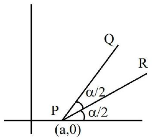
$m_{P R}=2-\sqrt{3}=\tan 15^{\circ}$
$\therefore \frac{\alpha}{2}=15^{\circ} \quad \Rightarrow \alpha=30^{\circ}$
equation of $P R$ :
$y=\tan 15^{\circ}(x-a)$
$y=(2-\sqrt{3})(x-a)$
$\perp$ distance from origin $=\frac{1}{\sqrt{2}}$
$\left|\frac{\sqrt{3} a-2 a}{\sqrt{4+3-4 \sqrt{3}+1}}\right|=\frac{1}{\sqrt{2}}$
$\frac{|\mathrm{a}|(2-\sqrt{3})}{2 \sqrt{(2-\sqrt{3})}}=\frac{1}{\sqrt{2}}$
$|a|=\frac{\sqrt{2}}{\sqrt{2-\sqrt{3}}}=\sqrt{2}(\sqrt{2+\sqrt{3}})$
$a^{2}=2(2+\sqrt{3})$
$3 a^{2} \tan ^{2} \alpha-2 \sqrt{3}$
$3 \times(4+2 \sqrt{3}) \cdot \frac{1}{3}-2 \sqrt{3}=4$ View full question & answer→MCQ 104 Marks
The integral $\int_{-1}^{\frac{3}{2}}\left(\left|\pi^{2} x \sin (\pi x)\right|\right) d x$ is equal to :
- A
$3+2 \pi$
- B
$4+\pi$
- ✓
$1+3 \pi$
- D
$2+3 \pi$
AnswerCorrect option: C. $1+3 \pi$
(C) $1+3 \pi$
Let, $\mathrm{I}=\pi^{2} \int_{-1}^{3 / 2}|\mathrm{x} \sin \pi \mathrm{x}| \mathrm{dx}$
$=\pi^2\left\{\int_{-1}^1 x \sin \pi xdx -\int_1^{3 / 2} x \sin \pi xdx \right\}$
$=\pi^2\left\{2 \int_0^1 x \sin \pi xdx -\int_{-1}^{3 / 2} x \sin \pi xdx \right\}$
Consider
$\int x \sin \pi x d x$
$-\mathrm{x} \cdot \frac{1}{\pi} \cos \pi \mathrm{x}+\int 1 \cdot \frac{1}{\pi} \cos \pi \mathrm{xdx}$
$=-\frac{\mathrm{x}}{\pi} \cos \pi \mathrm{x}+\frac{\sin \pi \mathrm{x}}{\pi^{2}}$
$\mathrm{I}=\pi^{2}\left\{2\left(-\frac{\mathrm{x}}{\pi} \cos \pi \mathrm{x}+\frac{\sin \pi \mathrm{x}}{\pi^{2}}\right)_{0}^{1}-\left(-\frac{\mathrm{x}}{\pi} \cos \pi \mathrm{x}+\frac{\sin \pi \mathrm{x}}{\pi^{2}}\right)_{1}^{3 / 2}\right\}$
$=\pi^{2}\left\{\frac{2}{\pi}-\left(-\frac{1}{\pi^{2}}-\frac{1}{\pi}\right)\right\}$
$=\pi^{2}\left\{\frac{3}{\pi}+\frac{1}{\pi^{2}}\right\}$
$=3 \pi+1$
View full question & answer→MCQ 114 Marks
Let the ellipse $3 x^{2}+p y^{2}=4$ pass through the centre $C$ of the circle $x^{2}+y^{2}-2 x-4 y-11=0$ of radius $r$. Let $f_{1}, f_{2}$ be the focal distances of the point C on the ellipse. Then $6 f_{1} f_{2}-r$ is equal to
Answer(C) 78
$E: \frac{x^{2}}{4 / 3}+\frac{y^{2}}{4 / P}=1$
Centre of circle $(1,2)$, radius
$\mathrm{r}=\sqrt{1+4+11}$
$r=4$
$\because$ E pass from centre $(1,2)$
$\therefore \frac{3}{4}+\mathrm{P}=1$
$\mathrm{P}=\frac{1}{4} \quad \therefore$ vertical ellipse
$\mathrm{e}=\sqrt{1-\frac{4 / 3}{16}}=\sqrt{1-\frac{1}{12}}=\sqrt{\frac{11}{12}}$
$\therefore$ Focal distance of C (h, k)
$=\mathrm{b} \pm \mathrm{ek}$
$\mathrm{F}_{1}=4+\sqrt{\frac{11}{12}} \times 2$
$\mathrm{F}_{2}=4-\sqrt{\frac{11}{12}} \times 2$
$\therefore \mathrm{F}_{1} \mathrm{~F}_{2}=16-\frac{11}{3}=\frac{37}{3}$
$\therefore 6 \mathrm{~F}_{1} \mathrm{~F}_{2}-\mathrm{r}=74-4=70$
View full question & answer→MCQ 124 Marks
Let $\overrightarrow{\mathrm{a}}=\hat{\mathrm{i}}+2 \hat{\mathrm{j}}+\hat{\mathrm{k}}$ and $\overrightarrow{\mathrm{b}}=2 \hat{\mathrm{i}}+\hat{\mathrm{j}}-\hat{\mathrm{k}}$. Let $\hat{\mathrm{c}}$ be a unit vector in the plane of the vectors $\vec{a}$ and $\vec{b}$ and be perpendicular to $\vec{a}$. Then such a vector $\hat{c}$ is :
- A
$\frac{1}{\sqrt{5}}(\hat{j}-2 \hat{k})$
- B
$\frac{1}{\sqrt{3}}(-\hat{i}+\hat{j}-\hat{k})$
- C
$\frac{1}{\sqrt{3}}(\hat{i}-\hat{j}+\hat{k})$
- ✓
$\frac{1}{\sqrt{2}}(-\hat{\mathrm{i}}+\hat{\mathrm{k}})$
AnswerCorrect option: D. $\frac{1}{\sqrt{2}}(-\hat{\mathrm{i}}+\hat{\mathrm{k}})$
(D) $\frac{1}{\sqrt{2}}(-\hat{\mathrm{i}}+\hat{\mathrm{k}})$
Let vector $\vec{p}$ in plane of $\vec{a} \& \vec{b}=K(\vec{a}+\lambda \vec{b})$
$\overrightarrow{\mathrm{p}} \perp \overrightarrow{\mathrm{a}}=\overrightarrow{\mathrm{p}} \cdot \overrightarrow{\mathrm{a}}=0$
$\Rightarrow K(\vec{a}+\lambda \vec{b}) \cdot \vec{a}=0$
$\Rightarrow \vec{a} \cdot \vec{a}+\lambda \vec{b} \cdot \vec{a}=0$
$\Rightarrow 6+\lambda(3)=0$
$\Rightarrow \lambda=-2$
$\Rightarrow \overrightarrow{\mathrm{p}}=(-3 \hat{\mathrm{i}}+3 \hat{\mathrm{k}})$
Unit vector $\rightarrow \pm \frac{(-\hat{\mathrm{i}}+\hat{\mathrm{k}})}{\sqrt{2}}$
View full question & answer→MCQ 134 Marks
Let $f(x)$ be a positive function and $I_{1}=\int_{-\frac{1}{2}}^{1} 2 x f(2 x(1-2 x)) d x$ and $I_{2}=\int_{-1}^{2} f(x(1-x)) d x$. Then the value of $\frac{I_{2}}{I_{1}}$ is equal to __________
Answer(D) 4
$I_{1}=\int_{-\frac{1}{2}}^{1} 2 x f(2 x(1-2 x)) d x$
$\Rightarrow 2 \mathrm{x}=\mathrm{t} \Rightarrow 2 \mathrm{dx}=\mathrm{dt} \quad \Rightarrow \mathrm{I}_{1}=\frac{1}{2} \int_{-1}^{2} \mathrm{tf}(\mathrm{t}(1-\mathrm{t})) \mathrm{dt}$
$\Rightarrow 2 \mathrm{I}_{1}=\int_{-1}^{2}(1-\mathrm{t}) \mathrm{f}(1-\mathrm{t})(1-(1-\mathrm{t})) \mathrm{dt}$
$\Rightarrow 2 \mathrm{I}_{1}=\int_{-1}^{2} \mathrm{f}\left(\mathrm{t}(1-\mathrm{t}) \mathrm{dt}-\int_{-1}^{2} \mathrm{tf}(\mathrm{t}(1-\mathrm{t}) \mathrm{dt}\right.$
$\Rightarrow 2 \mathrm{I}_{1}=\mathrm{I}_{2}-2 \mathrm{I}_{1}$
$\Rightarrow 4 \mathrm{I}_{1}=\mathrm{I}_{2}$
$\Rightarrow \frac{\mathrm{I}_{2}}{\mathrm{I}_{1}}=4$
View full question & answer→MCQ 144 Marks
Let a be the length of a side of a square OABC with O being the origin. Its side OA makes an acute angle $\alpha$ with the positive x-axis and the equations of its diagonals are $(\sqrt{3}+1) x+(\sqrt{3}-1) y=0$ and $(\sqrt{3}-1) x-(\sqrt{3}+1) y+8 \sqrt{3}=0$. Then $\mathrm{a}^{2}$ is equal to
Answer(A) 48
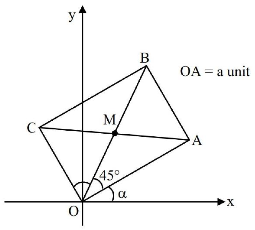
Slope of diagonal $\mathrm{OB}=\frac{\sqrt{3}+1}{1-\sqrt{3}}$
\begin{equation*}
=\tan 105^{\circ}
\end{equation*}
$\therefore \alpha=60^{\circ}$
$\therefore \mathrm{A}\left(\operatorname{acos} 60^{\circ}, \mathrm{asin} 60^{\circ}\right)$
$\therefore \mathrm{A}\left(\frac{\mathrm{a}}{2}, \frac{\sqrt{3} \mathrm{a}}{2}\right)$
A Lies on other diagonal
$\therefore\left(\frac{\sqrt{3}-1}{2}\right) a-\left(\frac{\sqrt{3}+1}{2}\right) \cdot \sqrt{3} a+8 \sqrt{3}=0$
$\mathrm{a}\left[\frac{\sqrt{3}-1-3-\sqrt{3}}{2}\right]=-8 \sqrt{3}$
$a=4 \sqrt{3}$
$\therefore \mathrm{a}^{2}=48$ View full question & answer→MCQ 154 Marks
The sum of the squares of the roots of $|\mathrm{x}+2|^{2}+|\mathrm{x}-2|-2=0$ and the squares of the roots of $x^{2}-2|x-3|-5=0$, is
Answer(B) 36
$|\mathrm{x}-2|^{2}+2|\mathrm{x}-2|-|\mathrm{x}-2|-2=0$
$\Rightarrow(|\mathrm{x}-2|+2)(|\mathrm{x}-2|-1)=0$
$\Rightarrow|\mathrm{x}-2|=1$
$\Rightarrow \mathrm{x}=2 \pm 1=3,1$
$\Rightarrow$ sum of square of roots $=9+1=10$
$\mathrm{x}^{2}-2|\mathrm{x}-3|-5=0$
Case-I $x-3 \geq 0$
$\Rightarrow \mathrm{x}^{2}-2 \mathrm{x}+1=0$
$\Rightarrow(\mathrm{x}-1)^{2}=0$
$\Rightarrow \mathrm{x}=1$
But $x \geq 3$
$\Rightarrow \mathrm{x} \in \phi$
Case-II $\mathrm{x}-3<0$
$x^{2}+2 x-11=0, D>0
\Rightarrow$ Real & distinct roots
$f(x)=x^{2}+2 x-11$
$f(3)>0,
\frac{-p}{2 \mathrm{a}}=-1<3$
$\Rightarrow$ both roots $<3$, both roots acceptable
Sum of square of roots
$=(\alpha+\beta)^{2}-2 \alpha \beta$
$=4+22=26$
$\Rightarrow$ Final sum $=10+26=36$
View full question & answer→MCQ 164 Marks
If $\frac{1}{1^{4}}+\frac{1}{2^{4}}+\frac{1}{3^{4}}+\ldots . . \infty=\frac{\pi^{4}}{90}$,
$\frac{1}{1^{4}}+\frac{1}{3^{4}}+\frac{1}{5^{4}}+\ldots \ldots \infty=\alpha$,
$\frac{1}{2^{4}}+\frac{1}{4^{4}}+\frac{1}{6^{4}}+\ldots . . \infty=\beta$,
then $\frac{\alpha}{\beta}$ is equal to
Answer(C) 15
If $\frac{1}{1^{4}}+\frac{1}{2^{4}}+\frac{1}{3^{4}}+\ldots . . \infty=\frac{\pi^{4}}{90}$ $\ldots(i)$
$\beta=\frac{1}{2^{4}}+\frac{1}{4^{4}}+\frac{1}{6^{4}}+\ldots$,
$=\frac{1}{16}\left[\frac{1}{1^{4}}+\frac{1}{2^{4}}+\frac{1}{3^{4}}+\ldots ..\right]$,
$=\frac{1}{16} \times \frac{\pi^{4}}{90} \quad$ using (ii) $\ldots(ii)$
$\alpha=\frac{1}{1^4}+\frac{1}{3^4}+\frac{1}{5^4}+\ldots \ldots \infty$
$\left(\frac{1}{1^{4}}+\frac{1}{2^{4}}+\frac{1}{3^{4}}+\frac{1}{4^{4}}+\frac{1}{5^{4}}+\ldots ..\right)$
$-\left(\frac{1}{2^{4}}+\frac{1}{4^{4}}+\frac{1}{6^{4}}+\ldots ..\right)$
$\alpha=\frac{\pi^{4}}{90}-\frac{1}{16} \times \frac{\pi^{4}}{90} \quad[$ using (i) and (ii)]
$\alpha=\frac{16-1}{16 \times 90} \times \pi^{4}=\frac{15}{16 \times 90} \pi^{4}=\frac{\pi^{4}}{96}$
$\therefore \frac{\alpha}{\beta}=\frac{\frac{\pi^{4}}{96}}{\frac{\pi^{4}}{16 \times 90}}=\frac{16 \times 90}{96}=15$
View full question & answer→MCQ 174 Marks
If A and B are two events such that $\mathrm{P}(\mathrm{A})=0.7$, $\mathrm{P}(\mathrm{B})=0.4$ and $\mathrm{P}(\mathrm{A} \cap \overline{\mathrm{B}})=0.5$, where $\overline{\mathrm{B}}$ denotes the complement of $B$, then $P(B \mid(A \cup \bar{B}))$ is equal:-
- ✓
$\frac{1}{4}$
- B
$\frac{1}{2}$
- C
$\frac{1}{6}$
- D
$\frac{1}{3}$
AnswerCorrect option: A. $\frac{1}{4}$
(A) $\frac{1}{4}$
$\mathrm{P}(\mathrm{A})=\frac{7}{10}, \mathrm{P}(\mathrm{B})=\frac{4}{10}$
$\mathrm{P}(\mathrm{A} \cup \overline{\mathrm{B}})=\frac{5}{10}$
$\mathrm{P}\left(\frac{\mathrm{B}}{\mathrm{A} \cup \overline{\mathrm{B}}}\right)=\frac{\mathrm{P}(\mathrm{B} \cap(\mathrm{A} \cup \overline{\mathrm{B}}))}{\mathrm{P}(\mathrm{A} \cup \overline{\mathrm{B}})}$
$=\frac{\mathrm{P}((\mathrm{B} \cap \overline{\mathrm{B}}) \cup(\mathrm{B} \cap \mathrm{A}))}{\mathrm{P}(\mathrm{A} \cup \overline{\mathrm{B}})}=\frac{\mathrm{P}(\mathrm{A} \cap \mathrm{B})}{\mathrm{P}(\mathrm{A} \cup \overline{\mathrm{B}})}$
$=\frac{\mathrm{P}(\mathrm{A})-\mathrm{P}(\mathrm{A} \cap \overline{\mathrm{B}})}{\mathrm{P}(\mathrm{A})+\mathrm{P}(\overline{\mathrm{B}})-\mathrm{P}(\mathrm{A} \cap \overline{\mathrm{B}})}=\frac{\frac{7}{10}-\frac{5}{10}}{\frac{7}{10}+\left(1-\frac{4}{10}\right)-\frac{5}{10}}$
$=\frac{2}{8}=\frac{1}{4}$
View full question & answer→MCQ 184 Marks
Let the function $\mathrm{f}(\mathrm{x})=\frac{\mathrm{x}}{3}+\frac{3}{\mathrm{x}}+3, \mathrm{x} \neq 0$ be strictly increasing in $\left(-\infty, \alpha_{1}\right) \mathrm{U}\left(\alpha_{2}, \infty\right)$ and strictly decreasing in $\left(\alpha_{3}, \alpha_{4}\right) \cup\left(\alpha_{4}, \alpha_{5}\right)$. Then $\sum_{i=1}^{5} \alpha_{i}^{2}$ is equal to :-
Answer(D) 36
$\mathrm{f}(\mathrm{x})=\frac{\mathrm{x}}{3}+\frac{3}{\mathrm{x}}+3, \mathrm{x} \neq 0$
$f^{\prime}(x)=\frac{1}{3}-\frac{3}{x^{2}}=0 \quad \Rightarrow x= \pm 3$
$f^{\prime}(x)=\frac{x^{2}-3}{3 x^{2}}$
$\mathrm{f}^{\prime}(\mathrm{x})>0 \forall(-\infty,-3) \cup(3, \infty) \rightarrow$ increasing
$\mathrm{f}^{\prime}(\mathrm{x})<0 \forall(-3,0) \cup(0,3) \rightarrow$ decreasing
$\sum_{i=1}^{5} \alpha_{i}^{2}=(-3)^{2}+(3)^{2}+(-3)^{2}+(0)^{2}+(3)^{2}$ $=36$
View full question & answer→MCQ 194 Marks
Let $\alpha$ be a solution of $x^{2}+x+1=0$, and for some $a$ and $b$ in
$\mathbb{R},\left[\begin{array}{lll}4 & \mathrm{a} & \mathrm{b}\end{array}\right]\left[\begin{array}{ccc}1 & 16 & 13 \\ -1 & -1 & 2 \\ -2 & -14 & -8\end{array}\right]=\left[\begin{array}{lll}0 & 0 & 0\end{array}\right]$. If $\frac{4}{\alpha^{4}}$ $+\frac{\mathrm{m}}{\alpha^{\mathrm{a}}}+\frac{\mathrm{n}}{\alpha^{\mathrm{b}}}=3$, then $\mathrm{m}+\mathrm{n}$ is equal to __________
Answer(B) 11
$x^{2}+x+1=0$
$\alpha$ is root
$\therefore \alpha^{2}+\alpha+1=0$
$\Rightarrow \alpha=\omega$ as $\omega^{2}$ [cube root of unity]
also
$\begin{array}{l}{\left[\begin{array}{lll}4-a-2 b & 64-a-14 b & 52+2 a-8 b\end{array}\right]} \\ \quad=\left[\begin{array}{lll}0 & 0 & 0\end{array}\right] \\ \therefore a+2 b=4\end{array}$
$\begin{aligned} & a+14 b=64 \\ \Rightarrow & 12 b=60 \Rightarrow b=5 \\ \Rightarrow & a=-6\end{aligned}$
$\begin{array}{l}\therefore \frac{4}{\alpha^4}+\frac{m}{\alpha^6}+\frac{n}{\alpha^5}=3 \\ \Rightarrow \frac{4}{\omega}+\frac{m}{1}+\frac{n}{\omega^2}=3 \\ \Rightarrow 4 \omega^2+m+n \omega=3\end{array}$
$ \begin{array}{l} \Rightarrow 4\left(-\frac{1}{2}-\frac{\sqrt{3}}{2} i\right)+m+n\left(-\frac{1}{2}+\frac{\sqrt{3}}{2} i\right)=3 \\ \therefore-2+m-\frac{n}{2}=3 \quad \ldots(1) \\ \& \frac{-4 \sqrt{3}}{2}+\frac{n \sqrt{3}}{2}=0 \\ \therefore n=4 \\ m=7 \\ \therefore m+n=11 \end{array} $
View full question & answer→MCQ 204 Marks
Let the values of $\lambda$ for which the shortest distance between the lines $\frac{x-1}{2}=\frac{y-2}{3}=\frac{z-3}{4}$ and $\frac{x-\lambda}{3}=\frac{y-4}{4}=\frac{z-5}{5}$ is $\frac{1}{\sqrt{6}}$ be $\lambda_{1}$ and $\lambda_{2}$. Then the radius of the circle passing through the points $(0,0),\left(\lambda_{1}, \lambda_{2}\right)$ and $\left(\lambda_{2}, \lambda_{1}\right)$ is __________
- ✓
$\frac{5 \sqrt{2}}{3}$
- B
- C
$\frac{\sqrt{2}}{3}$
- D
AnswerCorrect option: A. $\frac{5 \sqrt{2}}{3}$
(A) $\frac{5 \sqrt{2}}{3}$
$\quad \vec{p}=2 \hat{i}+3 \hat{j}+4 \hat{k}, \vec{q}=3 \hat{i}+4 \hat{j}+5 \hat{k}$
$\Rightarrow \overrightarrow{\mathrm{p}} \times \overrightarrow{\mathrm{q}}=\left|\begin{array}{ccc}\hat{\mathrm{i}} & \hat{j} & \hat{k} \\ 2 & 3 & 4 \\ 3 & 4 & 5\end{array}\right|=-\hat{\mathrm{i}}+2 \hat{\mathrm{j}}-\hat{\mathrm{k}}$
$\mathrm{A} \equiv(1,2,3) \mathrm{B} \equiv(\lambda, 4,5)$
Shortest Distance $=\left|\frac{\overrightarrow{\mathrm{AB}} \cdot(\overrightarrow{\mathrm{P}} \times \overrightarrow{\mathrm{q}})}{|\overrightarrow{\mathrm{P}} \times \overrightarrow{\mathrm{q}}|}\right|$
$\frac{1}{\sqrt{6}}=\left|\frac{((\lambda-1) \hat{i}+2 \hat{j}+2 \hat{k}) \cdot(-\hat{i}+2 \hat{j}-\hat{k})}{\sqrt{6}}\right|$
$\Rightarrow|-\lambda+1+4-2|=1 \Rightarrow|\lambda-3|=1$
$\Rightarrow \lambda=3 \pm 1=4,2$
Radius of circle passing through points $(0,0),(4,2) \&(2,4)$
$=\frac{\mathrm{abc}}{4 \Delta}=\frac{\sqrt{20} \times \sqrt{20} \times \sqrt{8}}{4 \times \frac{1}{2}\left|\begin{array}{lll}1 & 1 & 1 \\ 0 & 4 & 2 \\ 0 & 2 & 4\end{array}\right|}=\frac{20 \times 2 \sqrt{2}}{2 \times 12}$
$=\frac{5 \sqrt{2}}{3}$
View full question & answer→