MCQ
A liquid does not wet the sides of a solid, if the angle of contact is
  • A
    Zero
  • Obtuse (More than $90^°$)
  • C
    Acute (Less than $90^°$)
  • D
    $90^°$

Answer

Correct option: B.
Obtuse (More than $90^°$)
b
(b) A liquid does not wet the solid surface if the angle of contact is obtuse ie, greater than $90^{\circ} .$ In this case cohesive forces will be greater than adhesive forces and so, the liquid does not wet the surface of solid.

Need a full question paper?

Generate a complete, print-ready paper with questions like this in minutes — across 16+ boards, with answer keys.
Start Generating Free

Similar questions

A vessel of volume $0.02 \,\,m^3$ contains a mixture of hydrogen and helium at $20\,^oC$ and $2$ atmospheric pressure. The mass of mixture is $5\,\, gms$. Find the ratio of mass of hydrogen to that of helium in the mixture.
A car is moving with a velocity of $30\ ms^{-1}$. On applying the brakes, the velocity decreases to $15\ ms^{-1}$ in $2s.$ The acceleration of the car is:
The number of significant figure in $6.25\times10^5$ is
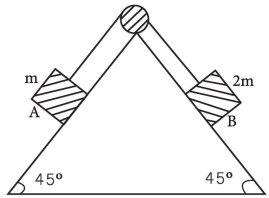
Consider the diagram shown below in which two masses of $m$ and $2 m$ are placed on a fixed triangular wedge. The coefficient of friction between block $A$ and the wedge is $2 / 3$, while that for block $B$ and the wedge is $1 / 3$
The relative density of material of a body is found by weighing it first in air and then in water. If the weight in air is ($5.00 \pm 0.05$) Newton and weight in water is ($4.00 \pm 0.05$) Newton. Then the relative density along with the maximum permissible percentage error is
Which of the following statements is true for a car moving on the road?
A particle is moving along a straight line with constant acceleration. At the end of tenth  second its velocity becomes $20\, m/s$ and in tenth second it travels a distance of $10\, m$.  Then the acceleration of the particle will be........$m/s^2$
If an object is projected vertically upwards with speed, half the escape speed of earth, then the maximum height attained by it is [ $R$ is radius of earth]
That gas cannot be liquified
If $W$ be the weight of a body of density $\rho $ in vacuum then its apparent weight in air of density $\sigma $ is