MCQ
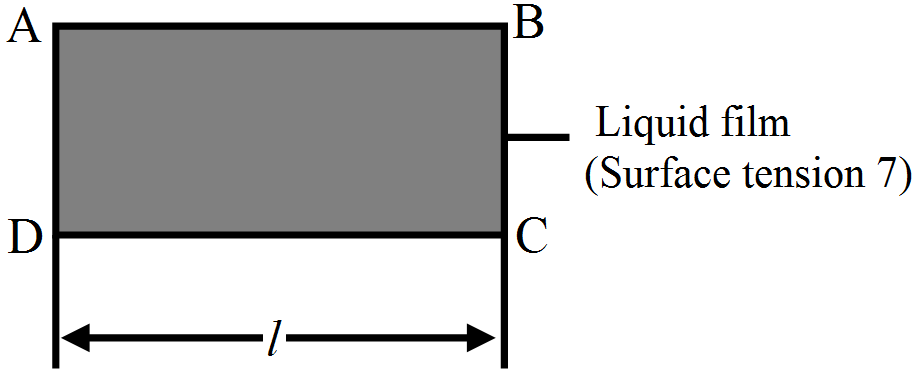
A liquid film is formed over a frame $\text{ABCD}$ as shown in figure. Wire $\text{CD}$ can slide without friction. Maximum value of mass that can be hanged from $\text{CD}$ without breaking the liquid film is:
  • A
    $\frac{\text{Tl}}{\text{g}}$
  • $\frac{2\text{Tl}}{\text{g}}$
  • C
    $\frac{\text{g}}{2\text{Tl}}$
  • D
    $\text{T}\times\text{l}$

Answer

Correct option: B.
$\frac{2\text{Tl}}{\text{g}}$

Need a full question paper?

Generate a complete, print-ready paper with questions like this in minutes — across 16+ boards, with answer keys.

Start Generating Free

Similar questions

The time period of a satellite, revolving above earth's surface at a height equal to $R$ will be (Given $g =\pi^2 m / s ^2, R =$ radius of earth)
$Assertion$ : A tennis ball bounces higher on hills than in plains.
$Reason$ : Acceleration due to gravity on the hill is greater than that on the surface of earth
At whose name did India launch the first statellie?
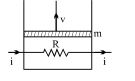
A resistance coil connected to an external battery is placed inside an adiabatic cylinder fitted with a frictionless pistn and containing an ideal gas. A current $i$ flows through the coil which has a resistance $R$. At what speed must the piston move upward in order that the temperature of the gas remains uchanged? Neglect atmospheric pressure. 
The mass and volume of a body are $4.237g$ and $2.5\ cm^3$, respectively. The density of the material of the body in correct significant figures is:
A gas behaves more closely as an ideal gas at:
A thermo-dynamical system is changed from state $({P_1},\,{V_1})$ to $({P_2},\,{V_2})$ by two different process. The quantity which will remain same will be
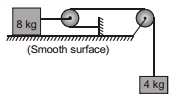
If pulleys shown in the diagram are smooth and massless and $a_1$ and $a_2$ are acceleration of blocks of mass $4 \,kg$ and $8 \,kg$ respectively, then
The ratio of Young's modulus of the material of two wires is $2 : 3.$ If the same stress is applied on both, then the ratio of elastic energy per unit volume will be
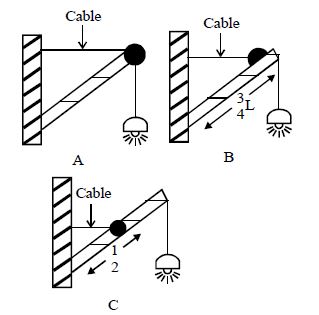
If a street light of mass $M$ is suspended from the end of a uniform rod of length $L$ in different possible patterns as shown in figure, then