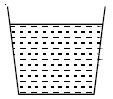
A liquid of mass $1$ $kg$ is filled in a flask as shown in figure. The force exerted by the flask on the liquid is $(g = 10\ m/s^2)$[Neglect atmospheric pressure]:
Medium
Download our app for free and get started
Force applied by liquid on flask $=m g=1 \times 10=10 N$
As there is no atmospheric pressure and liquid is stationary with respect to flask
so force exerted by the liquid on flask $=$ force exerted by flask on liquid $=10 N$

Download our appand get started for free
Experience the future of education. Simply download our apps or reach out to us for more information. Let's shape the future of learning together!No signup needed.*
Similar Questions
- 1Two small spherical metal balls, having equal masses, are made from materials of densities $\rho_{1}$ and $\rho_{2}\left(\rho_{1}=8 \rho_{2}\right)$ and have radii of $1\; \mathrm{mm}$ and $2\; \mathrm{mm}$, respectively. They are made to fall vertically (from rest) in a viscous medum whose coefficient of viscosity equals $\eta$ and whose denstry is $0.1 \mathrm{\rho}_{2} .$ The ratio of their terminal velocitites would beView Solution
- 2There is a $1$ $mm $ thick layer of glycerine between a flat plate of area $100$ $cm^2$ $\&$ a big fixed plate. If the coefficient of viscosity of glycerine is $1.0$ $kg/m^{-s}$ then ....... $N$ force is required to move the plate with a velocity of $7$ $cm/s$ ?View Solution
- 3A triangular lamina of area $A$ and height h is immersed in a liquid of density $\rho $ in a vertical plane with its base on the surface of the liquid. The thrust on the lamina isView Solution
- 4View SolutionIncrease in pressure at one point of the enclosed liquid in equilibrium of rest is transmitted equally to all other points of liquid. This is as per ...........
- 5What is the pressure in $atm$ on a swimmer $10\; m$ below the surface of a lake?View Solution
- 6A metal ball of density $7800\ kg/m^3$ is suspected to have a large number of cavities . It weighs $9.8$ $kg$ when weighed directly on a balance and $1.5$ $kg$ less when immersed in water . The fraction by volume of the cavities in the metal ball is approximately ....... $\%$View Solution
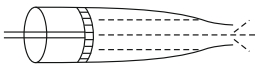
- 7Figure below shows a liquid being pushed out of the tube by a piston having area of cross section $2.0\,cm ^2$. The area of cross section at the outlet is $10\,mm ^2$. If the piston is pushed at a speed of $4\,cm s ^{-1}$, the speed of outgoing fluidis $.........\,cm s ^{-1}$.View Solution
- 8A spherical ball of density $\rho$ and radius $0.003$ $m$ is dropped into a tube containing a viscous fluid filled up to the $0$ $ cm$ mark as shown in the figure. Viscosity of the fluid $=$ $1.260$ $N.m^{-2}$ and its density $\rho_L=\rho/2$ $=$ $1260$ $kg.m^{-3}$. Assume the ball reaches a terminal speed by the $10$ $cm$ mark. The time taken by the ball to traverse the distance between the $10$ $cm$ and $20$ $cm$ mark isView Solution
( $g$ $ =$ acceleration due to gravity $= 10$ $ ms^{^{-2}} )$

- 9A rectangular box has water in it. It is being pulled to the right with an acceleration $a$. Which of the following options shows the correct shape of water surface on it ?View Solution
- 10View SolutionAn ice block floats in a liquid whose density is less than water. A part of block is outside the liquid. When whole of ice has melted, the liquid level will