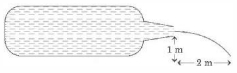
Figure below shows a liquid being pushed out of the tube by a piston having area of cross section $2.0\,cm ^2$. The area of cross section at the outlet is $10\,mm ^2$. If the piston is pushed at a speed of $4\,cm s ^{-1}$, the speed of outgoing fluidis $.........\,cm s ^{-1}$.
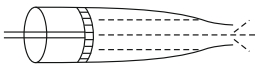
JEE MAIN 2023, Easy


Download our appand get started for free
Experience the future of education. Simply download our apps or reach out to us for more information. Let's shape the future of learning together!No signup needed.*
Similar Questions
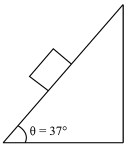
- 1A cubical block of side $‘a’$ and density $‘\rho ’$ slides over a fixed inclined plane with constant velocity $‘v’$. There is a thin film of viscous fluid of thickness $‘t’$ between the plane and the block. Then the coefficient of viscosity of the thin film will be:View Solution
- 2A liquid is kept in a cylindrical vessel which rotated along its axis. The liquid rises at the sides. If the radius of the vessel is $0.05\,m$ and the speed of rotation is $2\,rev/s$ , The difference in the height of the liquid at the centre of the vessel and its sides will be .............. $\mathrm{cm}$ $(\pi ^2 = 10)$View Solution
- 3A liquid of density $\rho $ is coming out of a hose pipe of radius $a$ with horizontal speed $v$ and hits a mesh. $50\%$ of the liquid passes through the mesh unaffected. $25\%$ looses all of its momentum and $25\%$ comes back with the same speed. The resultant pressure on the mesh will beView Solution
- 4Small water droplets of radius $0.01 \mathrm{~mm}$ are formed in the upper atmosphere and falling with a terminal velocity of $10 \mathrm{~cm} / \mathrm{s}$. Due to condensation, if $8 \mathrm{such}$ droplets are coalesced and formed a larger drop, the new terminal velocity will be ........... $\mathrm{cm} / \mathrm{s}$.View Solution
- 5A barometer kept in an elevator reads $76 \,cm$ when the elevator is accelerating upwards. The most likely pressure inside the elevator (in $cm$ of $Hg$ ) is ........View Solution
- 6View SolutionA block of ice floats in an oil in a vessel when the ice melts, the level of oil will ..............
- 7View SolutionGauge pressure ........
- 8Two capillary of length $L $ and $2L$ and of radius $R$ and $2R$ are connected in series. The net rate of flow of fluid through them will be (given rate of the flow through single capillary, $X = \pi P{R^4}/8\eta L)$View Solution
- 9View SolutionIn a laminar flow the velocity of the liquid in contact with the walls of the tube is
- 10A bottle has a thin nozzle on top. It is filled with water, held horizontally at a height of $1 \,m$ and squeesed slowly by hands, so that the water jet coming out of the nozzle hits the ground at a distance of $2 \,m$. If the area over which the hands squeese it is $10 \,cm ^{2}$, the force applied by hand is close to .......... $N$ (take, $g=10 \,m / s ^{2}$ and density of water $=1000 \,kg / m ^{3}$ )View Solution