MCQ
A liquid with coefficient of volume expansion $\gamma$ is filled in a container of a material having the coefficient of linear expansion $\alpha$. If the liquid overflows on heating, then
  • A
    $\gamma = 3 \alpha$
  • $\gamma > 3 \alpha$
  • C
    $\gamma < 3 \alpha$
  • D
    $\gamma > 3 \alpha^3$

Answer

Correct option: B.
$\gamma > 3 \alpha$
b
Volumetric coefficient of expansion of material is $3 a$

As the system is heated liquid started flowing out of box, it means volumetric coefficient of expansion of liquid is greater then of the container.

$\mathrm{So}, \gamma>3 a$

Need a full question paper?

Generate a complete, print-ready paper with questions like this in minutes — across 16+ boards, with answer keys.

Start Generating Free

Similar questions

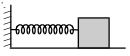
A spring block system is placed on a rough horizontal floor. The block is pulled towards right to give spring some elongation and released.
A vessel contains a mixture of one mole of oxygen and two moles of nitrogen at $300 K$. The ratio of the average rotational kinetic energy per ${O_2}$ molecule to that per ${N_2}$ molecule is
A bullet of mass m fired at $30^\circ$ to the horizontal leaves the barrel of the gun with a velocity $v.$ The bullet hits a soft target at a height h above the ground while it is moving downward and emerges out with half the kinetic energy it had before hitting the target. Which of the following statements are correct in respect of bullet after it emerges out of the target?
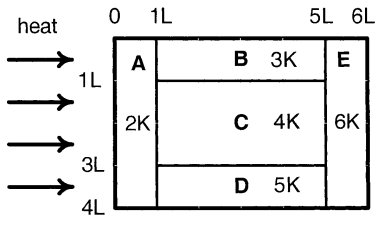
A composite block is made of slabs $A, B, C, D$ and $E$ of different thermal conductivities (given in terms of a constant $K$ ) and sizes (given in terms of length, $L$ ) as shown in the figure. All slabs are of same width. Heat $'Q'$ flows only from left to right through the blocks. Then in steady state $Image$

$(A)$ heat flow through $A$ and $E$ slabs are same.

$(B)$ heat flow through slab $E$ is maximum.

$(C)$ temperature difference across slab $E$ is smallest.

$(D)$ heat flow through $C =$ heat flow through $B +$ heat flow through $D$.

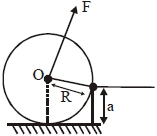
A uniform cylinder of mass $M$ and radius $R$ is to be pulled over a step of height $a (a < R$) by applying a force $F$ at its centre $'O'$ perpendicular to the plane through the axes of the cylinder on the edge of the step ( see figure). The minimum value of $F$ required is 
$Assertion$ : $n$ small balls each of mass $m$ colliding elastically each second on surface with velocity $u$. The force experienced by the surface is $2\,mnu$.

$Reason$ : On elastic collision, the ball rebounds with the same velocity.

Abody performs simple harmonic oscillations along the straight line $ABCDE$ with $C$ as the midpoint of $AE.$ Its kinetic energies at $B$ and $D$ are each one fourth of its maximum value. If $AE = 2R,$ the distance between $B$ and $D$ is
If the radius of a star is $R$ and it acts as a black body, what would be the temperature of the star, in which the rate of energy production is $Q$?

($\sigma$ stands for Stefan's constant)

A sphere is rotating about a diameter:
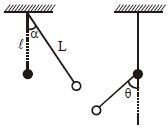
A simple pendulum consisting of a mass $M$ attached to a string of length $L$ is released from rest at an angle $\alpha$. $A$ pin is located at a distance $l$ below the pivot point. When the pendulum swings down, the string hits the pin as shown in the figure. The maximum angle $\theta$ which string makes with the vertical after hitting the pin is :-