A load $W$ produces an extension of $1mm$ in a thread of radius $r.$ Now if the load is made $4W$ and radius is made $2r$ all other things remaining same, the extension will become..... $mm$
Medium
Download our app for free and get started
(c) $l = \frac{{FL}}{{AY}}\therefore l \propto \frac{F}{{{r^2}}}$
$\frac{{{l_1}}}{{{l_2}}} = \frac{{{F_2}}}{{{F_1}}}{\left( {\frac{{{r_1}}}{{{r_2}}}} \right)^2} = (4) \times {\left( {\frac{1}{2}} \right)^2} = 1$
${l_2} = {l_1} = 1mm$

Download our appand get started for free
Experience the future of education. Simply download our apps or reach out to us for more information. Let's shape the future of learning together!No signup needed.*
Similar Questions
- 1A force of $200\, N$ is applied at one end of a wire of length $2\, m$ and having area of cross-section ${10^{ - 2}}\,c{m^2}$. The other end of the wire is rigidly fixed. If coefficient of linear expansion of the wire $\alpha = 8 \times 10{^{-6}}°C^{-1}$ and Young's modulus $Y = 2.2 \times {10^{11}}\,N/{m^2}$ and its temperature is increased by $5°C$, then the increase in the tension of the wire will be ........ $N$View Solution
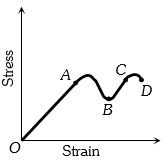
- 2In the below graph, point $B$ indicatesView Solution
- 3A load $W$ produces an extension of $1mm$ in a thread of radius $r.$ Now if the load is made $4W$ and radius is made $2r$ all other things remaining same, the extension will become..... $mm$View Solution
- 4A wire is loaded by $6\, kg$ at its one end, the increase in length is $12\, mm.$ If the radius of the wire is doubled and all other magnitudes are unchanged, then increase in length will be ......... $mm$View Solution
- 5A rod of uniform cross-sectional area $A$ and length $L$ has a weight $W$. It is suspended vertically from a fixed support. If Young's modulus for rod is $Y$, then elongation produced in rod is ......View Solution

- 6View SolutionThe Young's modulus of steel is twice that of brass. Two wires of same length and of same area of cross section, one of steel and another of brass are suspended from the same roof. If we want the lower ends of the wires to be at the same level, then the weights added to the steel and brass wires must be in the ratio of
- 7A stress of $1.5\,kg.wt/mm^2$ is applied to a wire of Young's modulus $5 \times 10^{11}\,N/m^2$ . The percentage increase in its length isView Solution
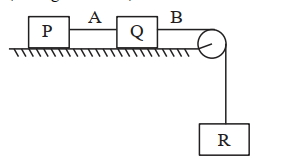
- 8Each of three blocks $P$, $Q$ and $R$ shown in figure has a mass of $3 \mathrm{~kg}$. Each of the wire $A$ and $B$ has cross-sectional area $0.005 \mathrm{~cm}^2$ and Young's modulus $2 \times 10^{11} \mathrm{~N} \mathrm{~m}^{-2}$. Neglecting friction, the longitudinal strain on wire $B$ is____________ $\times 10^{-4}$. $\left(\right.$ Take $\mathrm{g}=10 \mathrm{~m} / \mathrm{s}^2$ )View Solution
- 9A steel wire having a radius of $2.0\, mm$, carrying a load of $4\, kg$, is hanging from a ceiling. Given that $g = 3.1\pi \,m{s^{ - 2}}$ , what will be the tensile stress that would be developed in the wire?View Solution
- 10A steel wire can sustain $100\,kg$ weight without breaking. If the wire is cut into two equal parts, each part can sustain a weight of ......... $kg$View Solution