Question

A logic gate is an electronic circuit which

(a) Makes logic decisions

(b) Allows electrons flow only in one direction

(c) Works binary algebra

(d) Alternates between 0 and 1 values

Answer

(a) Makes logic decisions

Need a full question paper?

Generate a complete, print-ready paper with questions like this in minutes — across 16+ boards, with answer keys.

Start Generating Free

Similar questions

Two conducting spheres of radii 5 cm and 10 cm are given a charge of 15 μC  each. After the two spheres are joined by a conducting wire, the charge on the smaller sphere is

(a) 5 μC   

(b) 10 μC

(c) 15 μC

(d) 20 μC

A closed cubical box is completely filled with water and is accelerated horizontally towards right with an acceleration α. The resultant normal force by the water on the top of the box.
  1. Passes through the centre of the top.
  2. Passes through a point to the right of the centre.
  3. Passes through a point to the left of the centre.
  4. Pecomes zeros.

Two coherent light sources S1 and S2 (l= 6000 Å) are 1mm apart from each other. The screen is placed at a distance of 25 cm from the sources. The width of the fringes on the screen should be

(a) 0.015 cm

(b) 0.025 cm

(c) 0.010 cm

(d) 0.030 cm

A free neutron decays to a proton but a free proton does not decay to a neutron. This is because:

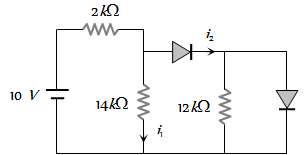
In the following circuit find I1 and I2

(a) 0, 0

(b) 5 mA, 5 mA

(c) 5 mA, 0

(d) 0, 5 mA

The angle which subtends the periphery of the spherical mirror at the centre of curvature is called:

Which scientist proposed the concept of atomic mass?

The formula for induced e.m.f. in a coil due to change in magnetic flux through the coil is (here A = area of the coil, B = magnetic field)

(a) e = - A.

(b) e = -B.

(c) e = -

(d) e = -)

The capacitor of capacitance 4 μF  and 6 μF  are connected in series. A potential difference of  500 volts is applied to the outer plates of the two capacitor system. The potential difference across the plates of capacitor of 4 μF  capacitance is

(a) 500 volts

(b) 300 volts

(c) 200 volts

(d) 250 volts

The energy of a given sample of an ideal gas depends only on its:
  1. Volume.
  2. Pressure.
  3. Density.
  4. Temperature.