Question
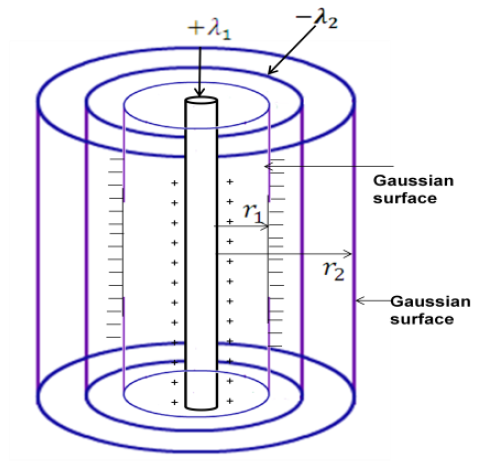
A long charged cylinder of linear charge density $+\lambda_1$ is surrounded by a hollow coaxial conducting cylinder of linear charge density $-\lambda_2$. Use Gauss’s law to obtain expressions for the electric field at a point (i) in the space between the cylinders, and (ii) outside the larger cylinder.
Answer

As Gauss’s Law states:

$\oint\overrightarrow{E}.\vec{ds}=\frac{q}{\in_0}$

  1. $\oint\overrightarrow{E_1}.\vec{ds}=\frac{\lambda_1l}{\in_0}$

$\Longrightarrow\overrightarrow{E_1}=\frac{\lambda_1}{2\pi\in_0r_1}\hat{r_1}$

  1. $\oint\overrightarrow{E_2}.\vec{ds}=\frac{(\lambda_1-\lambda_2)l}{\in_0}$

$\Longrightarrow\overrightarrow{E_2}=\frac{(\lambda_1-\lambda_2)}{2\pi\in_0r_2}\hat{r_2}$

Need a full question paper?

Generate a complete, print-ready paper with questions like this in minutes — across 16+ boards, with answer keys.

Start Generating Free

Similar questions

A galvanometer coil has a resistance of 15 Ω and the metre shows full scale deflection for a current of 4 mA. How will you convert the metre into an ammeter of range 0 to 6 A?
A proton describes a circle of radius 1cm in a magnetic field of strength 0.10T. What would be the radius of the circle described by an α-particle moving with the same speed in the same magnetic field?
Locate the image formed by refraction in the situation shown in figure.

Two equal charges are placed at a separation of 1.0m. What should be the magnitude of the charges so that the force between them equals the weight of a 50kg person?
Show that the radiation pressure exerted by an EM wave of intensity I on a surface kept in vacuum is I/c.
  1. Define current sensitivity of a galvanometer. Write its expression.
  2. A galvanometer has resistance G and shows full scale deflection for current Ig.
  1. How can it be converted into an ammeter to measure current up to I0(I0 > Ig)?
  2. What is the effective resistance of this ammeter?
Explain how the electron was historically discovered.
Show that the wavelength of electromagnetic radiation is equal to the de Broglie wavelength of its quantum (photon).
  1. Using the phenomenon of polarisation, show how transverse nature of light can be demonstrated.
  2. Two polaroids P1 and P2 are placed with their pass axes perpendicular to each other. Unpolarised light of intensity Io is incident on P1. A third polaroid P3 is kept in between P1 and P2 such that its pass axis makes an angle of 300 with that of P1. Determine the intensity of light transmitted through P1, P2 and P3.
A hydrogen atom in state n = 6 makes two successive transitions and reaches the ground state. In the first transition a photon of 1.13eV is emitted. (a) Find the energy of the photon emitted in the second transition (b) What is the value of n in the intermediate state?