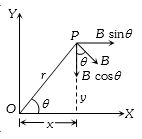
A long straight wire along the $z$-axis carries a current $I$ in the negative $z$ direction. The magnetic vector field $\mathop B\limits^ \to $ at a point having coordinates $(x, y)$ in the $z = 0$ plane is
IIT 2002, Diffcult


Download our appand get started for free
Experience the future of education. Simply download our apps or reach out to us for more information. Let's shape the future of learning together!No signup needed.*
Similar Questions
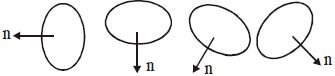
- 1Figure represents four positions of a current carrying coil is a magnetic field directed towards right. $\hat n$ represent the direction of area of vector of the coil. The correct order of potential energy isView Solution
- 2A charge of $2.0\,\mu C$ moves with a speed of $3.0 \times {10^6}\,m{s^{ - 1}}$ along $+ ve$ $X$ - axis $A$ magnetic field of strength $\vec B = - 0.2\,\,\hat k$ $Tesla$ exists in space. What is the magnetic force $({\overrightarrow F _m})$ on the chargeView Solution
- 3View SolutionMotion of a moving electron is not affected by
- 4A particle of mass $m$ and charge $q$ moving with velocity $v$ enters a region of uniform magnetic field $B.$ ThenView Solution
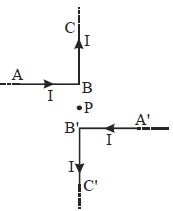
- 5Current through $ABC$ and $A'B'C'$ is $I$. What is the magentic field at $P$ ? $BP = PB' = r$ (Here $C'B'PBC$ are collinear)View Solution
- 6The resistance of a galvanometer is $50\,\Omega $ and it requires $2\,\mu A$ per two division deflection. The value of the shunt required in order to convert this galvanometer into ammeter of range $5\,A$ is (The number of divisions on the galvanometer scale on one side is $30$)View Solution
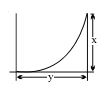
- 7$A$ particle having charge $q$ enters a region of uniform magnetic field $\vec B$ (directed inwards) and is deflected a distance $x$ after travelling a distance $y$. The magnitude of the momentum of the particle is:View Solution
- 8A current of $3$ $amp$ is flowing in a plane circular coil of radius $4\, cm$ and number of turns $20$. The coil is placed in a uniform magnetic field of magnetic induction $0.5\, tesla$. Then, the dipole moment of the coil is.....$A-m^2$View Solution
- 9A circular coil having $200$ turns, $2.5 \times 10^{-4} \mathrm{~m}^2$ area and carrying $100 \mu \mathrm{A}$ current is placed in a uniform magnetic field of $1 \mathrm{~T}$. Initially the magnetic dipole moment $(\vec{M})$ was directed along $\vec{B}$. Amount of work, required to rotate the coil through $90^{\circ}$ from its initial orientation such that $\overrightarrow{\mathrm{M}}$ becomes perpendicular to $\vec{B}$, is. . . . $\mu \mathrm{J}$.View Solution
- 10An electron is moving along $+x$ direction. To get it moving along an anticlockwise circular path in $x-y$ plane, magnetic field applied alongView Solution