Question
A long, straight wire carries a current. Is Ampere's law valid for a loop that does not enclose the wire? That encloses the wire but is not circular?

Answer

Ampere's law is valid for a loop that is not circular. However, it should have some charge distribution in the area enclosed so as to have a constant electric field in the region and a non-zero magnetic field. Even if the loop defined does not have its own charge distribution but has electric influence of some other charge distribution, it can have some constant magnetic field $\big(\oint\overrightarrow{\text{B}}.\text{d}\overrightarrow{\text{l}}=\mu_0\text{i}\ \text{enclosed}\big).$

Need a full question paper?

Generate a complete, print-ready paper with questions like this in minutes — across 16+ boards, with answer keys.
Start Generating Free

Similar questions

Draw a circuit diagram for use of NPN transistor as an amplifier in common emitter configuration. The input resistance of a transistor is $1000 \Omega$. On changing its base current by $10\mu\text{A}$ the collector current increases by 2mA. If a load resistance of $5\text{K}\Omega$. Is used in the circuit, calculate:
  1. The current gain.
  2. Voltage gain of the amplifier.
It is said that any charge given to a conductor comes to its surface. Should all the protons come to the surface? Should all the electrons come to the surface? Should all the free electrons come to the surface?
If three helium nuclei combine to form a carbon nucleus, energy is liberated. Why can't helium nuclei combine on their own and minimise the energy?
Using lens maker's formula obtain the equation of lens.
Deduce the expression for the electrostatic energy stored in a capacitor of capacitance 'C' and having charge 'Q'.
How will the (i) energy stored and (ii) the electric field inside the capacitor be affected when it is completely filled with a dielectric material of dielectric constant 'K'?
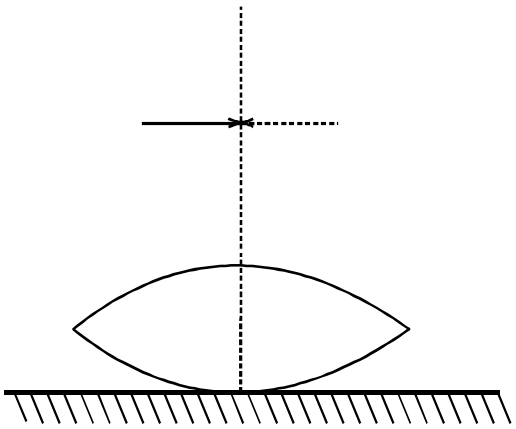
A symmetric biconvex lens of radius of curvature R and made of glass of refractive index 1·5, is placed on a layer of liquid placed on top of a plane mirror as shown in the figure. An optical needle with its tip on the principal axis of the lens is moved along the axis until its real, inverted image coincides with the needle itself. The distance of the needle from the lens is measured to be x. On removing the liquid layer and repeating the experiment, the distance is found to be y. Obtain the expression for the refractive index of the liquid in terms of x and y.

In an experiment on photoelectric effect, the slope of the cut-off voltage versus frequency of incident light is found to be 4.12 × 10–15 Vs. Calculate the value of Planck’s constant.
A hot gas emits radiation of wavelengths 46.0nm, 82.8nm and 103.5nm only. Assume that the atoms have only two excited states and the difference between consecutive energy levels decreases as energy is increased. Taking the energy of the highest energy state to be zero, find the energies of the ground state and the first excited state.
The human eye has an approximate angular resolution of $\phi=5.8\times10^{-4}$ rad and a typical photoprinter prints a minimum of 300dpi (dots per inch, 1inch = 2.54cm). At what minimal distance z should a printed page be held so that one does not see the individual dots.
Consider two pairs of neutrons. In each pair, the separation between the neutrons is the same. Can the force between the neutrons have different magnitudes for the two pairs?