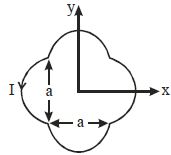
A loop in form of four connected semi-circular wires carrying current $I$ lies in the $x-y$ plane as shown in the figure. The unit vector $\hat k$ is coming out of the plane of the paper. The magnetic moment of the current loop is
Medium
Download our app for free and get started
Magnetic moment of the current loop
$A=\pi\left(\frac{a}{2}\right)^{2} \times 2+a^{2}$
$=\left(\frac{\pi}{2}+1\right) \mathrm{a}^{2}$
$\overrightarrow {\text{M}} = {\text{I}}\overrightarrow {\text{A}} = \left( {\frac{\pi }{2} + 1} \right){\text{I}}{{\text{a}}^2}\widehat {\text{k}}$

Download our appand get started for free
Experience the future of education. Simply download our apps or reach out to us for more information. Let's shape the future of learning together!No signup needed.*
Similar Questions
- 1View SolutionFrom Ampere's circuital law for a long straight wire of circular cross-section carrying a steady current, the variation of magnetic field in the inside and outside region of the wire is :
- 2A proton moving with a constant velocity, passes through a region of space without change in its velocity. If $E$ $\& B$ represent the electric and magnetic fields respectively, this region may haveView Solution
- 3Two protons move parallel to each other, keeping distance $r$ between them, both moving with same velocity $\vec V\,$. Then the ratio of the electric and magnetic force of interaction between them isView Solution
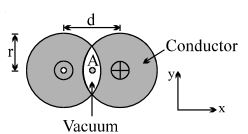
- 4Two long conductors are arranged as shown above to form overlapping cylinders, each of raidus $r$, whose centers are separated by a distance $d$. Current of density $J$ flows into the plane of the page along the shaded part of one conductor and an equal current flows out of the plane of the page along the shaded portion of the other, as shown. What are the magnitude and direction of the magnetic field at point $A?$View Solution
- 5An electron is travelling along the $x$-direction. It encounters a magnetic field in the $y$-direction. Its subsequent motion will beView Solution
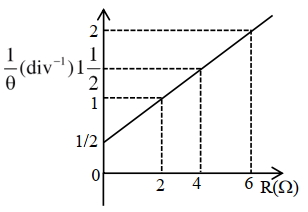
- 6In the experiment to determine the galvanometer resistance by half-deflection method, the plot of $\frac{1}{\theta}$ vs the resistance $(R)$ of the resistance box is shown in the figure. The figure of merit of the galvanometer is .............. $\times 10^{-1} \mathrm{~A} /$ division. [The source has emf 2V]View Solution
- 7A symmetric star conducting wire loop is carrying a steady state current $\mathrm{I}$ as shown in figure. The distance between the diametrically opposite vertices of the star is $4 a$. The magnitude of the magnetic field at the center of the loop isView Solution
- 8Two concentric coils $X$ and $Y$ of radii $16 \,\,cm$ and $10 \,\,cm$ lie in the same vertical plane containing $N-S$ direction. $X$ has $20$ $turns$ and carries $16 \,\,A.$ $Y$ has $25$ $turns$ $\&$ carries $18\,A$. $X$ has current in anticlockwise direction and $Y$ has current in clockwise direction for an observer, looking at the coils facing the west. The magnitude of net magnetic field at their common centre isView Solution
- 9A proton of mass $1.67\times10^{-27}\, kg$ and charge $1.6\times10^{-19}\, C$ is projected with a speed of $2\times10^6\, m/s$ at an angle of $60^o$ to the $X-$ axis. If a uniform magnetic field of $0.104\, tesla$ is applied along the $Y-$ axis, the path of the proton isView Solution
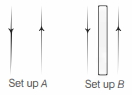
- 10In an experiment, set up $A$ consists of two parallel wires which carry currents in opposite directions as shown in the figure. $A$ second set up $B$ is identical to set up $A$, except that there is a metal plate between the wires. Let $F_A$ and $F_B$ be the magnitude of the force between the two wires in setup $A$ and setup $B$, respectively.View Solution