MCQ
A loop is moulded by a constant length current carrying wire and placed in external magnetic field, then torque acts on it does not depends upon

$(a)$ Shape of loop

$(b)$ Area of loop.

$(c)$ Current in loop

$(d)$ External magnetic field.


  • A
    Only $a$
  • B
    $a, b$
  • C
    $b, c$
  • None

Answer

Correct option: D.
None
d

Need a full question paper?

Generate a complete, print-ready paper with questions like this in minutes — across 16+ boards, with answer keys.

Start Generating Free

Similar questions

Eddy currents are induced when
If a voltage applied to an $X$ - ray tube is increased to $1.5$ times the minimum wavelength $({\lambda _{\min }})$ of an $X$ - ray continuous spectrum shifts by $\Delta \lambda = 26\,pm$. The initial voltage applied to the tube is
The work function of a photoelectric material is $3.3 eV$. The threshold frequency will be equal to
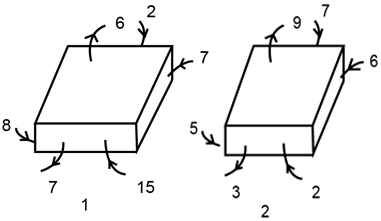
The figure shows two situations in which a Gaussian cube sits in an electric field. The arrows and values indicate the directions and magnitudes (in $N-m^2/C$) of the electric fields. What is the net charge (in the two situations) inside the cube?
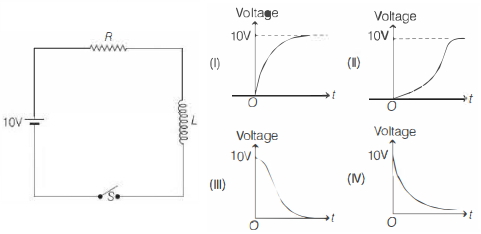
In the circuit shown below, the switch is closed at time $t=0$. Which of the graphs shown below best represents the voltage across the inductor, as seen on an oscilloscope?
The torque on a bar magnet due to the earth's magnetic field is maximum when the axis of the magnet is
The temperature inside and outside a refrigerator are $273 \,K$ and $300 \,K$ respectively. Assuming that the refrigerator cycle is reversible, for every joule of work done, the heat delivered to the surrounding will be nearly ........ $J$
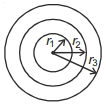
Figure shows three concentric metallic spherical shells. The outermost shell has charge $q_2$, the inner most shell has charge $q_1$, and the middle shell is uncharged. The charge appearing on the inner surface of outermost shell is
The pressure exerted by the gas on the walls of the container because
The maximum velocity of the photoelectrons emitted from the surface is $v$ when light of frequency $n$ falls on a metal surface. If the incident frequency is increased to $3n$ , the maximum velocity of the ejected photoelectrons will be