MCQ
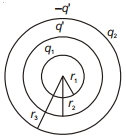
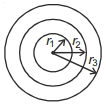
Figure shows three concentric metallic spherical shells. The outermost shell has charge $q_2$, the inner most shell has charge $q_1$, and the middle shell is uncharged. The charge appearing on the inner surface of outermost shell is
  • A
    $q_1+q_2$
  • B
    $\frac{q_2}{2}$
  • $-q_1$
  • D
    $0$

Answer

Correct option: C.
$-q_1$
c
(c)

Suppose a guassian surface passes through conducting shell with radius $\left(r_3\right)$

Flux through it well be zero. So, net charge enclosed must be zero.

$\therefore q_1+q^{\prime}=0$

$q^{\prime}=-q_1$

Need a full question paper?

Generate a complete, print-ready paper with questions like this in minutes — across 16+ boards, with answer keys.

Start Generating Free

Similar questions

When $2 \,\,gms$ of a gas are introduced into an evacuated flask kept at $25\,^0C$ the pressure is found to be one atmosphere. If $3 \,\,gms$ of another gas added to the same flask the pressure becomes $1.5$ atmospheres. The ratio of the molecular weights of these gases will be
Paramagnetic substances:
A. align themselves along the directions of external magnetic field.
B. attract strongly towards external magnetic field.
C. has susceptibility little more than zero.
D. move from a region of strong magnetic field to weak magnetic field.
Choose the most appropriate answer from the options given below:
The current in the windings of a toroid is $2.0\,A$. There are $400\,turns$ and the mean circumferential length is $40\,cm$. If the inside magnetic field is $1.0\,T,$ the relative permeability is near to
A wheel initially at rest, is rotated with a uniform angular acceleration. The wheel rotates through an angle ${\theta _1}$ in first one second and through an additional angle ${\theta _2}$ in the next one second. The ratio $\frac{{{\theta _2}}}{{{\theta _1}}}$ is
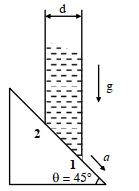
A cylindrical tube, with its base as shown in the figure, is filled with water. It is moving down with a constant acceleration $a$ along a fixed inclined plane with angle $\theta=45^{\circ} . P_1$ and $P_2$ are pressures at points 1 and 2 , respectively, located at the base of the tube. Let $\beta=\left(P_1-P_2\right) /(\rho g d)$, where $\rho$ is density of water, $d$ is the inner diameter of the tube and $g$ is the acceleration due to gravity. Which of the following statement($s$) is(are) correct?

$(A)$ $\beta=0$ when $a= g / \sqrt{2}$

$(B)$ $\beta>0$ when $a= g / \sqrt{2}$

$(C)$ $\beta=\frac{\sqrt{2}-1}{\sqrt{2}}$ when $a= g / 2$

$(D)$ $\beta=\frac{1}{\sqrt{2}}$ when $a= g / 2$

A body of mass $1\ kg$ is thrown upwards with a velocity $20\ m/s.$ It momentarily comes to rest after attaining a height of $18 m.$ How much energy is lost due to air friction ? $........... \mathrm{J}(g = 10\ m/s^2)$
What fraction of a radioactive material will get disintegrated in a period of two half-lives
Calculate the wavelength of light used in an interference experiment from the following data : Fringe width $=0.03\,cm$. Distance between the slits and eyepiece through which the interference pattern is observed is $1\,m$. Distance between the images of the virtual source when a convex lens of focal length $16\,cm$ is used at a distance of $80\,cm$ from the eyepiece is $0.8\,cm$.
A uniform solid sphere of mass $M$ and radius $R$ is surrounded symmetrically by a uniform thin spherical shell of equal mass and radius $2R$. The value of gravitational potential at a distance $\frac{3}{2}\,R$ from the centgre is 
Half life of $B{i^{210}}$ is $5$ days. If we start with $50,000$ atoms of this isotope, the number of atoms left over after $10$ days is