Question
A man is standing in a lift which goes up and comes down with the same constant acceleration. If the ratio of the apparent weights in the two cases is $2 : 1$, then the acceleration of the lift is  ......... $m/s^2$

Answer

$\frac{{m\,\left( {g + a} \right)}}{{m\,\left( {g - a} \right)}} = \frac{2}{1} \Rightarrow a = 3.33\,m/{s^2}$

Need a full question paper?

Generate a complete, print-ready paper with questions like this in minutes — across 16+ boards, with answer keys.
Start Generating Free

Similar questions

In an $L-R$ circuit connected to a battery the rate at which energy is stored in the inductor is plotted against time during the growth of the current in the circuit. Which of the following best represents the resulting curve
A bullet of mass $50 \mathrm{~g}$ is fired with a speed $100 \mathrm{~m} / \mathrm{s}$ on a plywood and emerges with $40 \mathrm{~m} / \mathrm{s}$. The percentage loss of kinetic energy is :
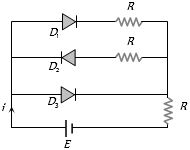
In the following circuit of $PN$ junction diodes $D_1, D_2$ and $D_3$ are ideal then $i$ is
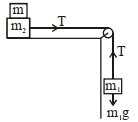
Two masses $m_1 = 5\ kg$ and $m_2 = 10\ kg$, connected by an inextensible string over a frictionless pulley, are moving as shown in the figure. The coefficient of friction of horizontal surface is $0.15$. The minimum weight $m$ that should be put on top of $m_2$ to stop the motion is $...... kg$
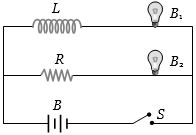
The resistance $R$ is the same as that of the coil that makes $L$. Which of the following statements gives the correct description of the happenings when the switch $S$ is closed
A magnet hung at $45^{\circ}$ with magnetic meridian makes an angle of $60^{\circ}$ with the horizontal. The actual value of the angle of dip is.
The capacity of the conductor does not depend upon
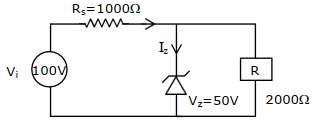
For the circuit shown below, calculate the value of ${I}_{{z}}$ : (In ${mA}$)
The length of an elastic string is a metre when the longitudinal tension is $4\, N$ and $b$ metre when the longitudinal tension is $5\, N$. The length of the string in metre when the longitudinal tension is $9\, N$ is
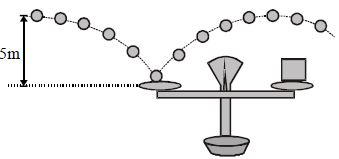
A stream of glass beads, each with a mass of $15\  gram$, comes out of a horizontal tube at a rate of $100\  per second$. The beads fall a distance of $5\  m$ to a balance pan and bounce back to their original height. How much mass(in $kg$) must be placed in the other pan of the balance to keep the pointer at zero?