The length of an elastic string is a metre when the longitudinal tension is $4\, N$ and $b$ metre when the longitudinal tension is $5\, N$. The length of the string in metre when the longitudinal tension is $9\, N$ is
Diffcult
Download our app for free and get started
(b) Let $L$ is the original length of the wire and $K$ is force constant of wire.
Final length $=$ initial length $+$ elongation
$L' = L + \frac{F}{K}$
For first condition $a = L + \frac{4}{K}$…$(i)$
For second condition $b = L + \frac{5}{K}$…$(ii)$
By solving $(i)$ and $(ii)$ equation we get
$L = 5a - 4b$ and $K = \frac{1}{{b - a}}$
Now when the longitudinal tension is $9N,$
length of the string $=$ $L + \frac{9}{K}$= $5a - 4b + 9(b - a)$$x = 5b - 4a$.

Download our appand get started for free
Experience the future of education. Simply download our apps or reach out to us for more information. Let's shape the future of learning together!No signup needed.*
Similar Questions
- 1View SolutionIf the length of a wire is made double and radius is halved of its respective values. Then, the Young's modules of the material of the wire will :
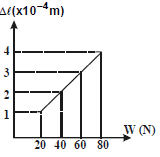
- 2The adjacent graph shows the extension $(\Delta l)$ of a wire of length $1\, m$ suspended from the top of a roof at one end and with a load $W$ connected to the other end. If the cross-sectional area of the wire is $10^{-6}\, m^2$, calculate the Young’s modulus of the material of the wire.View Solution
- 3Consider a thin square plate floating on a viscous liquid in a large tank. The height $h$ of the liquid in the tank is much less than the width of the tank. The floating plate is pulled horizontally with a constant velocity $u_0$. Which of the following statements is (are) true?View Solution
$(A)$ The resistive force of liquid on the plate is inversely proportional to $h$
$(B)$ The resistive force of liquid on the plate is independent of the area of the plate
$(C)$ The tangential (shear) stress on the floor of the tank increases with $u _0$
$(D)$ The tangential (shear) stress on the plate varies linearly with the viscosity $\eta$ of the liquid
- 4A substance breaks down by a stress of $10^6 N/m^2$. If the density of the material of the wire is $3×10^3 kg/m^3$, then the length of the wire of the substance which will break under its own weight when suspended vertically, is ......... $m$View Solution
- 5A uniform heavy rod of mass $20\,kg$. Cross sectional area $0.4\,m ^{2}$ and length $20\,m$ is hanging from a fixed support. Neglecting the lateral contraction, the elongation in the rod due to its own weight is $x \times 10^{-9} m$. The value of $x$ isView Solution
(Given. Young's modulus $Y =2 \times 10^{11} Nm ^{-2}$ અને $\left.g=10\, ms ^{-2}\right)$
- 6The density and breaking stress of a wire are $6 \times$ $10^4 \mathrm{~kg} / \mathrm{m}^3$ and $1.2 \times 10^8 \mathrm{~N} / \mathrm{m}^2$ respectively. The wire is suspended from a rigid support on a planet where acceleration due to gravity is $\frac{1^{\text {rd }}}{3}$ of the value on the surface of earth. The maximum length of the wire with breaking is ............ $\mathrm{m}$ (take, $\mathrm{g}=$ $\left.10 \mathrm{~m} / \mathrm{s}^2\right)$View Solution
- 7A rubber ball is taken to a $100\, m$ deep lake and its volume changes by $0.1\%$. The bulk modulus of rubber is nearlyView Solution
- 8View SolutionThe modulus of elasticity is dimensionally equivalent to
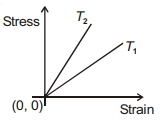
- 9View SolutionFigure shows graph between stress and strain for a uniform wire at two different femperatures. Then
- 10If the breaking force for a given wire is $F$, then the breaking force of two wires of same magnitude will beView Solution