Two masses $m_1 = 5\ kg$ and $m_2 = 10\ kg$, connected by an inextensible string over a frictionless pulley, are moving as shown in the figure. The coefficient of friction of horizontal surface is $0.15$. The minimum weight $m$ that should be put on top of $m_2$ to stop the motion is $...... kg$
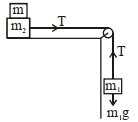
JEE MAIN 2018, Difficult
Download our app for free and get started
Given $m_1=5 \ kg ; m_2=10 \ kg ; \mu=0.15$
For $m_1, m_1 g-T=m_1 a$
$\Rightarrow 50-T=5 \times a$
and, $T-0.15(m+10) g=(10+m) a$
For rest $a=0$
or, $50=0.15(m+10) 10$
$\Rightarrow 5=\frac{3}{20}(m+10)$
$\frac{100}{3}=m+10 \therefore m=23.3 \ kg ;$
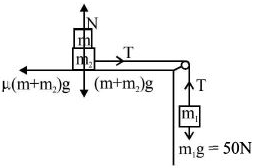
For $m_1, m_1 g-T=m_1 a$
$\Rightarrow 50-T=5 \times a$
and, $T-0.15(m+10) g=(10+m) a$
For rest $a=0$
or, $50=0.15(m+10) 10$
$\Rightarrow 5=\frac{3}{20}(m+10)$
$\frac{100}{3}=m+10 \therefore m=23.3 \ kg ;$

Download our appand get started for free
Experience the future of education. Simply download our apps or reach out to us for more information. Let's shape the future of learning together!No signup needed.*
Similar Questions
- 1A heavy box of mass $50 \mathrm{~kg}$ is moving on a horizontal surface. If co-efficient of kinetic friction between the box and horizontal surface is $0.3$ then force of kinetic friction is :View Solution
- 2A $20\, kg$ block is initially at rest on a rough horizontal surface. A horizontal force of $75 \,N$ is required to set the block in motion. After it is in motion, a horizontal force of $60\, N$ is required to keep the block moving with constant speed. The coefficient of static friction isView Solution
- 3A motor cyclist moving with a velocity of $72\, km/hour$ on a flat road takes a turn on the road at a point where the radius of curvature of the road is $20$ meters. The acceleration due to gravity is $10 m/sec^2$. In order to avoid skidding, he must not bend with respect to the vertical plane by an angle greater thanView Solution
- 4In the shown arrangement mass of $A = 1\,\,kg$ mass of $B = 2\,\,kg.$ Coefficient of friction between $A $ and $B = 0.2.$ There is no friction between $B$ and ground. The frictional force exerted by $A$ on $B$ equals toView Solution
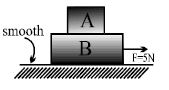
- 5$A$ block of mass $M$ is placed on $a$ horizontal surface and it is tied with an inextensible string to $a$ block of mass, as shown in figure. A block of mass $m_0$ is also placed on $M$ If there is no friction between any two surfaces, thenView Solution

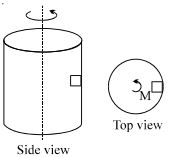
- 6A hollow vertical cylinder of radius $R$ is rotated with angular velocity $\omega$ about an axis through its center. What is the minimum coefficient of static friction necessary to keep the mass $M$ suspended on the inside of the cylinder as it rotates?View Solution
- 7The minimum force required to start pushing a body up a rough (frictional coefficient $\mu$) inclined plane is $F _{1}$ while the minimum force needed to prevent it from sliding down is $F _{2}$. If the inclined plane makes an angle $\theta$ from the horizontal such that $\tan \theta=2 \mu$, then the ratio $\frac{F_{1}}{F_{2}}$ isView Solution
- 8A rough vertical board has an acceleration $‘a’$ so that a $2$ kg block pressing against it does not fall. The coefficient of friction between the block and the board should beView Solution
- 9Block $A$ weighing $100$ kg rests on a block $B$ and is tied with a horizontal string to the wall at $C$. Block $B$ weighs $200 \,kg$. The coefficient of friction between $A$ and $B$ is $0.25$ and between $B$ and the surface is $1/3$. The horizontal force $P$ necessary to move the block $B$ should be ........ $N$ $(g = 10\,m/{s^2})$View Solution
- 10A motorcycle is going on an overbridge of radius $R$. The driver maintains a constant speed. As the motorcycle is ascending on the overbridge, the normal forces on it isView Solution