MCQ
A man slides down a light rope whose breaking strength is $\eta$ times the weight of man $(\eta<1)$. The maximum acceleration of the man so that the rope just breaks is ........
  • $g(1-\eta)$
  • B
    $g(1+\eta)$
  • C
    $g n$
  • D
    $\frac{g}{\eta}$

Answer

Correct option: A.
$g(1-\eta)$
a
(a)

Given that $T_{\max }=\eta w$

Using $F_{\text {net }}=m a$

$w-T_{\max }=\frac{w}{g} a$

$T_{\max }=\eta w$

So $a=g(1-\eta)$

Need a full question paper?

Generate a complete, print-ready paper with questions like this in minutes — across 16+ boards, with answer keys.
Start Generating Free

Similar questions

A wooden cylinder floats vertically in water with half of its length immersed. The density of wood is
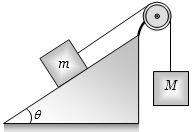
A wire of $9.8 \times {10^{ - 3}}kg{m^{ - 1}}$ passes over a frictionless light pulley fixed on the top of a frictionless inclined plane which makes an angle of $30°$ with the horizontal. Masses $m$ and $M$ are tied at the two ends of wire such that $m$ rests on the plane and $M$ hangs freely vertically downwards. The entire system is in equilibrium and a transverse wave propagates along the wire with a velocity of $100 ms^{-1}$. Chose the correct option $m =$ ..... $kg$
$A$ particle is moving along a circular path of radius $R$ in such a way that at any instant magnitude of radial acceleration & tangential acceleration are equal. If at $t = 0$ velocity of particle is $V_0$, the time period of first revolution of the particle is 
For a projectile, the ratio of maximum height reached to the square of flight time is ($g = 10 ms^{-2}$)
Determine coefficient of performance of given temperature limit.

$T_{1}=27^{\circ} C$ [outside fridge]

$T_{2}=-23^{\circ} C$ [inside fridge]

Weight of a body of mass $m$ decreases by $1\%$ when it is raised to height $h$ above  the Earth's surface. If the body is taken to a depth $h$ in a mine, then its weight will
Out of the following, the only incorrect statement about satellites is
The $x$ and $y$ coordinates of a particle at any time $t$ are given by $x = 7t + 4{t^2}$ and $y = 5t$, where $x$ and $y$ are in metre and $t$ in seconds. The acceleration of particle at $t = 5\;s$ is.........$m/{s^2}$
A screwgauage has pitch $1.5\;  mm$ and there is no zero error. Linear scale has marking at $MSD = 1\; mm$  and there are $100$ equal division of circular scale. When diameter of a sphere is measured with instrument, main scale is having $2\; mm$ mark visible on linear scale, but $3\; mm$ mark is not visible, $76^{th}$ division of circuler scale is in line with linear scale. .......... $mm$ is the diameter of sphere.
For the resultant of the two vectors to be maximum, what must be the angle between them....... $^o$